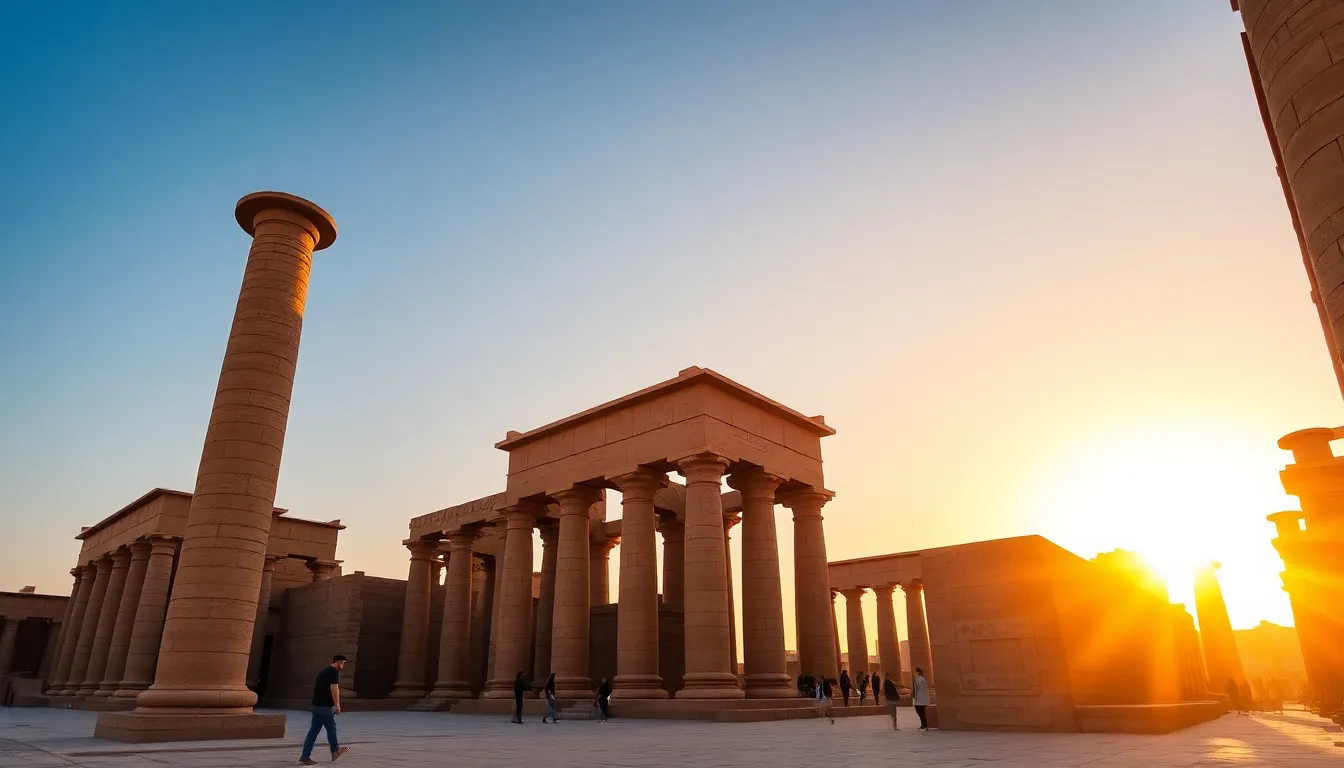
Some congregations want it all. They have heard about the Exodus trail and they want it, but they also want to stand under the columns of Karnak, sail the Nile, and see the temples of Luxor and Aswan that built Egypt’s reputation across the world. For years I told those groups they had to choose. Then I built this itinerary, and I stopped saying that.
Twelve days is the length that holds the whole of heritage Egypt without rushing. The Exodus arc, from the land of Goshen through Sinai. And the imperial sweep of the Nile Valley, Luxor and Aswan, the pharaonic civilization the biblical story unfolds against. North to south and back, the complete picture. It is the most comprehensive journey I offer inside a single country, and it is the one to choose when your community wants nothing left out.
It is the full version of our 8-day heritage itinerary, with the Nile Valley added in the middle. If your group instead wants to extend eastward into the wilderness, see our Egypt and Jordan itinerary.
Day 1: Arrival in Cairo
Groups land at Cairo International, usually in the afternoon. No site on arrival day. Settle, eat together, rest. An optional gentle walk near Khan el-Khalili if energy allows. Recommended base near Old Cairo, central to the museum and Coptic quarter.
Day 2: The Egyptian Museum and the Pyramids of Giza
We begin at the Egyptian Museum on Tahrir Square, with focused time in the New Kingdom rooms that scholars connect to the Exodus period, the mummies of Ramesses II and Seti I, the records of Egyptian labor. On a twelve-day trip, we then do what the shorter itineraries skip: the Pyramids of Giza and the Sphinx, and the Grand Egyptian Museum nearby. The Pyramids are not the Exodus story, but on the complete itinerary your group should stand before them and feel the scale of the civilization the whole biblical narrative unfolds against.
Reflection moment. In the museum garden, read the opening of Exodus. The story begins in the shadow of monuments like these.
Day 3: Jewish and Coptic Cairo
The heritage quarter gets a full, unhurried day. Ben Ezra Synagogue and the room where the Cairo Geniza was discovered, nearly a million documents of medieval Jewish life. The Hanging Church, one of the oldest in Egypt. The crypt of Saints Sergius and Bacchus, tied by tradition to the Holy Family. And a walk through Haret el-Yahud, the old Jewish quarter, now quiet. Two stories, Jewish and Christian, lived side by side here for a thousand years.
Reflection moment. Ask your group what document of their own community’s life they would want preserved for a thousand years, the way the Geniza preserved Cairo’s.
Day 4: The Land of Goshen and the Nile Delta
The Delta northeast of Cairo is the biblical land of Goshen. At Tell el-Dab’a, archaeologists have found evidence of a Semitic population in the eastern Delta during the relevant period. Archaeology is not literal proof of the text, but it shows the geography of the story is real. Standing in the flat green Delta, your group feels the ordinary human texture of the Exodus, the planting and building and hoping, before the dramatic sites begin.
Reflection moment. Let the group stand in the Delta and say it: this is where the labor happened. Here.
Day 5: Fly South to Luxor and the East Bank
A short morning flight from Cairo to Luxor moves you into a different Egypt entirely, the imperial heart of the Nile Valley. Luxor was ancient Thebes, the capital of Egypt at its height, and the East Bank holds the great temple complexes.
Karnak is the largest religious building ever constructed, a forest of stone columns built and rebuilt across centuries. Standing in the Hypostyle Hall, your group sees the actual scale of the power that the Exodus story sets itself against. The nearby Luxor Temple, especially at dusk, is one of the most beautiful sights in Egypt.
Reflection moment. Under the columns of Karnak, talk about what it meant for a small enslaved people to claim that their God was greater than all of this.
Day 6: The West Bank, Valley of the Kings, and the Royal Tombs
Across the Nile, the West Bank is the land of the dead, where the pharaohs were buried. The Valley of the Kings holds the tombs of the New Kingdom rulers, including Tutankhamun and several of the Ramesside pharaohs of the Exodus era. The painted tombs are extraordinary, color and text preserved for more than three thousand years. We also visit the mortuary temple of Hatshepsut, rising in terraces against the cliffs, and the Colossi of Memnon.
For a faith group, the West Bank is a meditation on a civilization that built its entire culture around defeating death through monuments, set beside a people whose hope was carried in a story rather than in stone.
Day 7: Sail the Nile Toward Aswan
A Nile cruise is the gentlest, most beautiful way to move south, and on the complete itinerary I build it in. The river is the spine of Egypt, and watching the green banks slide past, the palms, the farmers, the water buffalo, the children waving from the shore, gives the group a day of rest and reflection between the intensity of Luxor and Aswan. We stop at the temples of Edfu and Kom Ombo along the way, both remarkably preserved.
Reflection moment. On the deck, in the quiet, read a Psalm. After the monuments, the moving water is its own kind of teaching.
Day 8: Aswan, Philae, and the Edge of Nubia
Aswan is the southern frontier of ancient Egypt, gentler and more relaxed than Cairo or Luxor. The Temple of Philae, dedicated to Isis and rescued from the rising waters of the Aswan Dam, sits on an island reached by small boat. The High Dam itself tells the modern story of the Nile. Aswan is also the gateway to Nubia, a distinct culture with its own deep history, and a felucca sail at sunset around the islands is one of the calmest, most beautiful evenings of the whole trip.
Day 9: Fly North and Cross to the Red Sea
We fly back to Cairo and turn east toward the Sinai, leaving the imperial Nile Valley behind and rejoining the Exodus arc. The drive from Cairo toward Suez takes about two hours across desert the fleeing Israelites would have crossed. We bring the group to the water, read the Song of the Sea from Exodus 15, and let the place carry the words after a week among the monuments of the very civilization the song celebrates being delivered from.
Then we cross into the Sinai, through the Suez Canal into granite mountains and ancient silence, with the drive to Saint Catherine’s continuing the next stretch. Arrive for dinner, a briefing, and rest.
Day 10: Mount Sinai and Saint Catherine’s Monastery
The climb up Jebel Musa begins around 2:00 or 3:00 a.m. to reach the summit by sunrise. The mountain rises to 2,285 meters (7,497 feet). The Camel Path takes two to three hours, ending with the steep 750 Steps of Repentance. It is demanding and the cold is real, and I have watched people in their seventies reach the top and call it the most important morning of their lives. You stand where the Torah says Moses received the commandments, and the weight of the place is undeniable.
Reflection moment. At the summit, Exodus 19:3, no commentary. Just the text, the place, and silence.
At the base, Saint Catherine’s Monastery has stood since the sixth century, with the burning-bush bramble in its courtyard, a remarkable icon collection, and early biblical manuscripts. The afternoon is for rest and the wadis.
Day 11: The Eastern Sinai Coast at Nuweiba
The drive north to Nuweiba on the Gulf of Aqaba takes about two hours along a coastline of granite mountains dropping into clear water. After the climb, this day is the exhale. Some scholars locate the sea crossing here, so we take a second quiet moment at the water with the story. The rest of the day is rest, conversation, optional snorkeling, and an evening meal with the mountains behind you.
Day 12: Return to Cairo, Closing Circle, and Departure
Most groups fly home from Cairo, a return drive of four to five hours from the Sinai or a flight from Sharm el-Sheikh. I keep the last day light and center it on a closing gathering. In Coptic Cairo or a quiet corner, read a passage about the journey from slavery to freedom, and let each person name one thing they are carrying home. After twelve days, north to south and back, this circle is what people remember most. Then flights depart from Cairo International.
Our Egypt destination page covers how we structure these complete journeys, our group heritage tours page explains the group leader experience, and the best time to visit Egypt guide is especially worth reading for a twelve-day trip, since you will cross several of Egypt’s climate zones. For mixed-age congregations, our multigenerational itinerary shows how we adjust pacing.
FAQ: 12-Day Complete Egypt Itinerary
What does the 12-day itinerary include that the 8-day does not?
The full Nile Valley. The eight-day itinerary follows the Exodus arc, Cairo, the Delta, the Red Sea, and Sinai. The twelve-day version adds Luxor and Aswan, the Pyramids of Giza, the Valley of the Kings, Karnak, and a Nile cruise. It is the complete picture of heritage Egypt, both the biblical narrative and the imperial civilization behind it.
Is twelve days too much time in Egypt?
For a group that wants both the Exodus sites and the great Nile Valley monuments, twelve days is the right length, not too much. It allows a Nile cruise, full days at Luxor and Aswan, and unhurried time at the biblical sites. Trying to fit Luxor and Aswan into a shorter trip means rushing both the monuments and the spiritual sites.
Why fly within Egypt instead of driving?
The distances between Cairo, Luxor, and Aswan are long, and internal flights are short and inexpensive. Flying preserves your group’s energy for the sites and keeps the pace comfortable, especially for mixed-age groups. We coordinate all the internal flights as part of the trip.
Do we need a Nile cruise, or can we skip it?
You can skip it, but on the complete itinerary I recommend keeping it. The cruise is the gentlest day of the trip, a real rest between Luxor and Aswan, and it gives your group a feel for the river that is the spine of the entire country and the story. For many groups it becomes an unexpected favorite.
Can older travelers manage the full twelve days?
Yes, with planning. The Nile Valley days are comfortable, the cruise is restful, and internal flights cut the strain. The one demanding element is the Mount Sinai ascent, and we plan pacing, cooler-season timing, and alternatives at Saint Catherine’s for members who prefer not to climb. See our multigenerational itinerary for how we handle mixed-age groups.
If your congregation wants the complete picture of heritage Egypt, the Exodus arc and the great monuments together, this is the journey I would build with you. Reach out when you’re ready, and let’s talk through the full twelve days for your community.