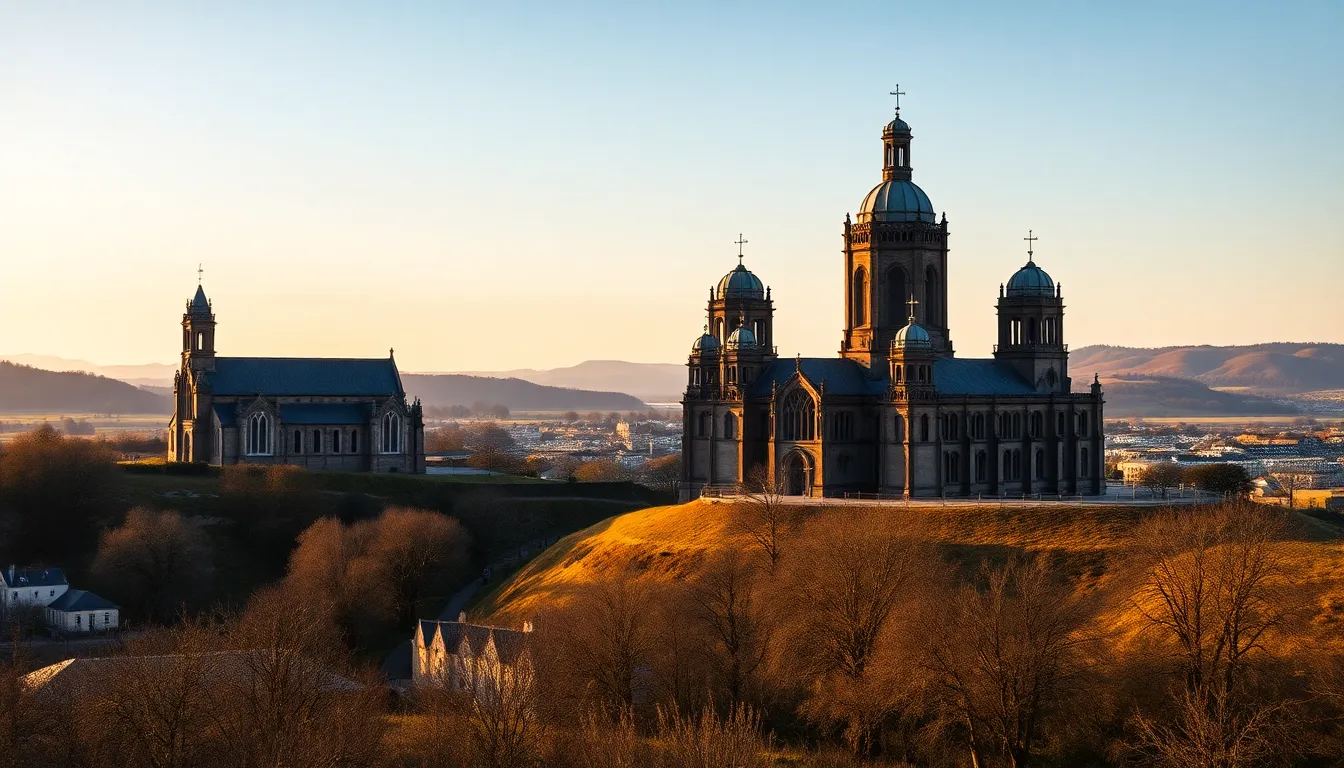
When I bring a group into Armagh for the first time, I have them stand at a spot where you can see both cathedrals at once. They sit on facing hills, two churches, both called Saint Patrick’s, one Catholic and one Church of Ireland, looking at each other across the city. People always ask the same question: why are there two? The answer is the whole story of Armagh in miniature. This small city in Northern Ireland has been the spiritual center of the entire island for over fifteen hundred years, since Patrick himself chose this hill for his principal church around the year 445. Whatever has happened in Irish Christianity since, it has revolved around this place. For a faith group, Armagh is where you stop talking about Patrick the legend and stand where Patrick the man planted his church.
Let me walk you through Armagh the way I would walk you through it on the ground.
Why Patrick Chose Armagh
To understand Armagh you have to understand why Patrick came here, and it tells you something about how he worked. Armagh, Ard Mhacha in Irish, “the height of Macha,” sits beside Navan Fort, the ancient royal and ceremonial center of the kings of Ulster. Patrick did not plant his church in some quiet backwater. He planted it next to the seat of pagan power.
That was the strategy of his whole mission. Patrick, a Romano-British Christian who had been enslaved in Ireland as a young man and later returned as a missionary bishop, deliberately worked with and around the kings and the existing power structures. By establishing his principal church beside Navan, he was claiming the spiritual high ground of Ulster for Christ, in the most public way possible.
Tradition holds that around 445 a local king granted Patrick the hill of Armagh, and there he built his great stone church. From that base, Armagh became the heart of his episcopal authority, and it has held primacy ever since.
For a group, this is the key insight. Armagh was a deliberate choice, faith planted next to power, and that boldness is part of what made Patrick’s mission stick.
Armagh as Ireland’s Ecclesiastical Capital
Here is the fact that surprises groups, and I make sure they grasp it. Armagh is, and has been for over fifteen centuries, the ecclesiastical capital of all Ireland, north and south. Both the Roman Catholic Church and the Church of Ireland have their primate, their senior archbishop, seated here. The Archbishop of Armagh is the Primate of All Ireland in both traditions.
That is why the city carries a weight far beyond its size. Armagh is to Irish Christianity what Canterbury is to the English church, the historic seat of authority, the place all roads run back to. Patrick’s choice in the fifth century set the pattern, and it never moved.
When your group understands that this modest city is the spiritual capital of the whole island, claimed for both major traditions, the two cathedrals stop being a curiosity and become the visible sign of something deep and old.
The Two Cathedrals
So, the two cathedrals. Both are dedicated to Saint Patrick, and both claim continuity with his original foundation.
The Church of Ireland Cathedral of Saint Patrick stands on Sailleán Hill, the traditional site of Patrick’s own church from 445. The present building is medieval in origin, much restored over the centuries, and it sits on the spot where the line of Patrick’s foundation runs unbroken. In its grounds, tradition holds, lies the grave of Brian Boru, the High King of Ireland who fell at the Battle of Clontarf in 1014, his body brought here for burial in recognition of Armagh’s primacy.
Facing it across the city, on a neighboring hill, rises the Roman Catholic Cathedral of Saint Patrick, a soaring twin-spired Gothic Revival church built in the nineteenth century, completed in 1904. It is the seat of the Catholic Archbishop of Armagh and a building of real grandeur, climbing its hill with a long flight of steps and an interior rich with mosaic and color.
I tell leaders to visit both, deliberately, and to talk with the group about what the two churches facing each other mean. They are not rivals so much as two branches of a tree with one root, and that root is Patrick. In a part of the world that has known division, the shared dedication to one saint is worth a thoughtful pause.
Patrick the Man, Behind the Legends
Armagh is the right place to separate the real Patrick from the shamrocks and snakes, and groups appreciate the honesty. The historical Patrick wrote two documents that survive in his own voice, the Confessio and the Letter to the Soldiers of Coroticus. They are among the earliest written texts from Ireland, and they are deeply personal.
In them, Patrick tells his own story. He was a Briton, son of a deacon, captured by Irish raiders around age sixteen and enslaved for six years tending flocks, probably in the west of Ireland. He escaped, returned home, and then, against every natural instinct, went back to the land of his captivity as a missionary bishop. He writes with humility about his own lack of learning and with fierce conviction about his calling.
That is the Patrick worth bringing to a group. Not the legend who drove out snakes, but a former slave who returned to love the people who had enslaved him. Standing in Armagh, the city he made the center of his work, that story has a place to land. I have seen it move groups more than any miracle tale could.
How Armagh Fits a Northern Ireland or UK Heritage Itinerary
Armagh sits at the heart of a compact cluster of Patrick sites in Northern Ireland, which makes it the natural anchor of a Patrick pilgrimage. From Armagh you are within easy reach of the places where his story began and ended, so the city works beautifully as a base or a centerpiece.
For pacing, give Armagh a full day. The two cathedrals, the city’s history, and nearby Navan Fort fill it well, and the hills between the churches are walkable but worth taking at an unhurried pace. Most groups combine Armagh with the wider Patrick trail. You can trace his burial place in our guide to Downpatrick and the grave of Saint Patrick, and the sites where his Irish story began in our guide to Saul and Slemish. To set Patrick alongside the other founders of British and Irish Christianity, see our overview of Christian heritage sites across the UK.
One practical note worth raising with your congregation early: with Heritage Tours, the group leader travels free when you bring fifteen or more participants. For a pastor building a Patrick pilgrimage in Northern Ireland, that is worth planning around from the start.
FAQ: Visiting Saint Patrick’s Armagh With a Faith Group
Why is Armagh called the ecclesiastical capital of Ireland?
Because Patrick established his principal church here around 445, and Armagh has been the seat of ecclesiastical authority for the whole island ever since. Both the Roman Catholic Church and the Church of Ireland seat their senior archbishop, the Primate of All Ireland, in Armagh. It is the historic spiritual capital of Ireland, north and south, much as Canterbury is for the English church.
Why are there two Saint Patrick’s cathedrals in Armagh?
One is Church of Ireland, on the traditional hill of Patrick’s original 445 church, and one is Roman Catholic, a nineteenth-century Gothic Revival building on a facing hill. Both are dedicated to Patrick and both claim continuity with his foundation. They reflect the two major traditions of Irish Christianity, sharing one root in Patrick, and visiting both is part of understanding Armagh.
Was Saint Patrick a real person?
Yes. Patrick was a fifth-century Romano-British Christian who left two genuine documents in his own voice, the Confessio and the Letter to Coroticus. They tell how he was captured by Irish raiders as a teenager, enslaved for six years, escaped, and later returned to Ireland as a missionary bishop. The historical Patrick is well attested, even though many later legends grew up around him.
What else can a group see near Armagh on a Patrick pilgrimage?
Armagh anchors a cluster of Patrick sites in Northern Ireland. Nearby Navan Fort, the ancient royal center of Ulster, explains why Patrick chose this spot. Within easy reach are Downpatrick, the traditional burial place of Patrick, and Saul and Slemish, where his Irish story began. Armagh works well as the base or centerpiece for the whole trail.
How much time should a group spend in Armagh?
A full day allows you to visit both cathedrals, take in the city’s history, and include Navan Fort nearby. The walking between the two hilltop cathedrals is manageable at an unhurried pace, and we plan the day around the group you bring so no one is left out of the meaningful moments.
If a Patrick pilgrimage with Armagh at its heart speaks to you for your congregation, I would be glad to help you shape it. The two cathedrals, the real story behind the legends, and the deep history of the place make a journey people remember. You can see how we build these trips on our United Kingdom heritage page or learn how the group experience works on our group heritage tours page.
Contact us whenever you are ready to start planning.