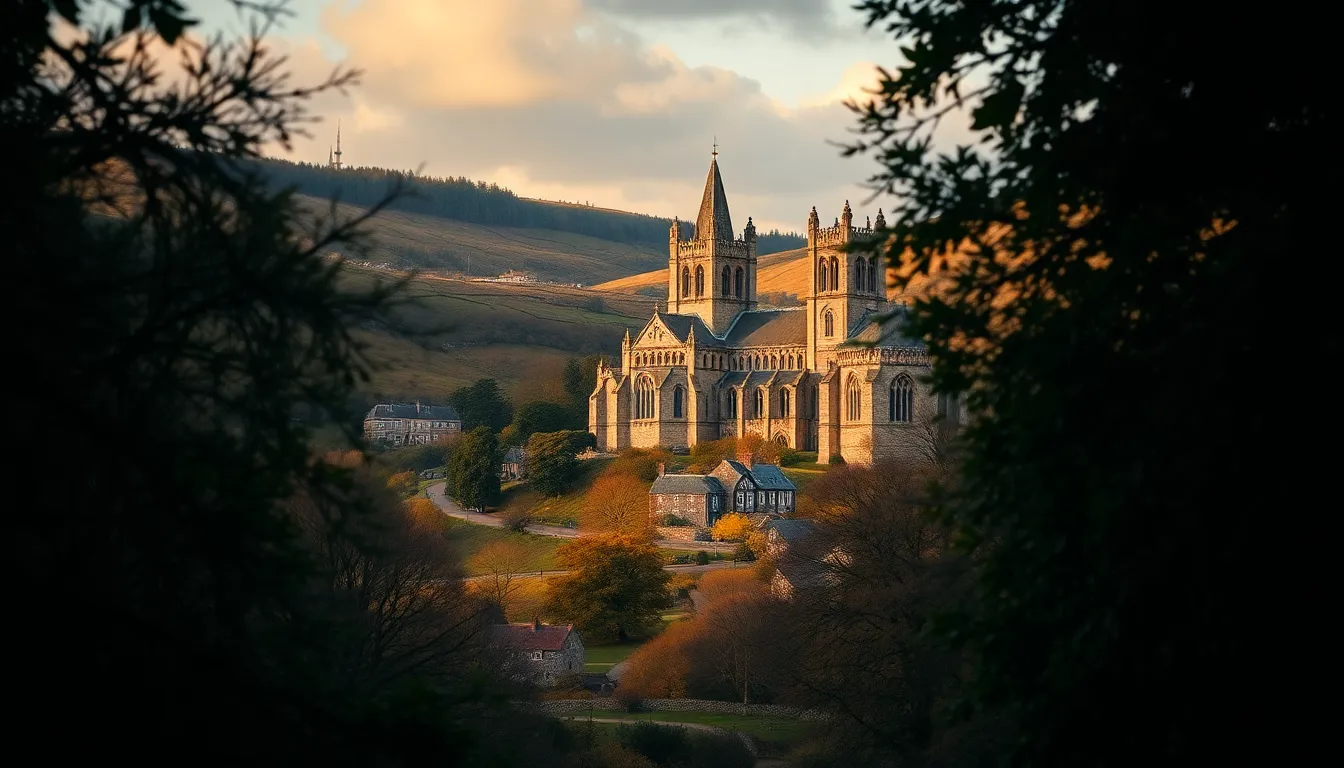
The thing nobody expects about St Davids is that you do not see the cathedral until you are almost on top of it. You walk through what is officially Britain’s smallest city, a place that feels more like a village, and then the ground drops away and there it is, a great medieval cathedral sitting down in a valley below you. I have brought groups here who had just come from the grand cathedrals of England, and they still stopped at that first view. There is a reason David built down in this hollow, partly hidden, and there is a reason this far corner of Wales became one of the most important pilgrimage sites in medieval Britain. Standing where your group stands, looking down at that nave, you are at the heart of Welsh Christianity.
Let me walk you through St Davids the way I would walk you through it on the ground.
Who Saint David Was
David, Dewi Sant in Welsh, is the patron saint of Wales, and he is a genuine sixth-century figure, not a legend stitched together later. He lived in the 500s, in the same great age of Celtic saints that produced Columba in the north and the Irish founders across the water. He founded a monastic community here in the southwest of Wales, in the region then called Menevia, and he became the leading figure of the Welsh church in his generation.
What we know of his life comes largely from a Life written centuries later by Rhygyfarch, around 1090, so the details mix history and tradition. But the core is solid. David was a monk and abbot-bishop known for a severe ascetic rule. His monks worked the land by hand, drank only water, which earned David the nickname Dewi Ddyfrwr, “David the Water Drinker,” and lived a life of deliberate hardship and prayer.
For a group, this is worth dwelling on. David’s holiness was not soft. It was disciplined, plain, and demanding, and that character is stamped on the place he founded.
The Most Famous Words: “Do the Little Things”
I always make sure groups hear the one line attributed to David, because it travels straight into the heart of a congregation. According to tradition, his last words to his monks were, in Welsh, “Gwnewch y pethau bychain,” “Do the little things.” The fuller saying is usually rendered, “Be joyful, keep the faith, and do the little things that you have seen and heard with me.”
Whether or not those were his exact dying words, that phrase has become the soul of Welsh Christian identity. For a faith leader, it is a gift. You can stand in the cathedral he founded and talk to your people about faithfulness in small, unglamorous things, and the place itself preaches the sermon with you. I have seen that single line do more for a group than a whole guidebook of dates.
St Davids Cathedral: What You See Today
The cathedral your group walks into was begun in 1181, centuries after David, built on the site of his original monastery. So as with the great Celtic sites, you explain the layering to your group. The stone is medieval. The ground is far older, sanctified by David’s community in the 500s.
The building is remarkable in person. The nave is famous for its floor, which slopes noticeably uphill toward the altar, and for the leaning piers, the result of the soft ground and an earthquake in the thirteenth century. The carved oak ceiling is one of the finest in Wales. Behind the high altar lies the shrine of Saint David, restored in recent years, where a reliquary holds bones traditionally associated with David and his companion Justinian.
Beside the cathedral stand the dramatic ruins of the Bishop’s Palace, a vast and once-luxurious complex that speaks to how rich and important this remote site became. The contrast is striking and worth pointing out to a group: David lived in austere poverty, and within centuries his shrine had drawn enough pilgrims to build a palace beside it.
Why This Remote Corner Became a Pilgrimage Powerhouse
Here is the fact that surprises most groups, and I make sure they hear it. In the medieval period, St Davids was so important a pilgrimage destination that the Pope reportedly declared two pilgrimages to St Davids equal to one to Rome, and three equal to one to Jerusalem. Whether that decree is exactly as later tradition reports, the standing it reflects is real. Kings came here. William the Conqueror came. This far-flung valley in Pembrokeshire drew pilgrims from across Britain and beyond.
That status is why the modest settlement around the cathedral holds the title of a city at all, despite being tiny. The presence of the cathedral, the seat of a bishop, is what makes it a city, and it is officially the smallest in Britain.
For your group, this transforms the visit. You are not at a quaint local church. You are at one of the great pilgrimage centers of medieval Christendom, set in one of the most beautiful and remote corners of Wales.
How St Davids Fits a Wales or UK Heritage Itinerary
St Davids sits at the far western tip of Wales, in the Pembrokeshire Coast National Park, which means the journey there is part of the reward. The coastline around the cathedral is some of the finest in Britain, and St Justinian’s chapel and the rugged headlands are a short distance away. I tell leaders to build in time to walk a stretch of the coast path, because the landscape is woven into David’s story.
For pacing, give St Davids a full day. The cathedral, the Bishop’s Palace, the shrine, and the surrounding coast deserve unhurried time. Many groups pair David with the wider family of Celtic saints whose lives ran parallel to his across the islands. You can see how these threads connect in our overview of Christian heritage sites across the UK, and trace the northern branch of the same movement in our guide to Iona, the cradle of Celtic Christianity. Groups tracing the patron saints of the British nations often pair David with Saint Patrick in Armagh.
A practical note worth raising with your congregation early: with Heritage Tours, the group leader travels free when you bring fifteen or more participants. For a pastor building a Wales pilgrimage, that is worth factoring in from the start.
FAQ: Visiting St Davids Cathedral With a Faith Group
Who was Saint David and why is he important?
David, Dewi Sant, is the patron saint of Wales, a real sixth-century monk and bishop who founded a monastic community in southwest Wales. He was known for a severe ascetic discipline and became the leading figure of the Welsh church in his generation. His feast day, March 1, is the national day of Wales, and he remains the central figure of Welsh Christian identity.
Is St Davids really a city, and is it the smallest in Britain?
Yes. St Davids holds city status because it is the seat of a bishop and home to the cathedral, and it is officially the smallest city in Britain, with a population in the hundreds. It feels like a village, which is part of its charm, and the cathedral sits in a valley just below the settlement.
What does “do the little things” mean and where does it come from?
It comes from the words traditionally attributed to David at the end of his life, “Gwnewch y pethau bychain,” “Do the little things.” The fuller saying urges joy, faithfulness, and attention to the small, daily acts of devotion. It has become the defining motto of Welsh Christianity and makes a natural theme for a group reflection in the cathedral he founded.
How remote is St Davids and is it hard to reach?
It sits at the far western tip of Wales in Pembrokeshire, so it takes some travel to reach, and that journey through the coastal landscape is part of the experience. The cathedral and its grounds are walkable, with the usual care needed on older steps and uneven ground. We plan the pace around the group you bring.
Why was such a remote place such an important pilgrimage site?
David’s shrine drew pilgrims from across Britain in the Middle Ages, and the site gained extraordinary standing, with later tradition holding that two pilgrimages to St Davids equaled one to Rome. Kings made the journey here. That medieval importance, set in a remote and beautiful corner of Wales, is exactly what makes it such a rewarding stop for a faith group today.
If a Wales pilgrimage centered on David speaks to you for your congregation, I would be glad to help you shape it. The cathedral, the coast, and the story of “the little things” make a quietly powerful journey. You can see how we build these trips on our United Kingdom heritage page or learn how the group experience works on our group heritage tours page.
Contact us whenever you are ready to start planning.