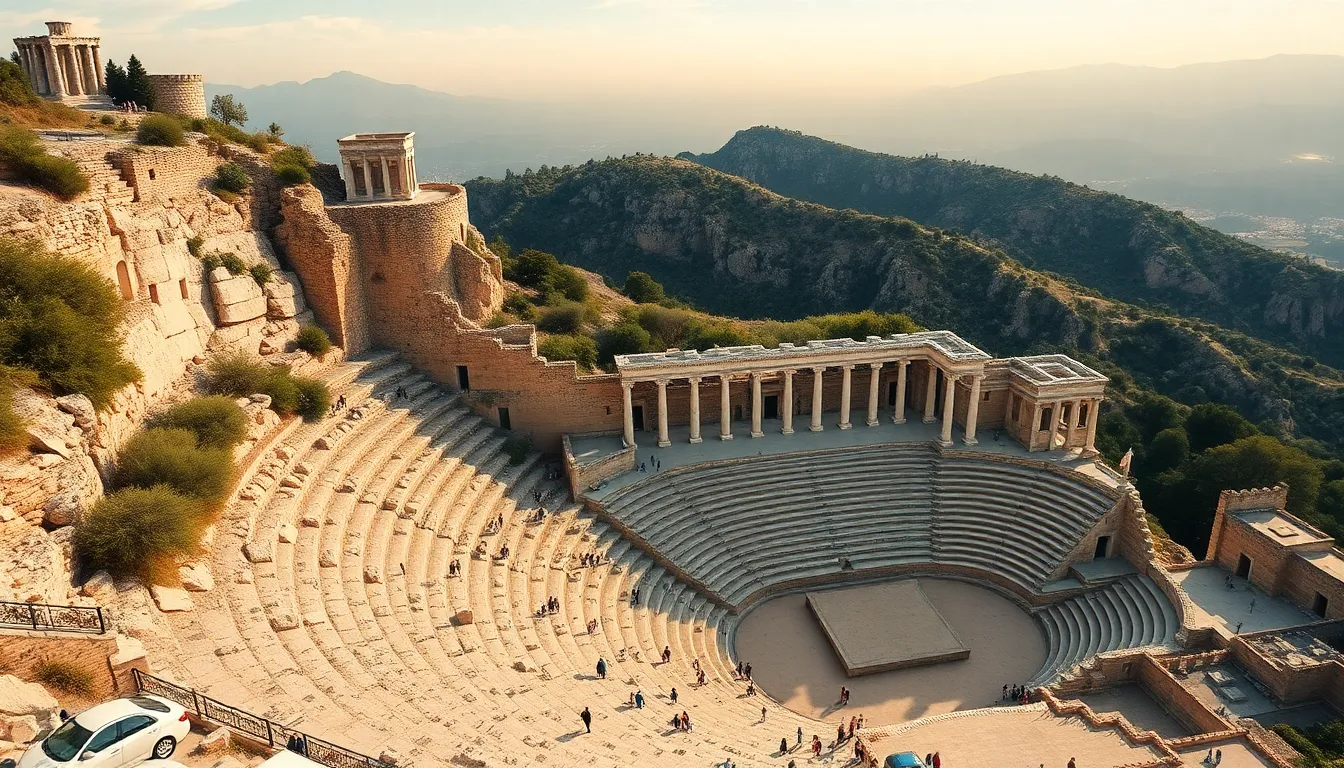
There is a moment at Pergamon that I plan for every time. We take the cable car up to the acropolis, step out onto the height, and I do not say anything yet. I let the group look. The plain spreads out below, the steepest theater in the ancient world drops away at a stomach-turning angle, and the broken temples crown the ridge. Then I read Revelation 2:13. “I know where you live, where Satan has his throne.” Standing up there, with the pagan temples all around and the city far below, nobody has to ask what John meant. The geography preaches the letter for you.
If you are leading a faith group through the seven churches, Pergamon is the one where the spiritual stakes become visible in stone. This is the church that stayed faithful in the hardest possible place, and it is one of the most dramatic sites on the whole circuit.
Why Pergamon Was Such a Hard Place to Believe
Pergamon was the third of the seven churches and the religious capital of Roman Asia. It was a center of pagan worship on a scale few cities matched. Several things converged here that made faithful Christian life genuinely dangerous.
It held the first temple of the imperial cult in Asia, dedicated to Rome and the emperor Augustus, which made Pergamon the official heart of emperor worship in the province. It was the home of a major sanctuary of Asclepius, the healing god, whose symbol was a serpent, drawing pilgrims from across the region seeking cures. And crowning the acropolis stood the great altar of Zeus, an enormous structure that many scholars connect directly to John’s phrase about Satan’s throne.
Put those together. A city built around emperor worship, serpent-god healing, and a towering altar to Zeus. For a Christian congregation, this was the front line. John does not soften it. He says Christ knows exactly where they live.
The Letter to Pergamon
Revelation 2:12 through 17 is the passage to read on the acropolis. John identifies Christ as the one “who has the sharp, double-edged sword,” fitting language for a city that held the Roman power of the sword in the province. Then the commendation. “I know where you live, where Satan has his throne. Yet you remain true to my name. You did not renounce your faith in me, not even in the days of Antipas, my faithful witness, who was put to death in your city, where Satan lives.”
Antipas is named. A real martyr, killed for his faith in this city, and John holds him up as proof that the church held fast under the worst pressure. That detail lands hard with a group standing where it happened.
Then the rebuke. Some in the church had tolerated the teaching of Balaam and the Nicolaitans, compromising with idol food and immorality, the temptation to blend in with a pagan culture rather than stand apart. The call is to repent, or Christ will come and fight against them with the sword of his mouth. The promise to the one who overcomes is intimate: hidden manna, and a white stone with a new name written on it, known only to the one who receives it.
I find Pergamon’s tension is one most congregations recognize. It is the pull to compromise just enough to be comfortable in a culture that does not share your faith. The letter names it without flinching.
What “Satan’s Throne” Refers To
People always ask what John meant, so I lay out the main views and let the group weigh them. There is no need to flatten it to one answer.
The most common reading connects “Satan’s throne” to the great altar of Zeus, which sat on a terrace high on the acropolis. Its throne-like shape and its dominance over the skyline make it the natural candidate. The altar was excavated in the nineteenth century and its remains were carried off to Berlin, where the reconstructed Pergamon Altar stands in a museum, so on the acropolis your group sees the empty terrace where it stood.
Others connect the phrase to the imperial cult temple, the official seat of emperor worship in Asia, or to the cult of Asclepius with its serpent symbol, an obvious link to the serpent of Genesis. A reasonable case can be made that John meant the whole concentrated weight of pagan power in this one city. I tend to present all three and let the height do the rest. From the acropolis, every one of them is plausible.
What Your Group Walks Today
Pergamon, beside the modern town of Bergama, splits into two main areas, and a good visit takes in both.
The Acropolis
The upper city is the highlight, reached by cable car. Here your group walks the terrace of the Zeus altar, the temple of Trajan with its re-erected white marble columns, the ruins of the imperial cult temple, and the steepest theater of the ancient world, cut into the hillside at a dizzying pitch. The remains of the great library, second only to Alexandria in the ancient world, are here too. Pergamon gave its name to parchment, the writing material developed when Egypt cut off the supply of papyrus. The views across the plain are worth the trip on their own, and they make the letter unforgettable.
The Asclepion
Down on the plain lies the Asclepion, the healing sanctuary, reached through a colonnaded sacred way. Your group can walk the underground tunnel pilgrims passed through, see the sacred spring, and stand in the small theater where patients were treated with a mix of medicine, ritual, and suggestion. The serpent symbol of Asclepius is everywhere. For a faith group, this is a vivid picture of the spiritual world the Pergamon church had to resist.
How Pergamon Fits the Seven Churches Circuit
Pergamon is day two for most groups, paired with Smyrna to the south, before the route turns inland to Thyatira and Sardis. It is the high point of the circuit in every sense, the most dramatic landscape and the sharpest picture of what John meant by spiritual opposition.
Our seven churches pilgrimage guide maps the full loop, and the Smyrna persecuted church and Thyatira and Lydia’s hometown guides cover the neighboring stops. For the wider picture of Turkey’s Christian heritage, see the spiritual sites in Turkey hub.
A practical note for any pastor planning this. With Heritage Tours, the group leader travels free when you bring fifteen or more participants. For a congregation building a Revelation pilgrimage, that is worth weighing as you plan numbers.
FAQ: Pergamon and the Church of Revelation
What does “where Satan has his throne” mean in Revelation 2?
It describes Pergamon as a center of concentrated pagan power. The phrase is most often linked to the great altar of Zeus that stood on the acropolis, though some connect it to the imperial cult temple or the serpent-god Asclepius. John was naming a city where emperor worship, idol temples, and pagan healing cults all converged, making faithful Christian life especially hard.
Who was Antipas in the letter to Pergamon?
Antipas was a Christian martyr killed in Pergamon for his faith, named by John in Revelation 2:13 as “my faithful witness.” He stands as proof that the church there held fast even under deadly pressure. Standing on the site where he was killed makes the letter’s commendation concrete for a group.
Can you still see the altar of Zeus at Pergamon?
You can see the terrace where it stood, but the altar itself was excavated in the nineteenth century and reconstructed in the Pergamon Museum in Berlin. On the acropolis, your group walks the platform and imagines the structure that once dominated the skyline. Many groups find the empty terrace, with its story, just as powerful.
What can a faith group see at Pergamon today?
The acropolis holds the Zeus altar terrace, the temple of Trajan, the imperial cult temple, the steepest theater of the ancient world, and the ruins of the great library. Down on the plain, the Asclepion healing sanctuary preserves a colonnaded sacred way, an underground tunnel, a sacred spring, and a small theater. A full visit takes in both.
Why is Pergamon one of the most dramatic stops on the circuit?
Its setting does the teaching. The acropolis rises high above the plain, surrounded by pagan temples, so John’s language about Satan’s throne becomes visible rather than abstract. For groups studying spiritual faithfulness under pressure, no other church on the circuit makes the point so vividly.
If Pergamon and its call to stay faithful speak to your congregation, I would be glad to help you build it into a full Revelation journey. The height, the temples, and the letter belong together, and they hit hardest in person. You can see how we plan these trips on our Turkey destination page and the group heritage tours page. Contact us whenever you are ready.