Why Turkey Holds Some of the World’s Most Significant Early Christian Sites
When most people think about the birthplace of Christianity, they think of Israel. And they are right. But the faith did not stay in Jerusalem. It moved, and the place it moved to first, the place where it grew from a small community into a world religion, was what we now call Turkey.
Paul’s missionary journeys brought him through Ephesus, Antioch, and dozens of cities across Anatolia. John is believed to have spent his final years near Ephesus. Mary may have lived and died on a hillside above the Aegean. The first seven ecumenical councils that shaped Christian theology were held in what is now Turkey. The Seven Churches that John addressed in the Book of Revelation are all here.
For a pastor or minister leading a faith group, Turkey is not a secondary destination. It is where the story of the early church unfolded, and the sites are still standing.
Ephesus: Where Paul Preached, John Lived, and the Church Took Shape
Ephesus deserves more than a half-day tourist stop. This was one of the largest and most important cities in the ancient world, and for early Christianity, it was where the faith met the wider Mediterranean culture for the first time.
Paul arrived in Ephesus around 52 AD and stayed for nearly three years, longer than he stayed almost anywhere else. He preached in the Great Theater, a structure that seated 25,000 people and still stands today. His Letter to the Ephesians was written to this community. The riots described in Acts 19, where silversmiths who made idols of Artemis turned against Paul’s followers, happened in these streets.
John is believed to have lived in Ephesus in his later years. Tradition holds that he wrote his Gospel here. The Basilica of St. John in nearby Selcuk was built over what is believed to be his burial site.
For a Christian group walking through Ephesus, this is not ancient history in the abstract. This is the ground where the letters they read every Sunday were first received.
What your group will see: The Great Theater, the Library of Celsus, the Terrace Houses (where wealthy Ephesians lived, with remarkably preserved mosaics and frescoes), the remains of the Temple of Artemis, and the Basilica of St. John. Heritage Tours can arrange early morning access before the general tourist crowds arrive, which changes the experience completely.
The House of the Virgin Mary: A Place of Pilgrimage for Christians and Muslims
On a wooded hillside above Ephesus, a small stone building draws pilgrims from around the world. According to a tradition supported by both Catholic and Orthodox churches, this is where Mary, the mother of Jesus, spent her final years, brought here by John after the crucifixion.
What makes this site remarkable is that it is sacred to both Christians and Muslims. The Quran honors Mary (Maryam) as one of the most righteous women who ever lived, and Muslim pilgrims visit this site with genuine reverence. Three popes have visited and prayed here.
The building itself is simple. A small chapel inside, a spring outside believed to have healing properties. There is no grand architecture. The power of the place is its quiet. Groups that visit in the morning, before the tourist buses arrive, consistently describe it as one of the most moving moments of their entire trip.
Hagia Sophia: A Cathedral That Became a Mosque That Became a Museum That Became a Mosque Again
Hagia Sophia is one of the most layered religious buildings in the world, and visiting it requires understanding that complexity rather than simplifying it.
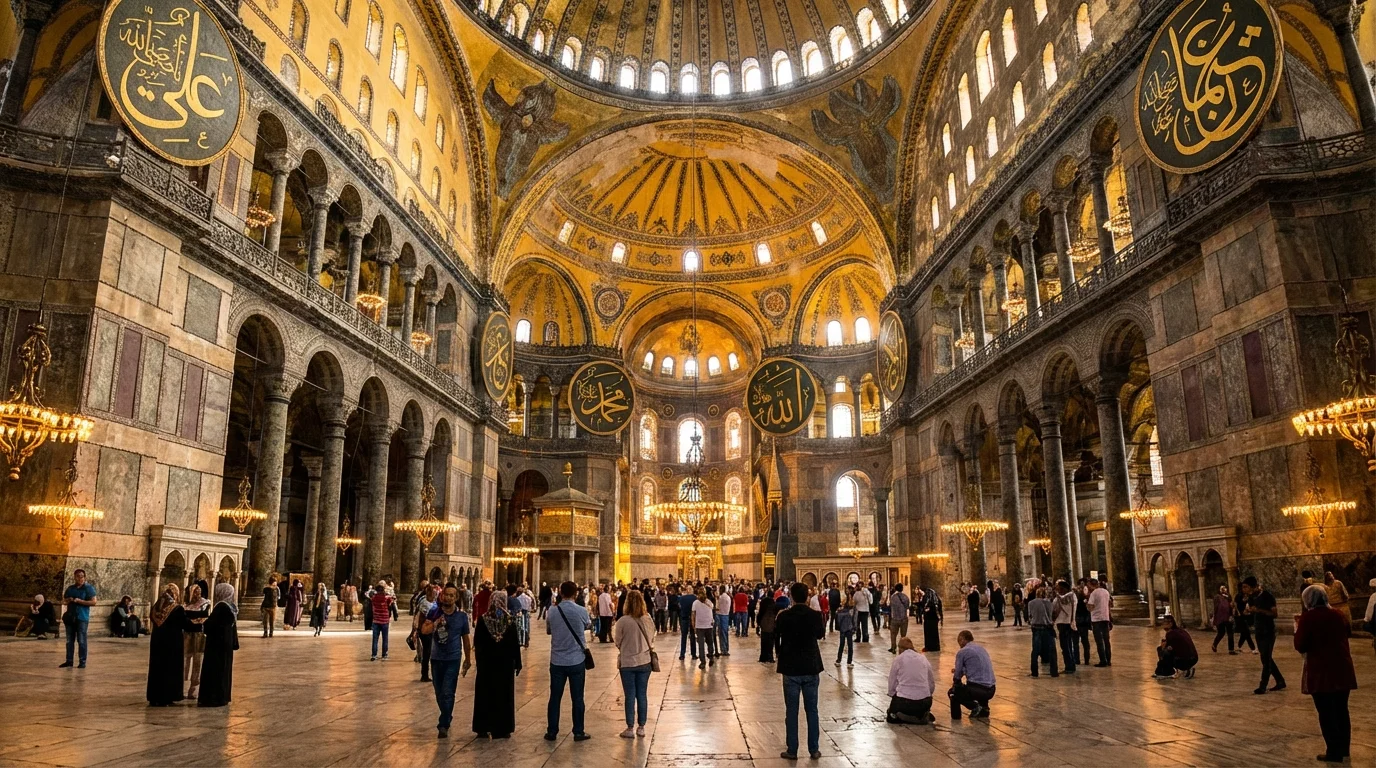
It was built as a Christian cathedral in 537 AD and served as the center of Eastern Orthodox Christianity for nearly a thousand years. When the Ottoman Empire conquered Constantinople in 1453, it was converted into a mosque. In 1934, Ataturk declared it a museum. In 2020, it was reconverted to a functioning mosque.
For a Christian group, Hagia Sophia holds deep significance. The mosaics that survived the conversions, depicting Christ, Mary, and the saints, are visible alongside Islamic calligraphy. Standing inside the building, you see the layers of faith literally overlapping on the walls.
As a functioning mosque, Hagia Sophia is open to non-Muslim visitors outside of prayer times. Modest dress is required (head coverings for women, shoulders and knees covered for everyone). Heritage Tours schedules visits at times when the building is open to visitors and the experience is contemplative rather than crowded.
Cappadocia’s Cave Churches: Early Christians in the Underground City
Cappadocia is where early Christians went when the world above ground became dangerous. Starting as early as the 4th century, communities carved churches, monasteries, and entire underground cities into the soft volcanic rock of central Anatolia. Some of these underground cities held thousands of people and extended eight stories below the surface.
The Goreme Open Air Museum contains dozens of cave churches with frescoes that date to the 10th and 11th centuries. The images of Christ, the apostles, and biblical scenes were painted by monks who lived and worshipped in these carved spaces. The Karanlik Kilise (Dark Church) is perhaps the most striking, with colors that have survived for a millennium because so little light reached them.
Derinkuyu Underground City gives your group a sense of what life was like for entire Christian communities living below ground. Kitchens, storage rooms, chapels, ventilation shafts, and narrow defensive passages. This was not a hiding place for a few people. This was a functioning city built to sustain a community of faith during persecution.
For a group leader, Cappadocia is powerful because it shows the physical cost of early Christian life. These were not comfortable or convenient places to worship. They were built by people who considered their faith worth that effort.
The Seven Churches of Revelation: A Complete Pilgrimage Circuit
In the Book of Revelation, John addresses seven churches in Asia Minor: Ephesus, Smyrna, Pergamon, Thyatira, Sardis, Philadelphia, and Laodicea. All seven are in western Turkey, and all seven can be visited on a heritage tour.
Some are better preserved than others. Ephesus and Pergamon have substantial ruins. Sardis has a remarkable gymnasium and synagogue complex. Smyrna (modern Izmir) has an ancient agora. Philadelphia (modern Alasehir) and Thyatira (modern Akhisar) have smaller remains but carry the same theological significance.
A full Seven Churches circuit typically adds three to four days to a Turkey itinerary. For a Christian group with a deep interest in Revelation and early church history, it is one of the most meaningful pilgrimage routes in the world. We build this circuit into itineraries regularly and can advise on which sites to prioritize if your group does not have time for all seven.
Neve Shalom and Istanbul’s Jewish Spiritual Landscape
Turkey’s spiritual heritage is not only Christian. Istanbul has been home to a Jewish community for over 500 years, since the Ottoman Empire welcomed Jews expelled from Spain in 1492. That community built synagogues, schools, and a cultural life that continues today.
Neve Shalom Synagogue is the largest and most active synagogue in Istanbul. It has also been the site of tragedy, targeted in attacks in 1986 and 2003. Visiting Neve Shalom is a spiritual experience that carries both beauty and grief, and your group should be prepared for both.
The Ahrida Synagogue in the Balat neighborhood dates to the 15th century and is one of the oldest synagogues in Istanbul. The Jewish Museum of Turkey, housed in a former synagogue, tells the story of five centuries of Ottoman and Turkish Jewish life.
For a Jewish group, Istanbul’s spiritual landscape is rich and complex. For a Christian group, understanding the Jewish heritage of Turkey adds a dimension to the story that is often missing from standard pilgrimage tours.
If Turkey’s spiritual sites are calling to your group, we would be glad to help you plan the journey.
FAQ: Spiritual Sites in Turkey for Faith Travel Groups
Why is Ephesus significant for Christian heritage travelers? Ephesus is where Paul spent nearly three years preaching and building one of the earliest Christian communities outside Israel. He preached in a theater that seated 25,000 people. John is believed to have lived and written his Gospel nearby. The Letter to the Ephesians was addressed to this community. For Christian heritage travelers, Ephesus is one of the most important sites in the history of their faith.
What are the Seven Churches of Revelation and can groups visit all of them? The Seven Churches are the communities John addressed in the Book of Revelation: Ephesus, Smyrna, Pergamon, Thyatira, Sardis, Philadelphia, and Laodicea. All seven are located in western Turkey and can be visited on a heritage tour. A complete circuit takes three to four days. Heritage Tours builds this into itineraries for groups that want the full pilgrimage experience.
Is the House of the Virgin Mary verified as authentic? The site has not been definitively verified by archaeological evidence, but it has been recognized by multiple popes and is considered a legitimate place of pilgrimage by both the Catholic and Orthodox churches. Pope Paul VI, Pope John Paul II, Pope Benedict XVI, and Pope Francis have all visited. The spiritual significance of the site is acknowledged by the Church regardless of the archaeological debate.
What is the significance of Hagia Sophia for Christian groups? Hagia Sophia was the largest cathedral in the world for nearly a thousand years and the center of Eastern Orthodox Christianity. The surviving Christian mosaics inside the building are among the finest examples of Byzantine art in existence. Its conversion to a mosque in 1453, its time as a museum, and its reconversion to a mosque in 2020 make it one of the most historically layered religious sites in the world.
Can Heritage Tours arrange private visits at Ephesus? Heritage Tours can arrange early morning visits to Ephesus before the general tourist crowds arrive. This is especially valuable for faith groups who want time for reflection and prayer at the site without the noise of large tour groups. We coordinate timing with local site management to give your group the most meaningful experience possible.