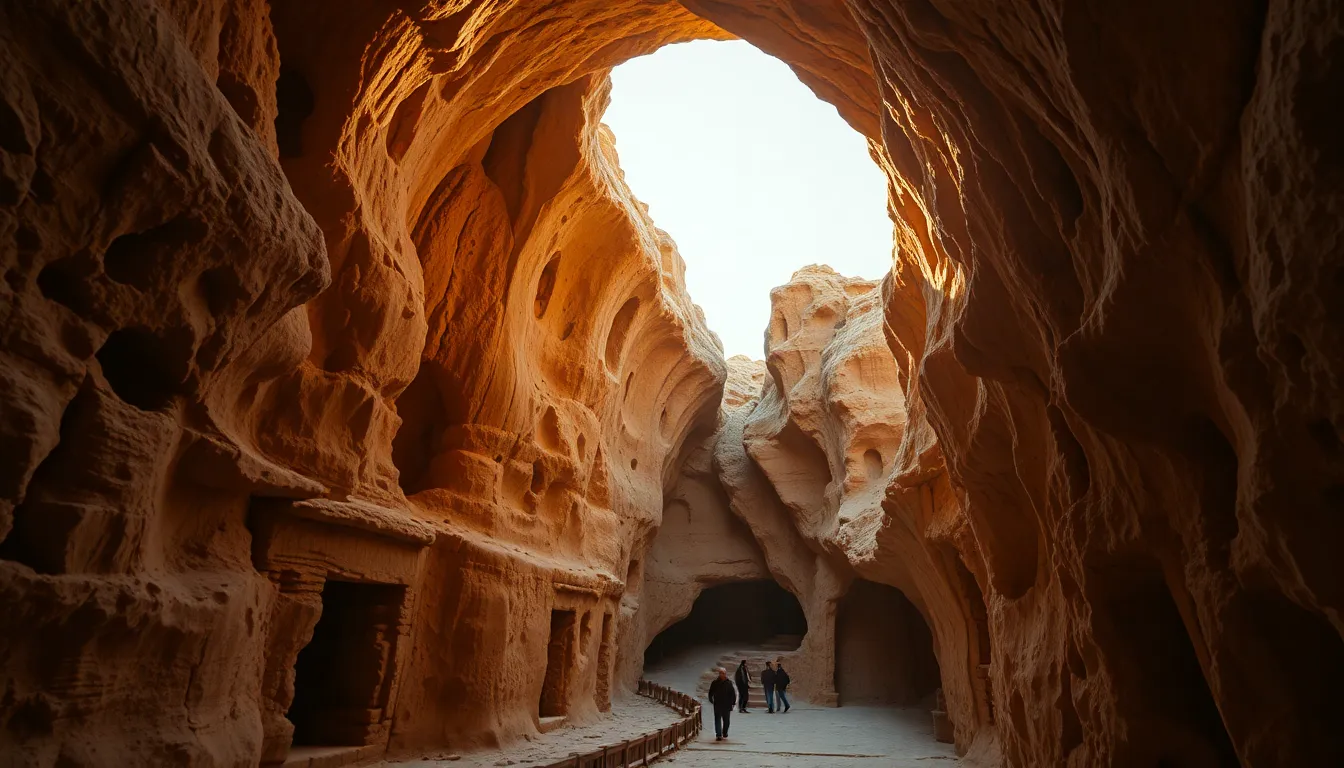
I remember the exact moment a group of mine understood what they were standing in. We had climbed down several levels into Derinkuyu, and I asked everyone to be quiet for a minute. Then I said, “Whole families lived down here. They worshipped down here. They rolled a stone door shut over their heads and waited.” A man near me put his hand flat against the cool rock wall and just held it there. You cannot read about these places and feel that. You have to go down into them. That descent is one of the most powerful things a heritage group can do in Turkey, and I want to help you give it to your people the right way.
The underground cities of Cappadocia are exactly what they sound like: entire towns carved straight down into the volcanic rock, level upon level, deep enough to shelter thousands of people. The two your group will most likely visit, Derinkuyu and Kaymakli, are the largest and best developed. They tell a story of faith under pressure that no surface ruin can match.
What the Underground Cities Are
These were not caves. They were planned cities, engineered with a sophistication that surprises people.
Derinkuyu, the deepest of them, descends roughly eight levels and around sixty meters into the ground. At its fullest it could shelter an estimated several thousand people along with their livestock and provisions. Kaymakli is broader and shallower, with wider passages, and is connected to Derinkuyu by a tunnel several kilometers long, though that tunnel is not open to walk today.
Down inside you find everything a community needs to survive: living quarters, kitchens with soot-blackened ceilings, stables for animals, storage rooms, wells, wine and oil presses, and chapels carved for worship. The engineering that keeps people alive is the impressive part. A network of ventilation shafts drew fresh air down through every level. Deep wells provided water that could not be poisoned from above. And at key points in the passages sit the famous round stone doors, great wheels of rock that could be rolled across a corridor from the inside and locked in place, sealing the city off from anyone above.
The earliest carving here likely predates Christianity, but it was the Christian communities of Cappadocia who expanded these cities and used them most. When raids and persecution threatened the region, whole congregations went underground, sometimes for weeks at a time, and kept the faith alive in the dark.
Why Early Christians Sheltered Here
This is the part worth slowing down for with a group, because it is easy to get the picture wrong.
Cappadocia sat on a frontier that was crossed by armies and raiders for centuries. In the early Christian centuries there was Roman persecution. Later came waves of Arab raids and other incursions that swept through the region. For the Christian communities living in these valleys, the underground cities were a survival strategy. When word came that a raiding force was approaching, families gathered their provisions, descended, rolled the stone doors shut, and waited out the danger.
And here is the detail that moves people most: they carved chapels down there. They did not just hide. They kept worshipping. Several levels below the surface, in air kept breathable by hand-cut ventilation shafts, these communities held services, baptized, and prayed. The faith did not pause when the threat came. It went underground and continued.
When I gather a group in one of those underground chapels and we read a psalm aloud, the meaning of words written for people in distress lands in a way it never does in a comfortable sanctuary. This is the physical cost of early Christian faith made visible. These communities considered their faith worth living in the dark for.
Derinkuyu and Kaymakli: Which to Visit
Both are remarkable, and the right choice depends on your group.
Derinkuyu is the showpiece. It is deeper, the descent feels more dramatic, and the sense of a true vertical city is strongest here. If your group is reasonably mobile and you want the full impact, Derinkuyu is the one.
Kaymakli has wider, more horizontal passages and is generally a little easier on travelers who are nervous about tight spaces or steep climbs. It still gives the full underground-city experience, just with a gentler footprint.
For most groups I plan one of the two rather than both, since the experience is similar enough that doing both can feel repetitive. We help you match the choice to the mobility and comfort of the people you are bringing.
How the Underground Cities Fit a Cappadocia Visit
The underground cities are part of the larger Cappadocian story, and they make most sense alongside the cave churches above ground. The same communities that sheltered below also carved the painted chapels in the valleys, and they lived out the communal faith shaped by the region’s great teachers.
Plan the underground city as a half-day within a two or three day Cappadocia stay. Pair it with the painted churches we cover in Cappadocia’s cave churches and the monastic settlement in our guide to the Goreme Open-Air Museum. To understand the people whose faith filled both the chapels and the refuges, our guide to the Cappadocian Fathers and early monasticism gives the background.
Within a wider Turkey trip, Cappadocia joins Ephesus, the House of the Virgin Mary, and the Seven Churches. See how it all connects in our overview of spiritual sites in Turkey and the planning details on our Turkey heritage page.
A practical point for leaders: with Heritage Tours, the group leader travels free when you bring fifteen or more participants. For a congregation trip, that is worth building into your planning early.
Practical Notes for Group Leaders
Be honest with your group about the conditions. The passages between levels are often low and narrow, and you sometimes have to stoop or descend steep, worn steps. Anyone with serious claustrophobia or limited mobility should know this in advance. I always brief leaders so they can talk to their people honestly before the day, and so no one feels trapped by surprise.
The temperature underground stays cool and steady year round, a welcome relief in summer heat but worth a light layer in cooler months.
Stay with the guide. The cities are genuine mazes, and the marked route exists for good reason. We keep groups together and paced so that the people who want a moment of prayer in a chapel get it, and the people who would rather keep moving are not left behind.
If you would like a knowledgeable guide and a thoughtful pace, that is exactly what we plan for. The descent is unforgettable when it is done with care.
If the underground cities of Cappadocia are calling to your group, we would be glad to help you plan the journey.
FAQ: The Underground Cities of Cappadocia for Heritage Groups
What are the underground cities of Cappadocia?
They are entire towns carved down into the volcanic rock, level upon level, deep enough to shelter thousands of people with their livestock and provisions. Derinkuyu and Kaymakli are the two largest and best developed. They include living quarters, kitchens, stables, wells, ventilation shafts, and chapels, and were used by early Christian communities as refuges during raids and persecution.
Why did early Christians use the underground cities?
Cappadocia sat on a contested frontier crossed by armies and raiders for centuries, and Christians there faced both Roman persecution and later waves of raids. When danger approached, whole communities descended underground, rolled great stone doors shut, and waited out the threat. They even carved chapels below the surface so worship could continue in the dark.
Which underground city should a group visit, Derinkuyu or Kaymakli?
Derinkuyu is deeper and more dramatic, the best choice for a reasonably mobile group that wants the full impact. Kaymakli has wider, more horizontal passages and is gentler on travelers nervous about tight spaces or steep climbs. We usually plan one rather than both and help you match the choice to your group.
Are the underground cities suitable for people with claustrophobia or limited mobility?
The passages are often low and narrow with steep steps, so they can be challenging for anyone with serious claustrophobia or limited mobility. We brief leaders in advance so they can prepare their group honestly, and Kaymakli’s wider passages are the easier option. No one should be caught off guard by the conditions.
How long does a visit to an underground city take?
Plan a half-day, including travel and a guided walk through the levels. The underground city fits within a two or three day Cappadocia stay alongside the cave churches and the Goreme Open-Air Museum. We pace the visit so there is time for a quiet moment of prayer in one of the underground chapels.