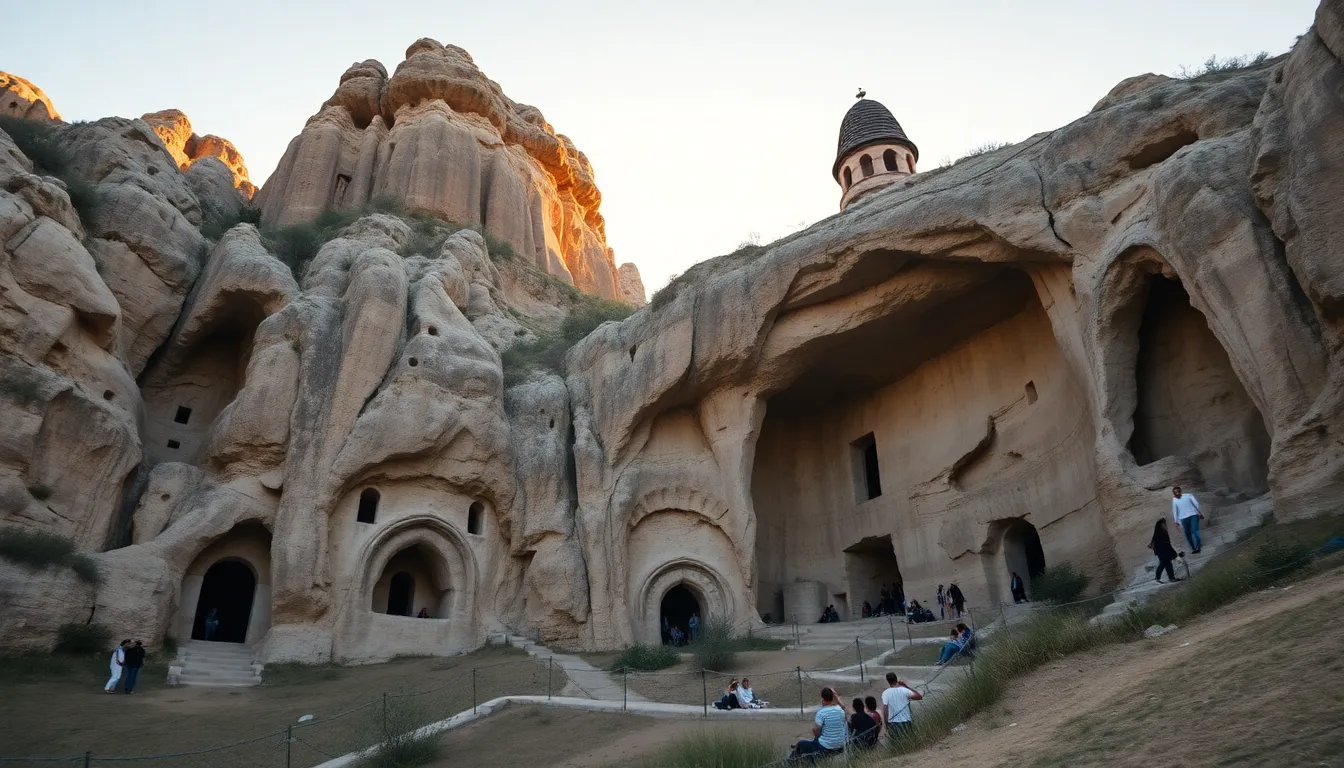
The first time I brought a group into a Cappadocian cave church, a woman from the back of the group stopped at the doorway and would not go in. She just stood there. When I asked if she was alright she said, “Somebody carved this with their hands. They knelt right here.” That is the thing about these churches. You do not look at them so much as you step into the place where someone decided their faith was worth cutting into solid rock. I want to help you give your congregation that doorway moment.
Cappadocia sits in the middle of Turkey, a landscape of soft volcanic stone shaped by wind and water into cones, ridges, and the spires people call fairy chimneys. For early Christians, that soft stone was an invitation. You could carve into it with simple tools, and what you carved would last. So they carved homes, storerooms, monasteries, and hundreds of churches. Many are still standing, and many still hold their frescoes.
Let me walk you through what your group will actually see, and how to think about it before you go.
Why Christians Carved Churches Into the Rock
People assume the cave churches were all about hiding from persecution. That is part of the story, but not the whole of it, and it helps to get this right before your group arrives.
The earliest Christian presence in Cappadocia goes back to the time when the faith was still illegal across the Roman world, and the rock did offer shelter and secrecy. But the great age of church building here came later, mostly between the 6th and 11th centuries, well after Christianity had become the official religion of the empire. By then the monks were not hiding. They were choosing the desert.
This region became one of the great centers of early monasticism. Men and women came here to withdraw from the world, to pray, and to live simply. The rock gave them everything they needed: cells to sleep in, refectories to eat in, and chapels to worship in, all carved from the same hillside. When you understand that, the churches read differently. They are not panic rooms. They are the deliberate work of a community that wanted to live close to God and far from distraction.
The Goreme Valleys and Their Frescoes
Most of the famous painted churches cluster in and around the valleys near the town of Goreme. The single best concentration sits inside the Goreme Open-Air Museum, a former monastic settlement where a short walk takes you past chapel after chapel. We give the museum its own full treatment in our guide to the Goreme Open-Air Museum, and for most groups it is the heart of the Cappadocia visit.
What makes the frescoes here special is their range. Some of the oldest paintings are simple red ochre designs, crosses and geometric patterns drawn straight onto the rock. These date from the iconoclast period, when the empire had banned religious images and artists kept to symbols. Then, after icons were restored, the walls fill with figures: Christ enthroned, the apostles, the Annunciation, the Nativity, the Crucifixion, the women at the tomb. The full Gospel, painted across stone ceilings, so that a monk lying on the floor in prayer looked up at the whole story of salvation.
Standing under one of those ceilings with a group, I usually just read the scene aloud. You do not need to add much. The painting and the room do the work.
Churches Your Group Should Not Miss
A few of these churches reward a slower visit. Here are the ones I plan around.
The Dark Church (Karanlik Kilise)
The Karanlik Kilise, or Dark Church, is the most vivid of them all, and the reason is almost an accident. It has only one tiny window, so for centuries almost no light reached the frescoes. That darkness preserved the colors. The blues and deep reds look like they were painted a generation ago, not a thousand years ago. There is a small extra ticket to enter, and it is worth every coin. I always tell leaders to budget for it.
Tokali Church (the Buckle Church)
Tokali is the largest church in the Goreme valley and one of the finest. Its walls carry a band of scenes telling the life of Christ in sequence, like a wraparound mural. For a group, it is one of the easiest places to walk the Gospel narrative panel by panel.
The Apple Church (Elmali Kilise)
Smaller and more intimate, the Elmali Kilise has a beautifully balanced set of frescoes under a compact domed ceiling. It tends to be quieter than the headline churches, which makes it a good place to pause.
There are dozens more scattered through the surrounding valleys, some still active pilgrimage sites, some known only to local guides. Part of what we do is match the right churches to the pace and interest of your group.
How the Cave Churches Fit a Faith Itinerary
Cappadocia is not a half-day stop. To do it honestly your group wants two full days, three if you also want the underground cities and a sunrise over the valleys. The region pairs naturally with the deeper Cappadocian story, and I usually frame the visit around three threads.
First, the churches and frescoes themselves, the visual Gospel in stone. Second, the people who built this tradition, which leads straight to the great teachers of the region. The faith that filled these valleys was shaped by Basil and the two Gregories, and we tell that story in our guide to the Cappadocian Fathers and early monasticism. Third, the underground refuges where whole communities once sheltered, covered in our guide to the underground cities of Cappadocia.
Cappadocia also sits well within a wider Turkey heritage trip alongside Ephesus, the House of the Virgin Mary, and the Seven Churches. You can see how it connects to the rest of the country in our overview of spiritual sites in Turkey, and the practical side on our Turkey heritage page.
One thing worth planning early: with Heritage Tours, the group leader travels free when you bring fifteen or more participants. For a pastor building a congregation trip, that changes the budget math, and it is worth knowing from the start.
A Few Practical Notes for Leaders
The churches are carved into hillsides, so expect uneven ground, low doorways, and the occasional set of stone steps. Most are manageable for an average group, but a few involve a short climb, and the rock can be slick. For older travelers, good shoes and an unrushed pace make all the difference.
Photography rules vary church to church. Inside the Dark Church and a few of the better frescoes, photography is restricted to protect the paint. I tell groups in advance so no one is caught off guard, and honestly, putting the phone away helps people actually see the room.
Mornings are the time to go. The light is gentler, the air is cooler for walking, and the largest crowds have not yet arrived. We schedule the painted churches early whenever the site allows it.
If Cappadocia is on your heart for your group, we would be glad to help you plan it.
FAQ: Cappadocia’s Cave Churches for Heritage Groups
How old are the cave churches and frescoes in Cappadocia?
The carving of Christian spaces in Cappadocia began in the early centuries of the faith, but most of the painted churches you visit date from roughly the 6th to the 11th centuries. The richest figurative frescoes, like those in the Dark Church, come from the 10th and 11th centuries, after the empire restored the use of religious images. So your group is looking at art that has survived close to a thousand years.
Why are the frescoes in the Dark Church so well preserved?
The Karanlik Kilise has almost no windows, so very little light reached its walls over the centuries. Light fades pigment, and the absence of it protected the colors. That is why the Dark Church holds the brightest, best-preserved frescoes in the region. There is a small separate entrance fee, and it is worth including for any group.
How much time should a faith group spend in Cappadocia?
Plan two full days at minimum to see the painted churches without rushing. Three days lets you add the underground cities and a sunrise over the valleys. Cappadocia rewards an unhurried pace, and the frescoes deserve time rather than a quick walk-through.
Are the cave churches accessible for older travelers?
Most are manageable, but the churches are carved into hillsides, so expect uneven ground, low doorways, and some stone steps. A few involve a short climb. With good shoes and a relaxed pace, the majority of an average group does fine, and we plan the walking around the people you bring.
Can Heritage Tours combine Cappadocia with Ephesus and the Seven Churches?
Yes. Cappadocia fits naturally into a wider Turkey heritage itinerary that includes Ephesus, the House of the Virgin Mary, and the Seven Churches of Revelation. We build these combined routes regularly and can advise on pacing so your group gets the full early-church story without exhausting itself.