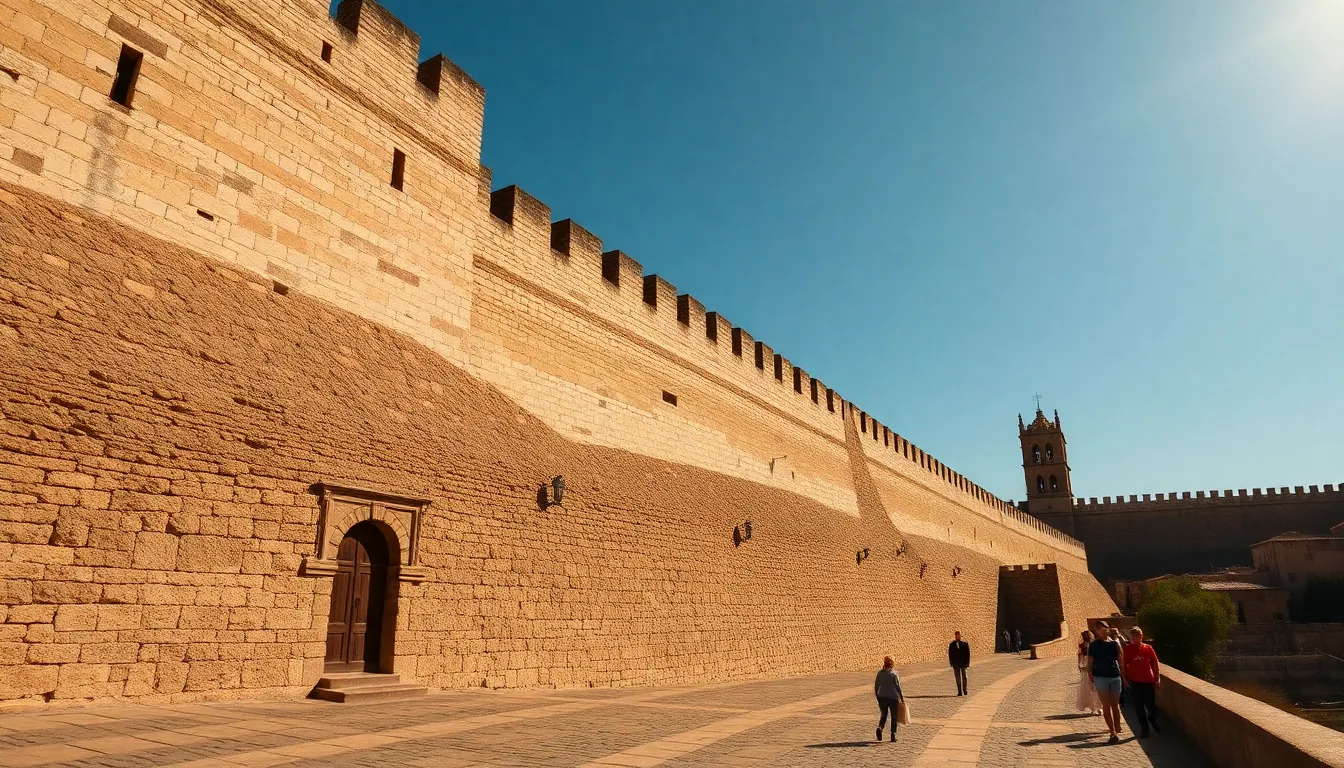
The First Time I Saw the Walls
I have brought a lot of groups to Spain, and I still remember the reaction the first time my coach crested the rise west of Avila and the whole circuit of walls came into view at once. People stopped talking. The town sits on a high plateau, more than a thousand meters up, and the granite ramparts wrap the old city in an unbroken ring of stone and towers. It does not look restored. It looks like it was never allowed to fall.
What makes Avila work for a heritage group is that the walls are only half the story. Inside them, this is the town where Teresa of Avila was born, raised, and converted into one of the most influential spiritual figures in Christian history. You get the medieval engineering and the spiritual biography in the same compact, walkable place. For a group leader, that combination is rare and worth planning around.
The Walls Themselves: What Your Group Is Looking At
The walls of Avila are the most complete medieval city walls in Spain, and among the best preserved in all of Europe. The circuit runs roughly two and a half kilometers, with 88 towers, nine gates, and more than two thousand turrets along the top. Construction in the form we see today began in the late 11th century, after Christian forces took the area, though parts of the foundation reuse Roman and earlier stonework.
The granite is the thing people remember. It glows warm in late afternoon light, and it gives the whole town a weight that lighter brick walls elsewhere do not have. Avila was a frontier town for generations, sitting on the contested line between Christian and Muslim territory, and the walls were not decorative. They were the reason the town survived.
For a group, the practical highlight is that long sections of the rampart walk are open. You can climb up and walk the top of the wall, looking down into the old streets on one side and out across the plateau on the other. It is one of the few places in Spain where you can physically walk a medieval defensive circuit rather than just photograph it from below.
Saint Teresa: Why This Town Produced a Reformer
Teresa de Cepeda y Ahumada was born in Avila in 1515 into a family of converso background, descended from Jews who had converted to Christianity. That detail matters more than most tours admit. Teresa grew up in a Spain still defining who belonged and who did not, and her family’s history shaped the world she moved through.
She entered the Carmelite order as a young woman and spent decades in a religious life she eventually found too comfortable and too compromised. What she did next is why she is remembered. She launched a reform of the Carmelites, founding a stricter, simpler branch, and she did it as a woman in 16th-century Spain, traveling the country to establish new convents against real opposition. Her writings on prayer and the interior spiritual life, especially “The Interior Castle,” are still read across Christian traditions today.
For a Christian group, standing in the town where this happened changes how her writing lands. For an educator or a mixed group, her converso roots open an honest conversation about identity, faith under pressure, and how the descendants of the expelled left their own mark on the Spain that expelled them.
The Teresian Sites Inside the Walls
Within and just outside the walls, several sites trace Teresa’s life directly. I usually structure a group visit around three or four of them.
The Convent of Saint Teresa was built on the site of her birthplace, the family home. The church is Baroque, finished in 1636, and a small chapel marks the room where she is believed to have been born. There is a museum here with relics and manuscripts that helps a group connect the woman to the place.
The Monastery of the Incarnation, just outside the northern walls, is where Teresa lived for nearly thirty years before her reform. This is the quieter, more affecting site. You can see the spaces where she actually lived and prayed, and the contrast between this long ordinary period and the reform that followed it is the part groups tend to discuss most.
The Convent of San Jose, founded in 1562, was the first house of her reformed Carmelites, the place where the whole movement began. For a group tracing the arc of her life, visiting it in order, birth, long formation, then the founding of the reform, gives the day a narrative spine rather than a list of churches.
How Groups Actually Visit Avila
Most groups reach Avila as a day from Madrid, which is a little over an hour by coach, or pair it with Segovia and Salamanca on a Castile loop. A full day lets you walk a section of the walls in the morning, when the light is good and the crowds are thin, and spend the afternoon on the Teresian sites.
The old city is compact and walkable, but it is built on a slope and the wall walk involves stairs, so I always ask group leaders to flag anyone with mobility concerns ahead of time. We can route those travelers along the lower streets, which reach the main sites without the climb, while the rest of the group takes the ramparts.
A note on pacing. The temptation is to treat Avila as a quick photo stop on the way somewhere else. It deserves better. Give it the day. The walls and the Teresian sites reward a group that has time to slow down, and the town empties out in the late afternoon once the bus tours leave, which is the best time to be there.
We coordinate timed entry where it is needed, arrange a guide who knows both the military history and Teresa’s biography, and build in a quiet stretch at the Incarnation for groups that want one. For groups of 15 or more, the leader travels free, which makes Avila straightforward to add to a longer Spain itinerary.
FAQ: Visiting the Walls of Avila and the Teresian Sites
Can you walk on top of the walls of Avila?
Yes. Long sections of the rampart walk are open to visitors, with access points at several towers and gates. You climb up and walk the top of the medieval circuit, looking down into the old town and out over the plateau. It involves stairs and some uneven footing, so we route travelers with mobility concerns along the lower streets instead, which still reach all the main sites.
Who was Saint Teresa of Avila and why does the town matter?
Teresa of Avila, born in the town in 1515, was a Carmelite nun who reformed her order and became one of the most influential spiritual writers in Christian history. She was later named a Doctor of the Church. Avila is where she was born, lived for decades, and founded her first reformed convent, so the town holds the whole arc of her life in one walkable place.
How much time should a group spend in Avila?
A full day. That gives you the walls in the morning light and the Teresian sites in the afternoon, with time to slow down once the day-tour crowds leave. Groups that try to fit Avila into a two-hour photo stop almost always wish they had stayed longer.
Is Avila a good day trip from Madrid for a group?
Yes. It is a little over an hour by coach from Madrid, which makes it one of the easier Castile destinations to reach. Many groups pair it with Segovia, and some extend the loop to Salamanca for a two- or three-day swing through historic Castile.
Does Teresa’s converso background come up at the sites?
It does in a thoughtful visit. Teresa descended from Jews who converted to Christianity, and that history shaped the Spain she lived in. A good guide raises it honestly, which makes Avila valuable not only for Christian groups but for educators and mixed groups exploring identity and faith under pressure.
If Avila fits the Spain journey you are planning for your community, we would be glad to help you build it into a wider Castile route. See our Spain heritage tour options, explore how we run group travel, or read more on Spain’s spiritual sites and the hidden heritage sites most groups miss. When you are ready, reach out and start a conversation.