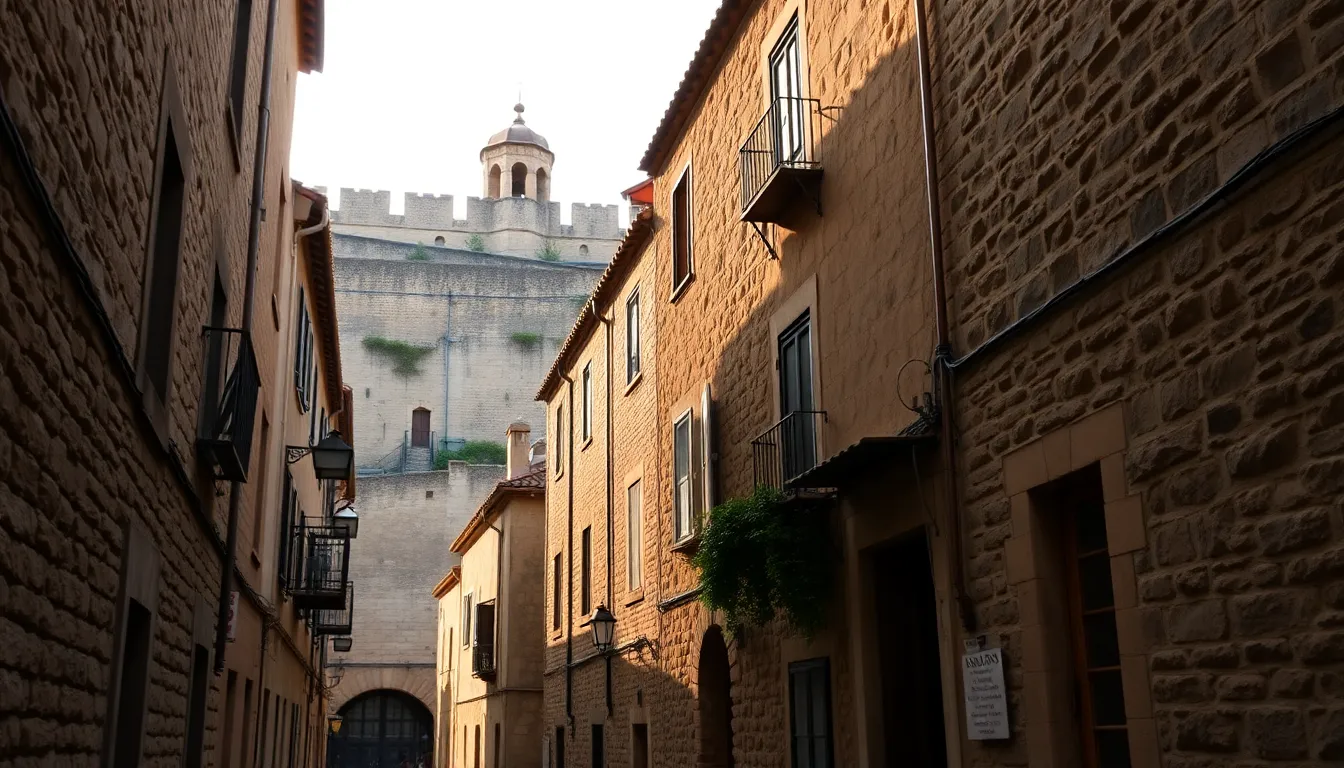
Most groups come to Segovia for the Roman aqueduct and the fairy-tale Alcazar, and then they leave. I understand why. The aqueduct is one of the most complete Roman structures in Europe, and you can stand under it without paying a euro or queuing for a ticket. But if you walk your group out of the main square and downhill toward the old walls, you enter a part of Segovia that the bus-tour crowds never see. This is the juderia, the medieval Jewish quarter, and the story it holds is one I think every heritage group should hear.
I have brought congregations here on the way between Madrid and the larger sites, and Segovia almost always surprises them. It is smaller and quieter than Toledo. There are no crowds pressing through the synagogue. And because so little has been turned into a polished museum experience, the place asks you to use your imagination, which for a group of thoughtful travelers is often the most powerful kind of visit.
A Community That Lasted Until the End
Jews lived in Segovia for centuries, and by the medieval period the community was substantial. It produced scholars, physicians, tax officials, and craftsmen. Segovia sat on important trade and wool routes, and Jewish merchants and financiers were part of the economic life of the city in ways that are easy to overlook now.
The community here did not fade away slowly. It was present, active, and rooted right up until 1492, when the Alhambra Decree forced every Jew in Spain to convert or leave within months. Families who had been in Segovia for generations packed what they could carry and walked out through these same gates. When you stand in the juderia, that is the weight you are standing in. Not a distant ruin, but a neighborhood that was alive and then, in a single brutal season, emptied.
The Synagogue That Became Corpus Christi
The most important building in Jewish Segovia is no longer a synagogue, and that fact is the whole story.
What is now the Church of Corpus Christi was originally the Sinagoga Mayor, the main synagogue of Segovia. It was built in the medieval period, and architecturally it belongs to the same family as Santa Maria la Blanca in Toledo. The white horseshoe arches, the octagonal pillars, the rhythm of the bays, all of it tells you that this was a Jewish house of prayer shaped by the artistic language of Al-Andalus.
In the early 15th century, nearly a hundred years before the expulsion, the synagogue was seized and converted into a church. A fire in 1899 damaged the building badly, and much of what you see inside today is a careful reconstruction of the original form. The convent of Poor Clare nuns now cares for it.
When I bring a group inside, I ask them to do one thing: look up at the arches and read the building backward. Picture the bimah, the ark, the men below and the women in their gallery. The bones of the synagogue are still here under the church it became. This is the same layered story you find across Spain, a synagogue that became a church, but in Segovia it is unusually intact, and standing in it is quietly moving.
Visiting Corpus Christi With a Group
The church is small and is part of a working convent, so plan for a respectful, contained visit rather than a long museum walk-through. Hours can be limited, and the space does not hold a large crowd comfortably. For a group of fifteen or more, it is worth coordinating the timing in advance so your people can enter in calm rather than in a rush. This is exactly the kind of detail we handle when we build an itinerary, so the group arrives when the door is open and the room is theirs.
Walking the Juderia
Step back outside and the quarter itself becomes the experience. The juderia of Segovia spread along the southern edge of the old city, near the present-day Calle de la Juderia Vieja and the surrounding lanes. The houses are stone, the streets are narrow, and the slope drops away toward the valley and the old wall.
A few things to point out to your group as you walk:
- The Puerta de San Andres, one of the old gates, marked the edge of the quarter and the route out toward the Jewish cemetery beyond the walls. Walking through it, you are walking the path the community took to bury its dead, and eventually the path many took into exile.
- The Centro Didactico de la Juderia, housed in what is believed to have been the home of Abraham Seneor, a prominent Segovia Jew who served as a royal tax official, gives helpful context. Seneor’s own story is complicated. Under enormous pressure, he converted rather than leave, a decision that still prompts real conversation in any group that hears it.
- The texture of the streets themselves. Unlike heavily restored quarters, much of Segovia’s juderia simply continued being lived in. That ordinariness is part of its honesty.
If your group has already walked the Call in Girona or the quarter in Toledo, Segovia reads differently. It is less curated and more residential, and many travelers find that the quiet helps the history land.
The Cemetery on the Hill
Across the Clamores valley, on the slope of El Pinarillo, lies the old Jewish cemetery of Segovia. For centuries it held the graves of the community, and archaeological work there has uncovered burials and carved tombstones that are now studied and, in part, displayed.
I treat the cemetery as a place for dignity, not for spectacle. The dead buried here were members of a community that was then driven out, and their resting place sat outside the walls of the city they had helped build. When a group looks back across the valley from the cemetery slope toward the silhouette of Segovia, the Alcazar and the cathedral on the ridge, the geography itself tells the story. The community lived inside the walls, prayed inside the walls, and was buried just beyond them. And then it was gone.
If a member of your group wishes to say Kaddish or simply to stand in silence, this is the place where I make room for that. It is the emotional center of a Segovia visit, and it should not be rushed.
Why Segovia Belongs on the Itinerary
Segovia is rarely the headline of a Spain heritage trip, and that is precisely its value. It is an easy distance from Madrid, it pairs naturally with the larger sites covered in our Spain Jewish heritage guide, and it gives a group something the famous sites cannot: room to breathe. You are not shuffling through a packed museum. You are walking a real neighborhood with a real and painful history, mostly on your own terms.
I usually frame Segovia as a counterpoint. In Toledo, the scale of Jewish Spain hits you. In Segovia, the intimacy of it does. Both are true, and a group that experiences both comes away with a fuller picture of what was lost in 1492.
If you are planning a route, Segovia also sits comfortably alongside the practical and cultural threads of a trip, from keeping kosher and Shabbat across Spain to understanding the conversos and crypto-Jews whose hidden story runs straight through cities like this one, where men like Abraham Seneor chose conversion over exile.
FAQ: Visiting Jewish Segovia
Is the Corpus Christi church really a former synagogue?
Yes. The Church of Corpus Christi was originally Segovia’s main synagogue, the Sinagoga Mayor, before it was seized and converted to a church in the early 15th century. Its horseshoe arches and octagonal columns reveal its origins clearly, and it is closely related in style to Santa Maria la Blanca in Toledo. It is cared for today by a convent of Poor Clare nuns.
Can you still see the old Jewish quarter in Segovia?
You can. The juderia survives as a walkable neighborhood along the southern edge of the old city, near Calle de la Juderia Vieja. It includes the Puerta de San Andres gate, the interpretation center in the former home of Abraham Seneor, and streets that have kept much of their medieval character. It is less restored than Toledo’s quarter, which many groups find gives it a quiet authenticity.
Where is the old Jewish cemetery in Segovia?
The medieval Jewish cemetery sits across the Clamores valley on the slope of El Pinarillo, outside the old city walls. Archaeological excavation there has recovered burials and carved tombstones. It is a place to approach with dignity, and it offers a clear view back toward the city the community lived in and was expelled from.
How does Segovia compare to Toledo for a heritage group?
Toledo offers grand, museum-quality synagogues and a sense of the scale of Jewish Spain. Segovia offers intimacy and quiet. There are fewer crowds, the former synagogue is small and contained, and the quarter feels residential rather than curated. Many groups visit both, using Toledo for scale and Segovia for reflection.
Is Segovia easy to add to a Madrid-based itinerary?
Very. Segovia is a short distance from Madrid and pairs naturally with a wider Spain heritage route. Because the Jewish sites are compact, a focused half-day works well, especially when the visit to Corpus Christi is timed in advance around the convent’s hours.
If Segovia sounds like the kind of quiet, honest stop you want your community to experience, I would be glad to talk it through. We build every group heritage tour around the specific interests of the people traveling, and with fifteen or more participants the group leader travels free. Take a look at our Spain destination page for the wider picture, and contact us when you are ready to start planning.