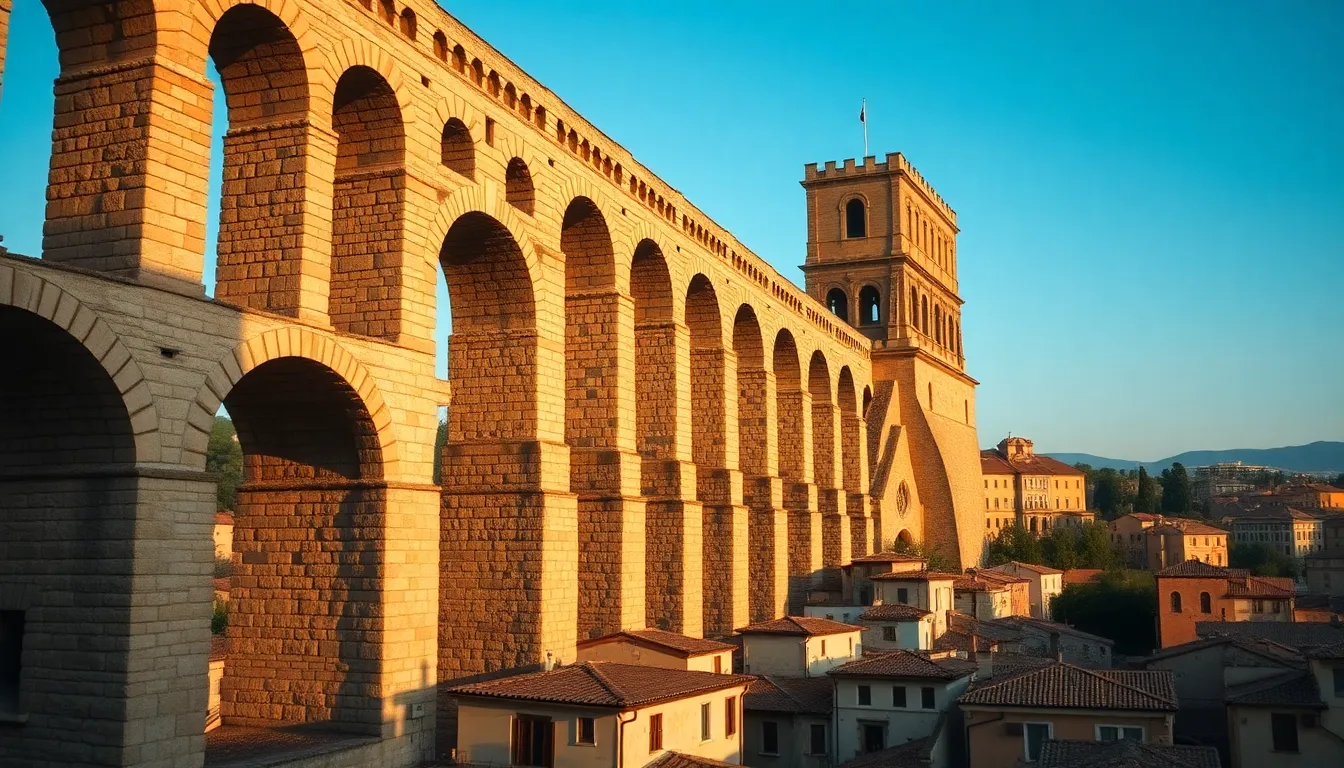
The first time I walked a group out of the train station and turned the corner toward the old town, someone stopped dead and said, “That cannot be real.” She was looking at the Roman aqueduct. Twenty-eight meters of stacked granite, no mortar holding it together, standing in the middle of a working city after two thousand years. I have brought groups to Segovia for years, and that moment still happens almost every time.
Segovia is small enough to see properly in a day, which is exactly why it works so well for heritage groups. You are not racing between sites. You walk from the aqueduct, up through the old streets, past the cathedral, into the Jewish quarter, and out to the Alcazar at the far end of the ridge. The whole town tells one continuous story, Roman, Christian, and Jewish layered into the same few square kilometers. Let me walk you through it the way I walk a group.
The Aqueduct: Where Every Visit Begins
You cannot avoid the aqueduct, and you should not want to. It is the first thing your group will see and the thing they will photograph most. Built by the Romans, most likely in the late first or early second century, it carried water from the Frio River more than fifteen kilometers into the city. The section that crosses the Plaza del Azoguejo is the tallest, and standing under it is the right way to start.
What I tell groups is to look at how it is built. There is no cement. The granite blocks hold each other up through sheer balance and weight, a Roman engineering principle that should not have survived earthquakes, weather, and twenty centuries of traffic. It did. For a faith group, there is something worth sitting with in that, the idea that careful work, done well, outlasts almost everything.
Practically, the Plaza del Azoguejo at the base of the aqueduct is your natural gathering point. There is space for a group to stand together, the guide can be heard, and it is an easy landmark to reunite at if people wander.
The Old Juderia: Segovia’s Jewish Quarter
Most visitors photograph the aqueduct and head straight up to the cathedral, missing the Jewish quarter entirely. I never let a group do that.
Segovia held one of the most important Jewish communities in medieval Castile. Before the 1492 expulsion, the Juderia sat on the southern edge of the old town, a dense neighborhood of narrow streets that you can still walk today. The community produced scholars, financiers, and physicians who served the Castilian crown. Abraham Seneor, one of the most prominent Jewish figures in fifteenth-century Spain, was based here.
The physical evidence remains, if you know where to look. The Corpus Christi church was originally the city’s main synagogue before it was converted after the community was forced out. Standing inside, you can still read the Jewish architecture under the Christian use, the same uncomfortable doubling you find in Toledo and Cordoba. The old Jewish cemetery sits on the hillside across the valley, the Pinarillo, where excavations have uncovered graves and you can look back at the town the community was expelled from.
For a rabbi bringing a congregation, the Juderia of Segovia is quieter and less visited than Toledo’s, which is part of why it lands so hard. There are no crowds to move through. You can stand in the street where Sephardic families lived and let the silence do its work.
The Cathedral and the Christian Town
Between the Juderia and the Alcazar sits the cathedral, the last great Gothic cathedral built in Spain, finished in the sixteenth century. The locals call it “the Lady of Cathedrals,” and from the surrounding hills it does look like it is presiding over the town.
The cathedral is worth time, but I usually frame it as part of the larger walk rather than a destination in itself. The interior is high, light, and calmer than Seville or Toledo. The cloister is a good place for a group to slow down and reflect. From the Plaza Mayor in front of it, your group can fan out for coffee, and it makes a natural midpoint in the day.
The streets between the cathedral and the Alcazar hold the rest of Christian Segovia, the Romanesque churches, the old convents, the noble houses with their carved facades. You do not need to enter all of them. Walking through is enough to feel the density of the place.
The Alcazar: The Castle at the End of the Ridge
Segovia narrows to a point, like the prow of a ship, and at the very tip stands the Alcazar. It is the kind of castle that looks invented, all turrets and slate spires, and it is widely said to have helped inspire the Disney castle. That story may or may not be exact, but your group will believe it the moment they see it.
The Alcazar matters historically beyond its looks. Isabella of Castile was proclaimed queen here in 1474, and her reign, alongside Ferdinand, is the reign that ended Muslim and Jewish Spain in 1492. There is a hard symmetry in standing in the Alcazar after walking through the Juderia. The decisions made by the people who lived in this castle reshaped the lives of the people who lived in that quarter below.
Climbing the tower is optional and involves a tight spiral staircase, so I gauge the group before suggesting it. The view from the top, out over the Castilian plain with the cathedral and aqueduct behind you, is the photograph people keep.
I often gather a group in the gardens just below the Alcazar at the end of the day, before we walk back through the town. From there you can see the whole ridge at once, the castle at your back, the cathedral rising in the middle distance, and the aqueduct anchoring the far end. It is the moment the day comes together. You have walked the Roman, the Jewish, and the Christian layers of one small city, and standing there, you can see all three in a single view. For a faith group, that kind of clarity is rare, and it is exactly what Segovia gives you in a single, walkable day.
Practical Orientation for Groups
Segovia is an easy day trip from Madrid. The high-speed train takes under thirty minutes to Segovia-Guiomar station, then a short bus or taxi ride into town. Many groups base in Madrid and come for the day, though staying a night lets you see the aqueduct lit up in the evening, which is worth it.
The town is built on a ridge, so there is real walking and some climbing involved. For groups with older members, I plan the route to go gently downhill where possible and build in rest stops at the Plaza Mayor. Spring and autumn are the best seasons. Segovia sits high on the Castilian plateau, which means hot summers and genuinely cold winters, so timing matters more than people expect.
If you are combining Segovia with other Castilian heritage, it fits naturally into a larger route. Many of our groups pair it with Toledo, Avila, and Burgos as a connected Castile trail, or use it as one stop in a broader Spain heritage journey. It also sits within reach of the central Castilian cities if you want a multi-day route rather than a single day.
FAQ: Segovia Heritage Travel
Is one day enough for Segovia with a group?
Yes, for the core sites. The aqueduct, the Juderia, the cathedral, and the Alcazar can be seen comfortably in a full day at a group pace. If you want to include the old Jewish cemetery across the valley or linger over meals, an overnight gives you breathing room and the bonus of the aqueduct lit at night.
What are the main Jewish heritage sites in Segovia?
The old Juderia neighborhood on the southern edge of the old town, the Corpus Christi church which was the community’s main synagogue before the expulsion, and the medieval Jewish cemetery on the Pinarillo hillside across the valley. Segovia’s Jewish quarter is less visited than Toledo’s, which many groups find makes it more affecting.
How do groups get to Segovia from Madrid?
The high-speed train from Madrid reaches Segovia-Guiomar station in under thirty minutes, followed by a short bus or taxi into the old town. There is also a slower regional train and coach options. For a group, the high-speed train plus a pre-arranged transfer into town is the smoothest combination.
When is the best time to bring a group to Segovia?
Spring (April through June) and autumn (September through October) are ideal. Segovia sits high on the Castilian plateau, so summers are hot and winters are cold, with the aqueduct district fully exposed to the sun. Mild seasons make the walking and climbing far more comfortable for mixed-age groups.
Does the group leader travel free to Segovia?
Yes. On all Heritage Tours group itineraries that include Segovia, the group leader travels free with fifteen or more participants. It is our way of honoring the work you put into bringing your community together.
If Segovia belongs in your community’s journey through Spain, I would be glad to talk it through with you. Reach out whenever you are ready and we can start shaping the trip around what matters to your group.