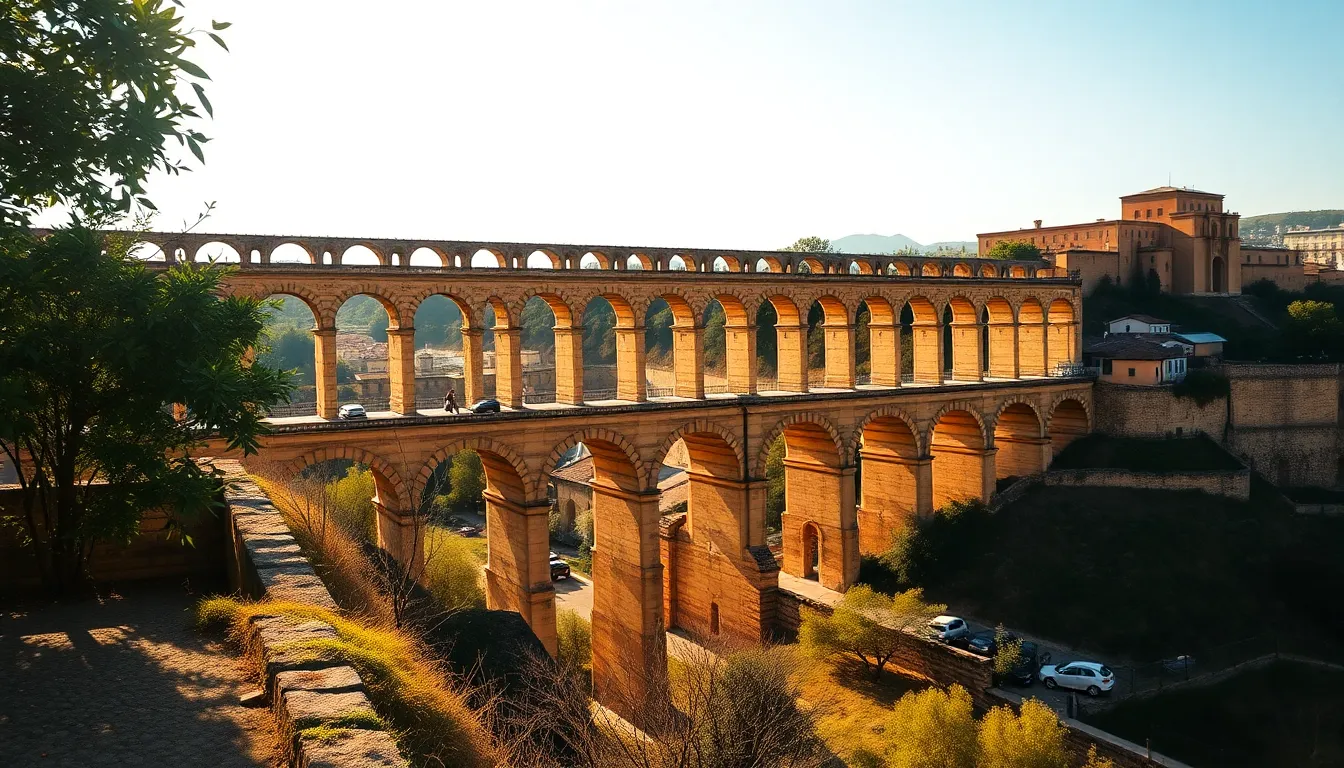
Standing Under the Arches
I have watched a lot of groups walk into the Plaza del Azoguejo in Segovia, and the reaction is almost always the same. Heads tilt back. The aqueduct rises straight out of the middle of a working city square, nearly twenty-nine meters at its tallest point, two tiers of granite arches marching across the valley. People reach for their phones and then forget to take the picture because they are too busy looking.
It is one of the great Roman monuments still standing in Western Europe, and it does not sit behind a fence in a ruin field. It runs through the center of a living town, with cafes underneath it and traffic around it. For a heritage group, that is exactly what makes it worth framing properly. This is not just an impressive structure. It is a window into the world that the biblical and post-biblical story unfolded inside, and putting it in that context is what turns a photo stop into a real visit.
What Your Group Is Actually Looking At
The aqueduct was built by the Romans, most likely in the late 1st or early 2nd century AD, to carry water about fifteen kilometers from the Frio River into the city. The visible section in the city, the part everyone photographs, is roughly 800 meters long and rises in a double tier of arches across the lowest ground.
Here is the detail that lands hardest with a group. The granite blocks are held together with no mortar at all. None. The entire structure stands on the precision of the cut and the balance of the weight. It has held for nearly two thousand years, through earthquakes and weather and the growth of a city around it, on engineering alone. When I point that out and let it sink in, the structure stops being decorative and starts being astonishing.
There are 167 arches in total along the full run, built from some 20,000 granite blocks. The aqueduct carried water into Segovia until the 19th century, and parts of the system functioned far longer than anyone designing it could have imagined.
The Heritage Frame: Why a Faith Group Should Care About Rome
A Roman aqueduct can feel like a detour from a faith heritage itinerary. It is not, and here is how I frame it for groups.
Rome is the water the whole New Testament swims in. The roads Paul traveled, the cities he wrote to, the legal system that tried Jesus and later Paul, the engineering that moved armies and goods across the Mediterranean, all of it was Roman. When your group stands under the Segovia aqueduct, they are looking at the same civilization, the same engineering culture, the same imperial reach that shaped the world of the early church and the Jewish world under occupation.
Spain itself, Hispania, was one of Rome’s most important provinces. It produced emperors, including Trajan and Hadrian. The aqueduct is physical evidence of how completely Rome had absorbed this far corner of the empire by the time the Gospel was spreading across it. For an educator or a pastor, the aqueduct becomes a teaching moment about scale, power, and the world into which the early faith communities carried their message.
I have found this framing matters because it connects a Roman monument to the larger journey the group came for. Without it, the aqueduct is a beautiful but disconnected stop. With it, it becomes part of the story.
Segovia Beyond the Aqueduct
The aqueduct is the headline, but Segovia gives a group a full half day or more. The old town climbs a long ridge, and walking it from the aqueduct upward gives a natural route through the city.
The Cathedral of Segovia, finished in the 16th century, is one of the last great Gothic cathedrals built in Spain, sometimes called the “Lady of Cathedrals” for its proportions. At the far end of the ridge, the Alcazar of Segovia is the fairy-tale castle, perched on a rock spur above the confluence of two rivers, its towers and turrets famous enough that they reportedly helped inspire later storybook castle imagery.
Segovia also had a significant medieval Jewish community, and the old Jewish quarter sits on the southern slope near the cathedral, with a former synagogue and an interpretation center that a heritage group can fold into the visit. For groups tracing the Sephardic story across Spain, this layer is worth including, and it pairs naturally with the deeper hidden-heritage sites elsewhere in the country.
How Groups Visit Segovia
Most groups reach Segovia as a day from Madrid, about an hour by coach, and many pair it with Avila for a two-stop Castile day or an overnight. The aqueduct sits at the low end of town, so I usually start groups in the Plaza del Azoguejo, looking up, and then walk uphill through the old town toward the cathedral and the Alcazar, ending at the castle viewpoint.
The walk is uphill and the streets are cobbled, so I always ask leaders to flag mobility concerns in advance. The coach can drop and collect at points that shorten the climb for travelers who need it. The square under the aqueduct is the natural gathering and photo point, and it works well as a meeting spot if your group splits up for lunch.
We arrange a guide who can hold both the Roman engineering and the heritage frame in the same talk, time the cathedral and Alcazar entries to avoid the worst crowds, and build in the Jewish quarter for groups that want it. For groups of 15 or more, the group leader travels free, which makes Segovia an easy addition to a Madrid-based itinerary.
FAQ: Visiting the Roman Aqueduct of Segovia
How old is the aqueduct of Segovia and who built it?
The Romans built it, most likely in the late 1st or early 2nd century AD, to carry water into the city from a river about fifteen kilometers away. It has stood for roughly nineteen hundred years and remained in use into the 19th century.
Is the aqueduct really held together without mortar?
Yes. The granite blocks are stacked and balanced with no mortar at all. The structure holds on the precision of the cut and the distribution of weight alone. That fact is usually the moment a group stops seeing it as a pretty arch and starts seeing it as an engineering feat.
Why include a Roman aqueduct on a faith heritage tour?
Because Rome is the world the New Testament happened inside. The roads, cities, law, and engineering that shaped the early church and the Jewish world under occupation were all Roman. Standing under the aqueduct gives a group a tangible sense of the scale and reach of that empire, which deepens the rest of the journey.
How much time does a group need in Segovia?
A half day covers the aqueduct, a walk up through the old town, and either the cathedral or the Alcazar. A full day lets you do both comfortably and add the old Jewish quarter, with time for lunch in the old town.
Can Segovia be combined with Avila in one trip?
Yes, and many groups do. The two towns are close, and pairing them makes a strong one- or two-day swing through historic Castile from a Madrid base. Avila gives you the medieval walls and the Teresian sites, Segovia gives you Rome and the Gothic cathedral.
If a Castile loop with Segovia and the aqueduct fits what you are planning for your community, we can build it cleanly into a wider Spain route. See our Spain heritage tour options, learn how we run group travel, and read more on the hidden heritage sites most groups miss or Spain’s spiritual sites. When you are ready, reach out and start the conversation.