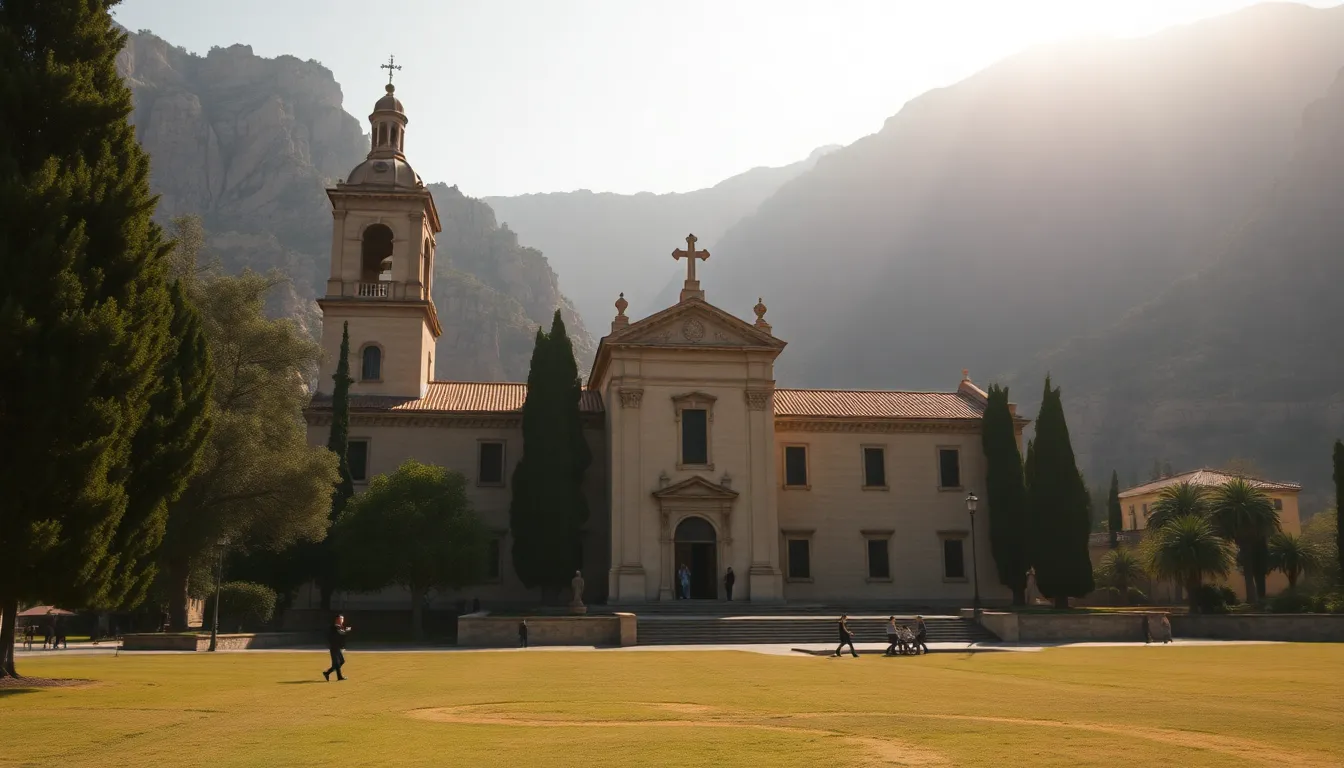
A Monastery You Do Not Expect to Find
There are a handful of places in Spain where a group goes quiet on their own, without me prompting them. San Juan de la Pena is one of them. You drive up into the foothills of the Pyrenees in northern Aragon, the road climbing through forest, and then the lower monastery appears tucked directly underneath a massive overhanging cliff. The rock forms the roof. The buildings are built into the hollow beneath it, sheltered by a hundred feet of stone leaning out over your head.
It is one of the most dramatic settings of any monastery in Europe, and it is also one of the least visited on the standard Spain circuit, which is exactly why it works for a heritage group. There is room here to think. And the place carries three threads at once: it was the cradle of the kingdom of Aragon, it holds the burial place of early Aragonese kings, and it sits at the center of one of the most enduring Holy Grail legends in Christian Europe. For a pastor, a rabbi, or an educator, that is a lot of substance for one stop.
The Lower Monastery: Built Under the Rock
The original monastery, now called the lower or old monastery, grew here from the 9th and 10th centuries, when hermits settled in the shelter of the cliff. Over time it became a Benedictine monastery and one of the most important religious centers in the early medieval kingdom of Aragon.
What survives is remarkable. There is an early church carved partly into the rock, a striking 12th-century Romanesque cloister with carved capitals telling scenes from scripture, and the royal pantheon where early kings of Aragon and Navarre were buried. The cloister is the part groups remember. Its open side faces directly into the overhanging cliff, so as you walk it you are looking up at raw rock where a sky should be. The carvings on the capitals, depicting the creation, the life of Christ, and other biblical scenes, are some of the finest Romanesque sculpture in northern Spain.
This is the heart of the visit. Standing in a 12th-century cloister with the mountain itself as the fourth wall is the kind of experience that does not translate to a photograph. You have to be there, and a group that is given a few quiet minutes here tends to carry the place with them.
The Cradle of Aragon and the Grail Legend
San Juan de la Pena matters to Spanish history out of proportion to its size. In the early medieval period, as small Christian kingdoms in the north pushed against Muslim Al-Andalus to the south, this monastery became a spiritual and political center for the emerging kingdom of Aragon. Kings were buried here. It is fair to call it the cradle of the Aragonese kingdom, and a guide who can sketch that history gives a group the political weight behind the religious site.
Then there is the Grail. According to a long tradition, the Holy Chalice, the cup believed to have been used at the Last Supper, was kept and protected at San Juan de la Pena for a period during the early Middle Ages, hidden in the mountains away from the reach of invading armies. The tradition holds that the relic later moved on and eventually reached Valencia Cathedral, where a chalice venerated as the Holy Grail is displayed today.
I am always careful with how I present this to a group. The Grail story is legend and tradition, not documented fact, and I say so plainly. But the tradition itself is real, centuries old, and woven into the identity of this place. For a Christian group it opens a genuine conversation about relics, devotion, and how communities preserve meaning. For a mixed or educator group it is a window into medieval religious culture. Handled honestly, the legend adds to the visit rather than cheapening it.
The Upper Monastery
A short distance up the road from the lower monastery sits the newer upper monastery, built in the 17th century after a fire damaged the original site. It is a large Baroque-era complex in a clearing, and today it houses an interpretation center that explains the history of both monasteries and the kingdom of Aragon.
For a group, the upper monastery is the practical anchor of the visit. It has the visitor facilities, the parking and coach access, the interpretation displays that set up the history, and open mountain views. I usually start groups here for the context, then move down to the lower monastery under the cliff for the experience itself. Taking them in that order, explanation first, then the dramatic original, gives the day a rhythm that works.
How Groups Visit San Juan de la Pena
This is a mountain site, and reaching it is part of the experience and part of the planning. It sits in the Pyrenean foothills of Aragon, most easily reached as a day from Jaca or Huesca, and it pairs well with a northern Spain itinerary that includes the Aragonese Pyrenees or a route toward the Camino. The drive up is winding, so I build in time and warn groups prone to motion sensitivity.
Access between the upper and lower monasteries is managed with a shuttle during busier periods, since the road and parking near the lower site are limited, and we coordinate that as part of the visit. The lower monastery involves some steps and uneven historic surfaces under the rock, so I ask leaders to flag mobility concerns ahead of time, and we route accordingly. The upper monastery and its interpretation center are more accessible for travelers who would rather not take on the steps below.
Because the site is remote and quiet, it is one of the easier places in Spain to arrange a genuinely reflective visit, with time in the Romanesque cloister that a busier monastery could never give. We handle the guide, the shuttle timing, and the pacing. For groups of 15 or more, the group leader travels free, which makes this dramatic and underused site easy to add to a northern Spain route.
FAQ: Visiting the Monastery of San Juan de la Pena
Why is San Juan de la Pena built under a cliff?
The original monastery grew from a hermitage that settled in the natural shelter of a huge overhanging rock in the Pyrenean foothills. The cliff forms a roof over the lower monastery, protecting it, and that dramatic setting is the site’s most striking feature. The Romanesque cloister opens directly onto the bare rock above it.
What is the connection to the Holy Grail?
A long-standing tradition holds that the Holy Chalice from the Last Supper was hidden and protected at San Juan de la Pena during part of the early Middle Ages, before eventually reaching Valencia Cathedral, where a chalice venerated as the Grail is displayed today. It is a centuries-old legend rather than documented fact, and a good guide presents it honestly as tradition.
Why is it called the cradle of Aragon?
In the early medieval period, the monastery was a key spiritual and political center for the emerging kingdom of Aragon, and early Aragonese and Navarrese kings were buried here in its royal pantheon. That role in the kingdom’s formation is why it is called the cradle of Aragon.
What is the difference between the upper and lower monasteries?
The lower monastery is the original site under the cliff, with the early church, the Romanesque cloister, and the royal tombs. The upper monastery, built in the 17th century after a fire, sits a short distance up the road and houses the visitor facilities and interpretation center. Groups usually start above for context and move down for the experience.
How do groups reach San Juan de la Pena?
It is a mountain site in the Aragonese Pyrenees, most easily visited as a day from Jaca or Huesca, and it suits a northern Spain itinerary near the Pyrenees or the Camino. The road up is winding, and a shuttle manages access between the two monasteries during busy periods. We coordinate the transport, timing, and pacing.
If a quieter, more dramatic northern Spain route appeals to your community, San Juan de la Pena is one of the most rewarding stops we run. See our Spain heritage tour options, learn how we handle group travel, and read more on Spain’s spiritual sites or the hidden heritage sites most groups miss. When you are ready, reach out and start the conversation.