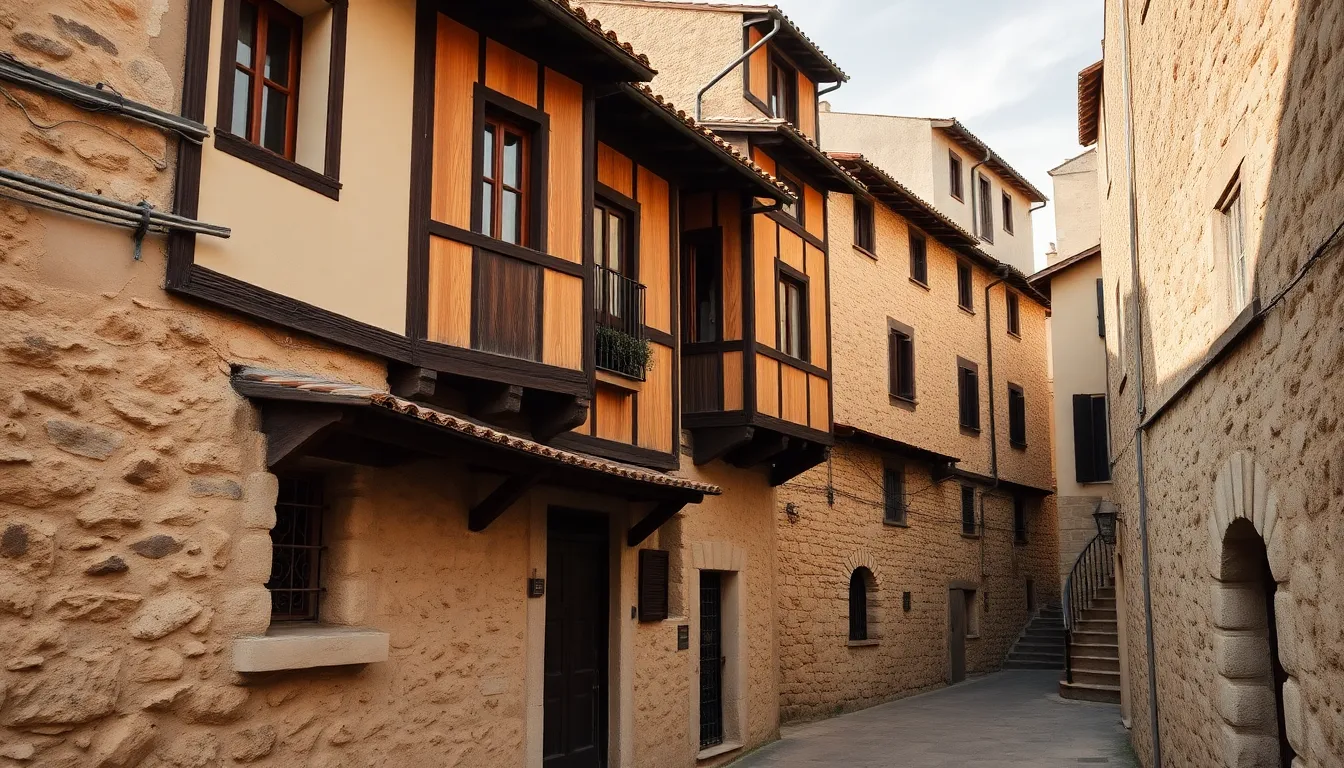
The first time I led a group into Hervas, someone in the back said quietly, “It feels like the village just closed its doors and walked away.” She was right, and that is exactly why I bring people here. Tucked into the mountains of northern Extremadura, far from the cathedrals and the cruise-ship crowds, Hervas holds one of the best-preserved Jewish quarters in all of Spain. Not a reconstructed one. Not a few labeled doorways. A whole quarter of timber-framed houses and twisting lanes that has survived more or less intact for over five hundred years.
Hervas asks something of a group. It is not on the way to anywhere obvious, and you have to want to go. But for a congregation willing to make the climb into the Ambroz valley, the reward is a kind of time travel that the famous sites cannot offer. You do not look at the medieval Jewish world here. You walk through it.
A Mountain Refuge
To understand Hervas, you have to understand its geography. The village sits in a green, watered valley in the Sierra de Bejar, a long way from the centers of royal power. Through much of the medieval period, that distance was a kind of shelter. Communities that came under pressure in the cities sometimes drifted toward smaller, quieter places, and the Jewish community of Hervas grew in this protected valley along the banks of the Rio Ambroz.
By the 15th century, Hervas had a notable Jewish population for a village of its size, supported by farming, crafts, tanning, and trade in the wool and chestnuts the region produced. The community built its life along the river, in the steep lanes that still carry its memory. When the expulsion came in 1492, this small mountain community was swept up in the same catastrophe that emptied Toledo and Segovia. Some left. Some converted and stayed as conversos. And the houses remained, lived in by others, largely unaltered, until the present day.
Walking the Juderia
The Jewish quarter of Hervas spills down the hillside toward the river, and walking it is the heart of any visit. A few stretches that I always make sure a group sees:
Calle de la Sinagoga
The street name says it plainly. This narrow lane is traditionally associated with the location of the village synagogue, and it runs through the densest part of the old quarter. Standing here, you are at the spiritual center of the medieval community. The synagogue building itself did not survive in recognizable form, which is honest history. Not everything endures, and the absence is part of the story.
Calle del Rabilero and the Lower Lanes
As the quarter drops toward the Ambroz, the houses lean closer together. Upper floors of timber and adobe overhang the street, almost touching across the gap. The lanes are too narrow for cars, which is part of why they survived unspoiled. Walk slowly. Look at the doorframes, the worn stone thresholds, the way the architecture adapts to the slope.
The Puente de la Fuente Chiquita
The small medieval bridge over the river anchors the lower edge of the quarter. The river was practical, water for the tanneries and daily life, but it also marks a natural boundary. I like to pause a group on the bridge and let them look back up at the tumble of houses climbing the hill. From here the scale of the surviving quarter becomes clear. This is not a fragment. It is a neighborhood.
Why Hervas Survived When Others Did Not
Groups always ask the same question here: how is this still standing when so much else was destroyed?
The honest answer is a mix of luck and obscurity. Hervas was small and remote. There was no great cathedral campaign to remake the center, no major industrialization to flatten the old streets, no war that leveled the valley. The houses were modest, useful, and lived in continuously, so nobody tore them down. Poverty and isolation, which were hardships for the village, turned out to be a kind of accidental preservation.
In recent decades Hervas has embraced this heritage with real seriousness. The village hosts an annual festival, Los Conversos, that engages with its Jewish and converso past, and it is part of the Red de Juderias de Espana, the network of Spanish cities working to protect and interpret their Jewish heritage. For a heritage group, this means you are walking through living memory that the community itself chooses to honor, not a forgotten corner that has been paved over.
Setting the Right Tone for a Group Visit
Hervas is intimate, and a group of fifteen or more changes the feel of a narrow lane quickly. I keep the pace gentle and the voices low. This is partly respect for the residents, who still live in these houses, and partly because the quarter rewards quiet. The history here is not delivered by a guide standing in front of a glass case. It rises out of the streets themselves when people slow down enough to feel it.
I usually pair the walk with a sit-down nearby, a meal or a long coffee in the village, where the group can talk through what they have just seen. Hervas tends to stir reflection. People who have read about the expulsion as a historical event find that walking an intact juderia makes it suddenly personal. Giving them room to process that is part of leading well.
Where Hervas Fits in a Spain Heritage Trip
Hervas is a detour, and I say that as a compliment. It does not compete with Toledo or Cordoba. It complements them. The grand sites show you the height of Jewish civilization in Spain. Hervas shows you its ordinary fabric, the lanes where regular families lived regular lives, preserved by the accident of obscurity.
It fits naturally into a longer route through western Spain and pairs well with the broader story laid out in our Spain Jewish heritage guide. For groups drawn to the human texture of this history, Hervas connects directly to the deeper threads of conversos and crypto-Jews, since the village’s own converso past is central to its identity, and to the cultural inheritance traced in our primer on Ladino and Sephardic culture, the world these mountain families carried with them into exile.
FAQ: Visiting the Jewish Quarter of Hervas
Why is Hervas’s Jewish quarter so well preserved?
Hervas is a small, remote mountain village in northern Extremadura. Its isolation and modest economy meant the old quarter was never cleared for grand building projects or industrialization. The timber-framed houses were lived in continuously and left largely intact, so the medieval street pattern survives in unusually complete form.
Is there a surviving synagogue in Hervas?
The medieval synagogue did not survive as a recognizable building, but its memory is preserved in the Calle de la Sinagoga, the street traditionally associated with its location at the heart of the quarter. The absence of the building itself is part of the honest history of a community that was expelled in 1492.
Where exactly is Hervas?
Hervas sits in the Ambroz valley in the Sierra de Bejar, in the province of Caceres in northern Extremadura, western Spain. It is well off the main tourist routes, which is part of its appeal. Reaching it takes intention, but the preserved quarter rewards the effort.
Is Hervas worth visiting alongside Toledo and Cordoba?
Yes, for groups that want more than the famous sites. Toledo and Cordoba show the grandeur of Jewish Spain through major synagogues. Hervas shows its everyday fabric, an entire ordinary quarter preserved by obscurity. Together they give a fuller picture of what Jewish life in Spain actually looked like.
Does Hervas acknowledge its Jewish and converso history today?
It does, and seriously. Hervas belongs to the Red de Juderias de Espana, the network of Spanish cities protecting their Jewish heritage, and it hosts an annual festival, Los Conversos, that engages with its Jewish and converso past. The village treats this history as a living part of its identity.
If a quiet mountain juderia sounds like the kind of stop your community would remember, let us build it into a route that makes sense for your group. Our group heritage tours are shaped around the people traveling, and with fifteen or more participants the group leader travels free. See the wider picture on our Spain destination page, and contact us to start planning your trip.