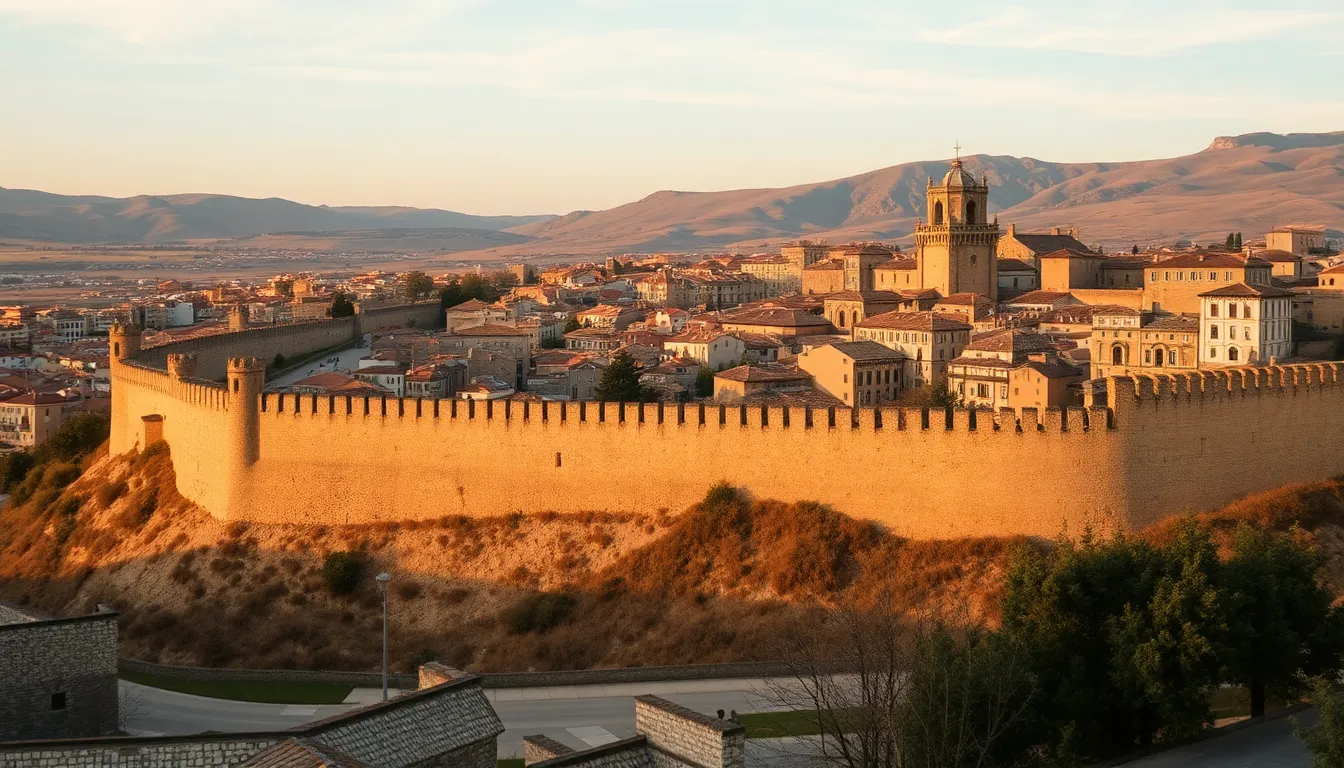
The first time my coach crested the rise toward Avila, the whole group went to the windows at once. The city sits behind a complete ring of medieval walls, golden stone against the high Castilian sky, and it looks exactly like what it is: a place set apart. I have brought many groups here, and Avila consistently surprises them. They come for a fortress town and they leave having met one of the most remarkable women in the history of the church.
If you are planning a heritage journey through Spain, Avila deserves more than a photo stop. Let me give you the city, the saint, and the reform she led, in the detail you will want to share with your congregation.
The Walled City
Avila is the highest provincial capital in Spain, sitting above 1,100 meters on the Castilian plateau, which is part of why it can be bitterly cold in winter and crisp even in summer. Its glory is the wall, built mainly in the late 11th and 12th centuries as the Christian kingdoms pushed south. It runs about two and a half kilometers around the old city, complete with some 88 towers and nine gates, and it is among the best preserved medieval walls in Europe. Walking a stretch of the ramparts gives your group both the views and a visceral sense of a frontier city on a contested edge.
Inside the walls, the cathedral is itself built into the defenses, its apse forming one of the great towers, a fortress church for a fortress town. The whole old city is a UNESCO World Heritage site. But the reason heritage groups come is the woman born inside these walls in 1515.
Who Saint Teresa of Avila Was
Teresa de Cepeda y Ahumada was born in Avila to a family of converso background, descended from Jewish ancestors who had converted to Christianity, a detail worth knowing in the context of Spain’s complicated 16th-century religious world. She entered the Carmelite convent of the Incarnation in Avila as a young woman, and for years lived a comfortable, somewhat lax religious life, common in the large convents of the day.
Then came a profound interior conversion in her late thirties, and with it a life of deep prayer and mystical experience that she would later describe with extraordinary honesty. Teresa was not a remote, ethereal figure. She was practical, witty, stubborn, a shrewd judge of people, and a relentless organizer. She founded convents across Spain on next to no money, argued with bishops and officials, traveled constantly over bad roads in poor health, and wrote some of the most important spiritual books in the Western tradition.
Her works, especially The Interior Castle and her Life, map the soul’s journey toward God through stages of prayer with a clarity that still guides readers four centuries later. In 1622 she was canonized, and in 1970 she was declared a Doctor of the Church, one of the first women to receive that honor. For a faith group, walking her city is a chance to encounter a believer whose toughness and warmth come through in everything she touched.
The Carmelite Reform
The heart of Teresa’s heritage is the reform she led, and it is worth understanding clearly because it explains every site you will visit.
By the 16th century, the Carmelite order had drifted from its original austerity. The convents Teresa knew were large, sociable, and lax. Convinced that genuine prayer required genuine poverty and enclosure, she set out to restore the order’s first rigor. In 1562 she founded the convent of San Jose in Avila, the first house of what became the Discalced Carmelites, the “barefoot” Carmelites, marked by simplicity, poverty, manual work, and contemplative prayer.
This was not a gentle process. The reform met fierce resistance from within the order and beyond, and Teresa endured opposition, suspicion, and investigation. But she pressed on, founding house after house across Castile and Andalusia. Crucially, she drew a young friar into the reform of the men’s branch of the order, a poet and mystic named John of the Cross, whose own heritage trail through Spain is closely bound to hers.
By the time she died in 1582, the Discalced Carmelites were established as a distinct and enduring movement that spread across the Catholic world and shaped the history of Christian contemplative prayer. That movement began behind the walls of Avila.
The Teresa Sites in Avila
A few places anchor any visit, and I sequence them so the story unfolds as you walk.
The Convent of San Jose, her first foundation from 1562, is where the reform physically began, and its plainness is the point. The Convent of the Incarnation, just outside the walls, is where Teresa lived for many years before and after her conversion and later served as prioress; it preserves rooms and relics tied to her. The Convent and Church of Santa Teresa was built in the 17th century over her birthplace, and it includes a chapel on the very site where tradition holds she was born, along with a small museum.
I encourage groups to slow down at these places. They are working religious houses and quiet by nature, and the contrast between the mighty city walls and the deliberate smallness of Teresa’s convents tells her whole story without a word of commentary.
How to Fit Avila Into a Spain Itinerary
Avila sits about 115 kilometers northwest of Madrid and pairs naturally with Segovia, which makes a strong two-city loop from the capital or a logical leg of a wider Castilian route. A full day lets your group walk a section of the walls, see the cathedral, and visit the principal Teresa sites without rushing. With an overnight, the city empties of day-trippers in the evening and the walls glow at dusk, which is when Avila is at its most moving.
Teresa’s reform is inseparable from her younger collaborator, so I almost always connect Avila with the Saint John of the Cross heritage trail when I plan a route. For the wider spiritual landscape of the country, see our Spain spiritual sites hub and our Spain destination page. Groups drawn to pilgrimage on foot often pair the Castilian saints with the Camino de Santiago.
A practical note for your planning: with Heritage Tours, the group leader travels free with fifteen or more participants, which makes bringing your congregation into this heritage genuinely workable.
FAQ: Visiting Avila and the Sites of Saint Teresa
Who was Saint Teresa of Avila?
Teresa of Avila (1515 to 1582) was a Spanish Carmelite nun, mystic, reformer, and writer. She led the reform of the Carmelite order into the Discalced Carmelites, founded convents across Spain, and wrote spiritual classics including The Interior Castle. She was canonized in 1622 and declared a Doctor of the Church in 1970, one of the first women to hold that title.
What is the Carmelite reform Teresa led?
By the 16th century the Carmelite order had grown lax, with large, comfortable convents. Teresa restored its original austerity, founding the Discalced (barefoot) Carmelites marked by poverty, enclosure, simplicity, and contemplative prayer. She began with the convent of San Jose in Avila in 1562 and, with Saint John of the Cross, extended the reform to the men’s branch of the order.
What are the main Teresa sites to see in Avila?
The Convent of San Jose, her first foundation; the Convent of the Incarnation outside the walls, where she lived for years and later served as prioress; and the Convent and Church of Santa Teresa, built over her birthplace with a chapel on the site and a small museum. The medieval city walls and the fortress cathedral frame all of it.
How much time should a group spend in Avila?
A full day allows your group to walk a stretch of the walls, see the cathedral, and visit the principal Teresa sites without rushing. An overnight is even better, since the day-trippers leave in the evening and the city and its walls are at their most atmospheric at dusk. Avila pairs naturally with nearby Segovia.
Is Avila suitable for non-Catholic faith groups?
Yes. While Teresa is a Catholic saint, her writing on prayer and the inner life has shaped Christians across traditions, and Protestant readers have long valued The Interior Castle. The walled city, its history on the frontier, and the story of a determined reformer speak to a wide range of faith groups.
If Avila and the story of Saint Teresa belong on your congregation’s journey, I would be glad to help you build it into a route that flows. Contact us whenever you are ready to talk.