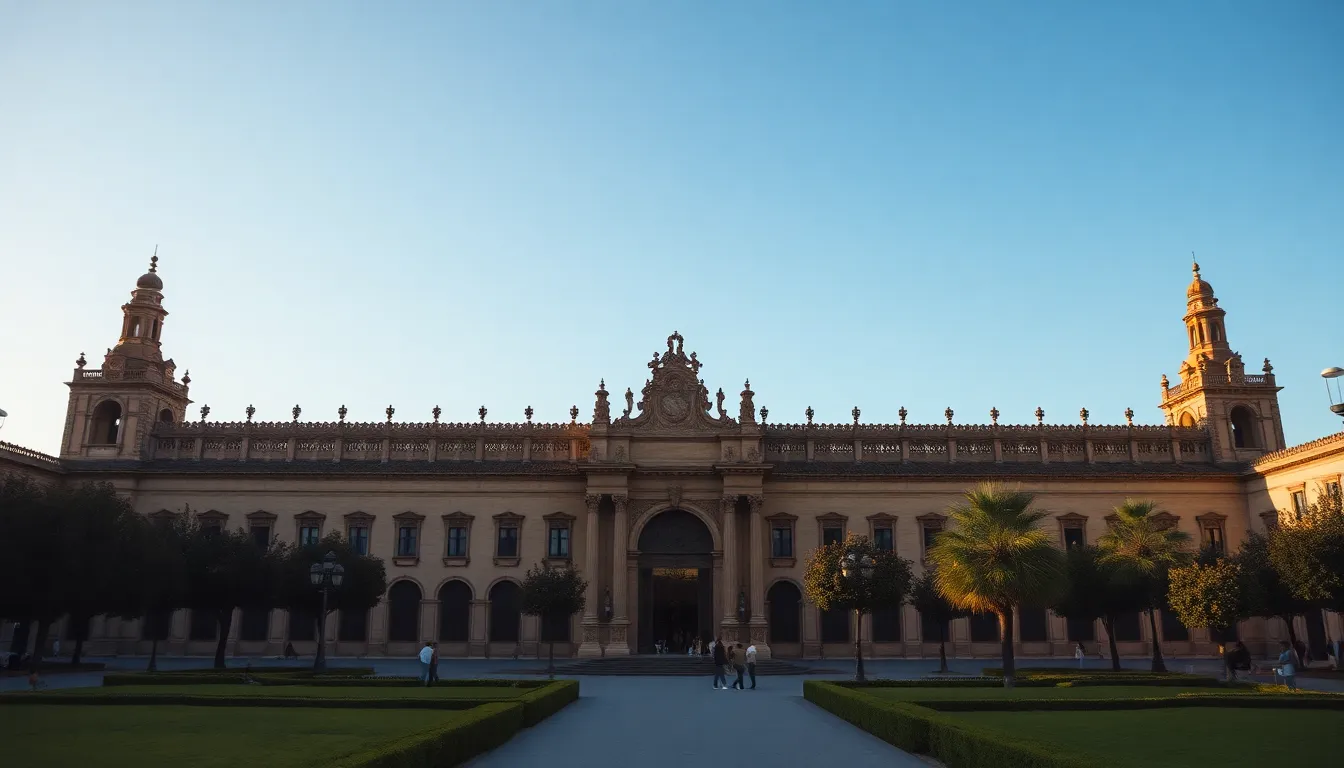
A Palace That Confuses People, in the Best Way
The first question I get from almost every group inside the Royal Alcazar of Seville is some version of “wait, who built this?” They are looking at walls covered in Arabic inscriptions and Islamic geometric tilework, carved plaster ceilings, and courtyards with reflecting pools, and they have just been told this was the palace of a Christian king. That confusion is the whole point, and once a group sits with it, the Alcazar becomes one of the most rewarding stops in all of Spain.
This is a royal palace that Christian kings built in the Islamic style, generations after the Christian conquest of Seville, using Muslim craftsmen and Islamic design language on purpose. For a pastor, a rabbi, or an educator, that fact opens a richer conversation than almost any “pure” monument can. The Alcazar is layered history you can walk through, and it is still a working royal residence today, which makes it the oldest royal palace in Europe still in use.
The Layers: What Your Group Is Standing On
The site has been a seat of power for well over a thousand years. It began as a Muslim fortress in the early medieval period, expanded under successive Islamic dynasties as Seville grew into one of the great cities of Al-Andalus. After Christian forces took Seville in 1248, the kings of Castile took over the complex and kept building.
The most famous part, the Palace of King Pedro I, was built in the 1360s. Pedro, a Christian king of Castile, commissioned it in the Mudejar style, the term for Islamic-influenced art and architecture produced under Christian rule. He brought in craftsmen from Granada and Toledo, including Muslim and Jewish artisans, to build a palace in the visual language of the very culture his predecessors had conquered. The result is a building where carved Arabic praises sit alongside the heraldry of Castile, sometimes on the same wall.
I make a point of slowing groups down here, because this is the lesson. The Alcazar is not a story of one faith replacing another and erasing it. It is a story of borrowing, of admiration, of a conquering culture so taken with the artistry of the conquered that it hired their descendants to build its own palaces. That nuance is what educators and faith leaders tend to want from a heritage trip, and the Alcazar hands it to them in stone.
What to Actually See Inside
The Alcazar is large, and a group can wander for hours, so I structure the visit around a few highlights rather than trying to cover everything.
The Patio de las Doncellas, the Courtyard of the Maidens, is the centerpiece of Pedro’s palace. A long reflecting pool runs down the middle, framed by delicate arches and tilework, and it is the image most people carry away. The Hall of Ambassadors, the throne room, sits under a spectacular gilded wooden dome meant to represent the heavens, and it is the single most ornate room in the complex.
The gardens are the other half of the experience and easy to underestimate. They spread across several terraces with fountains, pavilions, hedges, and orange and palm trees, and after the dense interiors they give a group room to breathe and regroup. On a hot Andalusian afternoon, the gardens are where I let people slow down.
One detail I make sure a group catches is the upper border of inscriptions in Pedro’s palace. Carved into the plaster in flowing Arabic script is a repeated phrase that translates roughly to “there is no conqueror but God.” A Christian king put a confession of Islamic faith on the walls of his own throne complex, in a language most of his court could not read, because it was the right artistic language for a palace of that ambition. When I translate it for a group, the room changes. That single line carries the whole strange, layered story of the place.
A note many groups appreciate: parts of the Alcazar have been used as a filming location for well-known television and film productions, which travelers sometimes recognize. I mention it lightly because it can spark interest, but the real story is always the history under the camera. The Alcazar, the cathedral, and the old Archive of the Indies were together named a UNESCO World Heritage Site in 1987, and the citation rewards exactly this layering rather than any one room.
How Groups Visit the Alcazar
The Alcazar is one of Seville’s two essential sites, the other being the cathedral and Giralda a few minutes’ walk away, and the two pair into a strong full day in the old city. Like the cathedral, the Alcazar gets very busy, so timed group entry booked in advance is not optional in my experience. It is the difference between walking in and standing in a long line in the Andalusian sun.
I usually bring groups in the morning when the interiors are coolest and least crowded, then let the gardens carry the back end of the visit as the day warms. The palace floors are mostly flat and the route is manageable for mixed mobility, though there are some steps and uneven historic surfaces, so I ask leaders to flag concerns ahead of time. The gardens have gentle paths and plenty of shaded seating, which makes them an easy place for travelers who want to rest while the rest of the group explores.
We arrange the guide, the timed entry, and the routing that pairs the Alcazar with the cathedral without exhausting the group. A guide who can read the Mudejar story, the borrowing and the layering, is what turns this from a pretty palace into a teaching visit. For groups of 15 or more, the group leader travels free, which makes the Alcazar straightforward to anchor a Seville day around.
FAQ: Visiting the Royal Alcazar of Seville
Who built the Royal Alcazar of Seville?
It was built over many centuries. The site began as a Muslim fortress and grew under Islamic rule, then the Christian kings of Castile took it over after 1248 and kept expanding it. The most famous section, the Palace of King Pedro I, was built in the 1360s by a Christian king using Muslim and Jewish craftsmen in the Islamic-influenced Mudejar style.
What is Mudejar style, and why does it matter here?
Mudejar is the term for Islamic-influenced art and architecture produced under Christian rule in Spain. The Alcazar is one of its greatest examples. It matters because it shows a conquering Christian culture deliberately adopting the artistry of the Muslim world it had defeated, hiring those craftsmen rather than erasing their work. That layering is the heart of what makes the site meaningful for heritage groups.
Is the Alcazar still used as a royal palace?
Yes. The Spanish royal family still uses the upper levels as an official residence when in Seville, which makes it the oldest royal palace in Europe still in use. Visitors tour the historic palace rooms and the gardens.
How long should a group spend at the Alcazar?
Plan for two to three hours to see the main palace rooms and the gardens at a reasonable pace. Pairing it with the cathedral and Giralda nearby makes a full and satisfying day in old Seville.
Do groups need to book entry in advance?
Yes. The Alcazar is one of Seville’s busiest sites, and timed group entry booked ahead avoids long queues in the Andalusian heat. We handle the booking and the timing as part of arranging the visit.
If Seville is on your community’s Spain itinerary, we can pair the Alcazar with the cathedral and Giralda into a smooth, well-paced day. See our Spain heritage tour options, learn how we run group travel, and read more on the nearby Cathedral of Seville and the Giralda or the hidden heritage sites most groups miss. When you are ready, reach out and start the conversation.