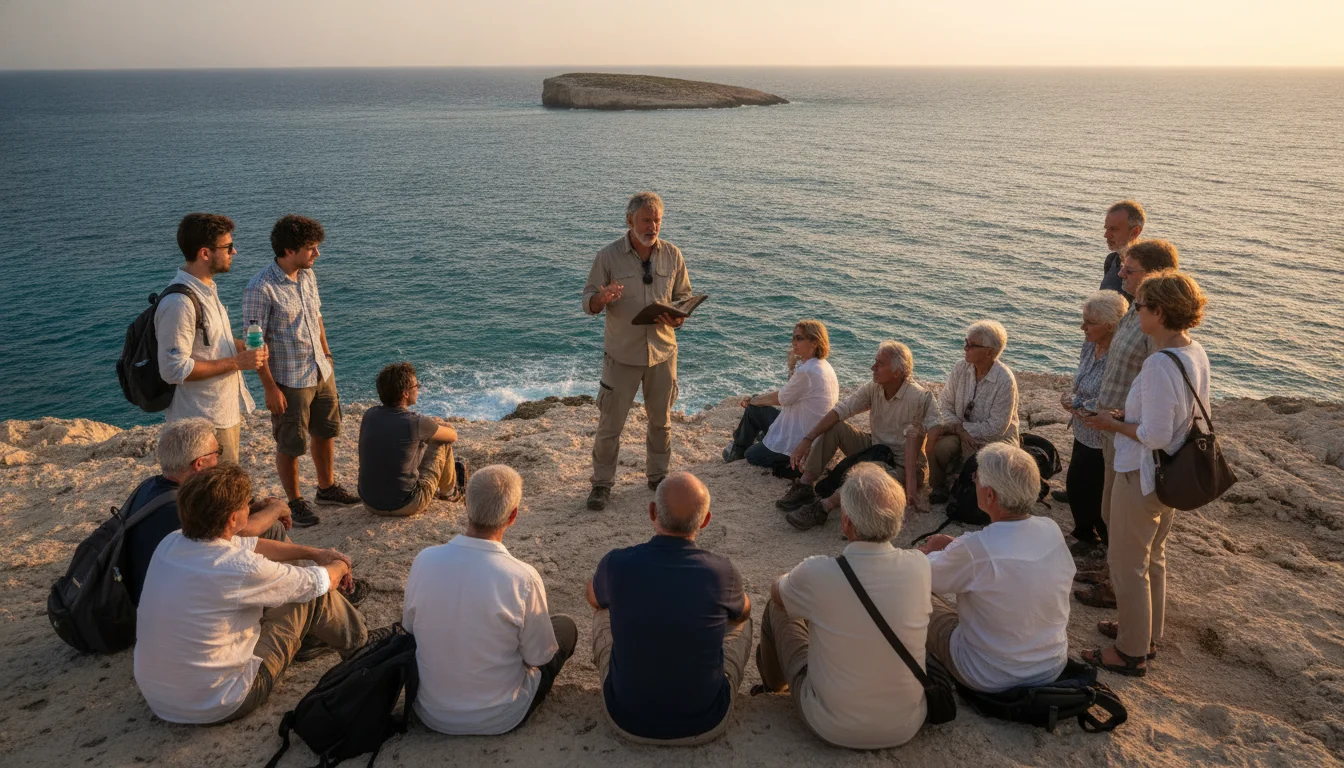
A seminary dean once told me the hardest part of proposing a Malta trip to his board was not the budget. It was the word “trip.” The moment people hear “trip,” they picture a vacation, and a board approving funds for study leave does not want to picture a vacation. He asked me to help him reframe the whole thing as what it actually was: a field course in early Christian history and Mediterranean Jewish heritage, delivered on location instead of in a classroom. That reframing changed the conversation entirely, and it is one I have had with clergy and educators many times since.
So let me lay out how to build and present a Malta heritage trip as the educational experience it genuinely is, because Malta happens to be one of the strongest destinations for this framing of any place we work.
Why Malta Is an Unusually Strong Educational Destination
Malta compresses an enormous amount of teachable history into a single small island, which is exactly what makes it work so well for an educational trip. Acts 27 and 28 describe Paul’s shipwreck in specific, verifiable geographic terms, a storm, a sandbar, a bay still called St. Paul’s Bay today. That is a primary text your students or congregation can read on the plane and then stand inside the following week. The Knights of St. John built an entire fortress capital, Valletta, as a functioning expression of their religious and military order, and St. John’s Co-Cathedral remains one of the clearest physical records of that era anywhere in Europe. Mdina holds the Giudecca, the site of a Jewish community that lived on this island for roughly 1,500 years before the 1492 expulsion, a chapter of Mediterranean Jewish history that almost no curriculum covers because almost no one knows it exists.
For a seminary, a Jewish day school, or an adult education program, this is not sightseeing. It is primary-source history you can walk through, layered across biblical, Christian, and Jewish threads on one accessible island.
Building the Pre-Trip Curriculum
The educational value of a Malta trip multiplies when preparation happens before departure, not on the bus. For Christian groups, I recommend assigning Acts 27 and 28 in full, along with background reading on the Knights of St. John, before the group ever leaves home. When your group arrives at St. Paul’s Bay having already studied the text, the site becomes confirmation and encounter rather than introduction. Our group heritage tour guide for Malta lays out how the Christian itinerary connects these sites into a single narrative arc, which is useful as a syllabus outline in itself.
For Jewish educational groups, the pre-trip reading should cover the Giudecca, the Rabat catacombs, and the 1492 expulsion, with explicit attention to how it parallels the Spanish expulsion of the same year. Our Jewish heritage in Malta post works well as an assigned reading itself, giving students the historical framework before they descend into catacombs carved with menorahs seventeen centuries ago.
Either way, the principle is the same: send the reading in advance, and structure a short pre-departure session where the group leader walks through what they will see and why it matters. A trip that begins with context lands differently than one that begins at the airport.

Framing the Trip for Boards, Committees, and Budget Approval
If you are the one who has to justify this trip to a board, a session, or a school committee, the language matters. Do not present Malta as a vacation with religious content attached. Present it as a field-study component of ongoing formation or curriculum, with specific learning objectives attached to specific sites: understanding the historical context of Pauline missionary travel, encountering a lesser-known chapter of Jewish Mediterranean history, examining the material culture of a religious military order at the height of its influence. Committees fund education. They are more skeptical of leisure travel wearing an educational label. The distinction is not just marketing. If you build the trip around genuine learning objectives, the label is simply accurate.
This is also where Heritage Tours’ core positioning matters for you directly. We are a heritage and faith-travel operator exclusively. We do not build itineraries around beach time or shopping days, because that is not the trip we exist to offer. Every stop on a Malta itinerary we design ties back to a historical, biblical, or communal thread, which makes the educational framing something the itinerary itself supports, not just something you claim in a grant proposal.
Structuring Reflection and Assessment
An educational trip benefits from structured reflection, not just a full day of sightseeing followed by dinner. For clergy groups, this can be as simple as a short evening gathering each day where the group discusses what a site meant against the text they read that morning. For a school or seminary group, this can be formalized further: a reflection journal, a short paper due after return, or a capstone presentation where students connect one Malta site to a theme from their coursework.
Some of our clergy groups build the entire trip around a single teaching thread, using each day’s site as an illustration for a broader theme they are developing for a future sermon series or course. Standing at St. Paul’s Bay to read the shipwreck narrative, then walking the Giudecca to discuss exile and return, gives a leader living material that a slideshow simply cannot replicate.
Practical Notes for an Educational Group
Malta’s compact geography works in your favor here too. Because the island is small and your group stays in one hotel base for the entire trip, as I describe in our group heritage tour guide, you can build a genuine daily rhythm of morning teaching, midday site visit, and evening reflection without losing hours to travel between cities. That rhythm is much harder to sustain in a multi-city European circuit where half of some days disappear into transit.
For a mixed group of clergy, educators, and students, our guides can adjust the depth and academic register of the on-site teaching to match your audience, whether that means a seminary-level discussion of Knights Hospitaller architecture or a more accessible framing for a youth group encountering this history for the first time.
With fifteen or more participants, the group leader travels free, which matters for an institution watching every line of the budget on an educational trip. You can see how a full itinerary comes together on our Malta destination page, and our group heritage tours page covers how we structure the group experience for institutions bringing students, congregants, or both.
FAQ: Educational Malta Heritage Trips
How do we frame a Malta trip as educational rather than a vacation for board approval?
Present it as a field-study component with specific learning objectives tied to specific sites, such as the historical context of Pauline travel narratives or the material culture of the Knights of St. John, rather than as general travel with religious content attached. Heritage Tours itineraries are built around heritage and faith content exclusively, which supports this framing directly.
What should students or congregants read before a Malta educational trip?
For Christian groups, Acts 27 and 28 along with background on the Knights of St. John. For Jewish groups, background on the Giudecca, the Rabat catacombs, and the 1492 expulsion. Assigning this reading before departure turns each site visit into confirmation of prior learning rather than a first introduction.
Can a Malta trip work as a formal academic course component?
Yes. Seminaries and schools have structured Malta trips around a reflection journal, a post-trip paper, or a capstone presentation connecting specific sites to coursework themes. The island’s compact geography supports a daily rhythm of teaching, site visit, and reflection without losing time to travel between cities.
Is Malta suited to mixed groups of clergy, educators, and students?
Yes. Our guides adjust the academic depth of on-site teaching to the audience, from a seminary-level discussion for clergy to a more accessible framing for younger students, without changing the underlying itinerary or sites.
Does the free group leader policy apply to educational and institutional trips?
Yes. With fifteen or more participants, the group leader travels free, which applies whether the group is a congregation, a school, or a seminary cohort, and is worth building into an institutional budget proposal from the start.
If you are building the case for a Malta trip to a board, a committee, or a curriculum team, I am glad to help you frame it, and build the itinerary to actually deliver on that framing.
Contact us and let’s put together a trip that holds up as education, not just travel.