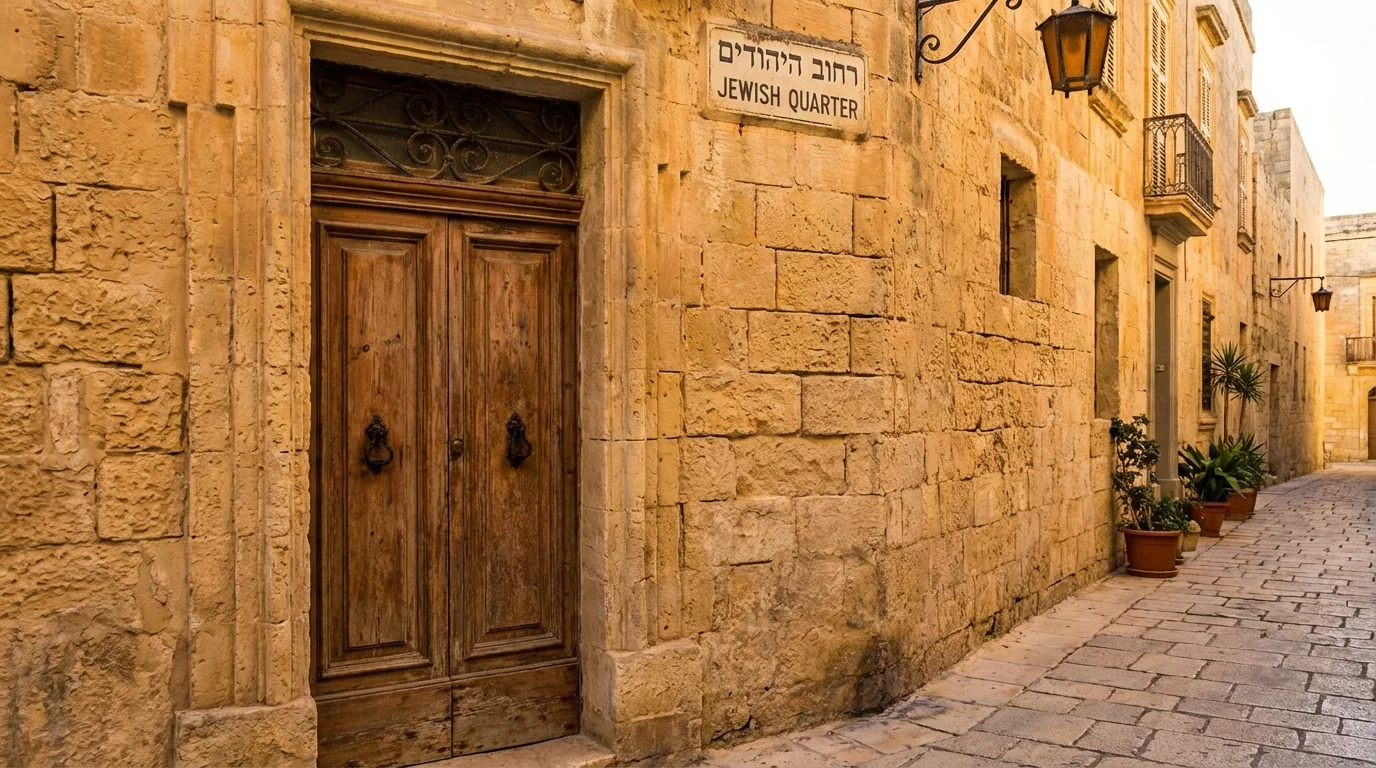
Malta’s Jews: A Community 1,500 Years in the Making
When people think of Jewish heritage in Europe, they think of Amsterdam, Prague, Krakow. Malta is rarely on the list. But the Jewish presence on this island stretches back further than most of those celebrated centers, and the story of what happened to Malta’s Jews is one of the least known chapters of the Jewish Mediterranean experience.
Jewish traders and families settled in Malta during the Roman period, possibly as early as the 1st century CE. By the medieval period, a recognizable Jewish community had established itself in Mdina, Malta’s ancient capital, with its own quarter, its own commercial life, and its own burial traditions. For over 1,500 years, Jews lived on this island.
Then, in 1492, they were expelled.
The scale of Jewish heritage in Malta is modest. I want to be honest about that. This is not Amsterdam. There are no grand synagogues standing from the 17th century, no vast Jewish museums. But the story is extraordinary, and the physical traces, though limited, are real and can be visited. For a rabbi leading a heritage group or for Jewish travelers who want to understand the full map of Jewish life in the Mediterranean, Malta has something genuine to offer.
The Giudecca: Mdina’s Jewish Quarter and What Remains
The Giudecca is what the Jewish quarter of Mdina was called. It occupied a section of the walled city near what is now Mesquita Street, a name that itself tells a layered story. The quarter had a synagogue, though its exact location is debated among historians. Jewish families lived and worked within these narrow medieval streets, part of a small but established community on the island.
Walking through the Giudecca today, you see the same limestone walls, the same narrow passage widths, the same enclosed feeling that the quarter would have had in the 15th century. The buildings have been repurposed. There are no markers, no plaques, no tourist infrastructure telling you what this place was. You need a guide who knows the history to understand what you are walking through.
That is part of what makes it meaningful. This is not a heritage site that has been packaged for visitors. It is a piece of geography where a community lived for centuries, and the physical footprint remains even after the community itself was removed.
Rabat’s Jewish Catacombs: Burial in the Rock
Just outside the walls of Mdina lies Rabat, and beneath Rabat’s streets is one of the most remarkable archaeological sites in Jewish Mediterranean heritage.
The catacombs of Rabat include a Jewish section, identifiable by the menorahs carved into the rock walls and by the absence of figural imagery that characterizes the adjacent Christian chambers. These are burial caves dating to approximately the 4th century CE, one of the very few Jewish catacomb sites in the Mediterranean world outside of Rome.
What makes the Rabat catacombs particularly striking is the proximity of the different burial traditions. Jewish, Christian, and pagan communities all carved their chambers into the same limestone beneath the same town. They buried their dead within meters of each other. The rock does not distinguish between them. Only the symbols, the menorahs, the crosses, the absence of both, tell you whose community rested where.
For a Jewish heritage group descending into these catacombs, the experience is direct. You are standing where Jewish Maltese buried their dead seventeen centuries ago. The space is cool, quiet, and carved by hand from the island’s golden stone.
1492: The Expulsion from Malta
The year 1492 is remembered in Jewish history primarily for the Spanish expulsion under Ferdinand and Isabella. What is far less known is that in the same year, the Knights of Malta expelled the Jewish community from the island. This was not a coincidence. It was part of a coordinated Catholic political movement across the Mediterranean.
The Knights of St. John, who controlled Malta, gave the island’s Jews a choice: convert to Christianity or leave. Some converted. These conversos, or in the Maltese context sometimes called neofiti, remained on the island under suspicion and surveillance for generations. Others left, joining the streams of Jewish refugees moving east and south across the Mediterranean.
The expulsion ended more than 1,500 years of continuous Jewish presence on Malta. The synagogue in Mdina was closed. The community’s property was absorbed. Within a generation, the visible Jewish character of the Giudecca had been erased.
For a rabbi standing in Mdina and telling this story to a group, the parallel to Spain gives it weight. 1492 was not a single event. It was a continent-wide decision to remove Jewish life from Catholic-controlled territories. Malta was part of that decision.
What Survived the Centuries
After the expulsion, Jewish heritage in Malta went underground, sometimes literally. The catacombs survived because they were buried. The streets of the Giudecca survived because stone does not forget its layout even when its inhabitants are removed.
Over the following centuries, small numbers of Jewish individuals passed through Malta, particularly merchants and traders. But there was no reconstituted Jewish community for a very long time. Malta remained overwhelmingly Catholic through the Knights’ period, the French and British colonial eras, and into independence.
In the 20th century, a small number of Jewish families returned. During World War II, Malta’s proximity to the conflict brought some Jewish refugees to the island temporarily. After the war, a tiny community persisted but never grew to significant numbers.
What survived was not a living community in the way Prague or Thessaloniki maintained theirs. What survived was the physical record: the streets, the catacombs, the archival documents, and the memory that Jewish life once existed here.
The New Valletta Synagogue: The Story Continues
And now something is changing. As of recent years, a new synagogue is being established in Valletta. It is the first dedicated Jewish house of worship on the island since 1492.
This is a small project, not a grand restoration on the scale of Budapest or Berlin. But its significance is real. After 530 years, the Jewish story in Malta is being written again. A prayer space exists where none has existed for half a millennium.
For Jewish heritage groups visiting Malta, the new Valletta synagogue is a hopeful final stop. It says that the story did not end in 1492. That exile is not always permanent. That return, even in modest form, is possible across the span of centuries.
What Jewish Groups Can Experience in Malta Today
A Jewish heritage itinerary in Malta is not long, but it is meaningful. It typically includes the Giudecca in Mdina, the Jewish section of the Rabat catacombs, the new Valletta synagogue, and the broader context of Malta’s layered history where Jewish, Christian, and pre-Christian traditions all left their mark on the same small island.
Heritage Tours includes these sites as part of our Malta itineraries for Jewish groups. Our local historians are among the few people who can guide the Giudecca with the depth it deserves, connecting the streets to the stories of the community that lived there.
If you are a rabbi or community leader considering Malta as a heritage destination for your group, we would welcome the conversation. The island is small, the heritage is real, and the story is one that very few people know. Explore our Malta destination page to learn more about what a heritage journey here looks like.
Frequently Asked Questions
When was Malta’s Jewish community expelled? Malta’s Jewish community was expelled in 1492, the same year as the Spanish expulsion. The Knights of Malta, a Catholic military order controlling the island, gave the Jewish community a choice between conversion to Christianity and departure. The expulsion ended over 1,500 years of continuous Jewish presence.
What is the Giudecca in Mdina, Malta? The Giudecca was the Jewish quarter within Mdina, Malta’s ancient walled capital. It occupied a section of narrow streets near Mesquita Street. The quarter included a synagogue and housed the Jewish community for centuries. The streets still stand today, though no Jewish communal buildings remain.
Are there Jewish catacombs in Malta? Yes. Beneath the town of Rabat, adjacent to Mdina, there are catacombs that include a Jewish section dating to approximately the 4th century CE. The Jewish chambers are identified by menorahs carved into the rock. This is one of the very few Jewish catacomb sites in the Mediterranean outside of Rome.
Is there a synagogue in Malta? A new synagogue is being established in Valletta, the first Jewish house of worship on the island since the expulsion of 1492. It represents the return of organized Jewish religious life to Malta after more than five centuries.
What is the oldest Jewish heritage site in Malta? The Jewish catacombs beneath Rabat, dating to approximately the 4th century CE, are the oldest identifiable Jewish heritage site in Malta. The Giudecca in Mdina dates from the medieval period, though the community it housed was likely established much earlier.