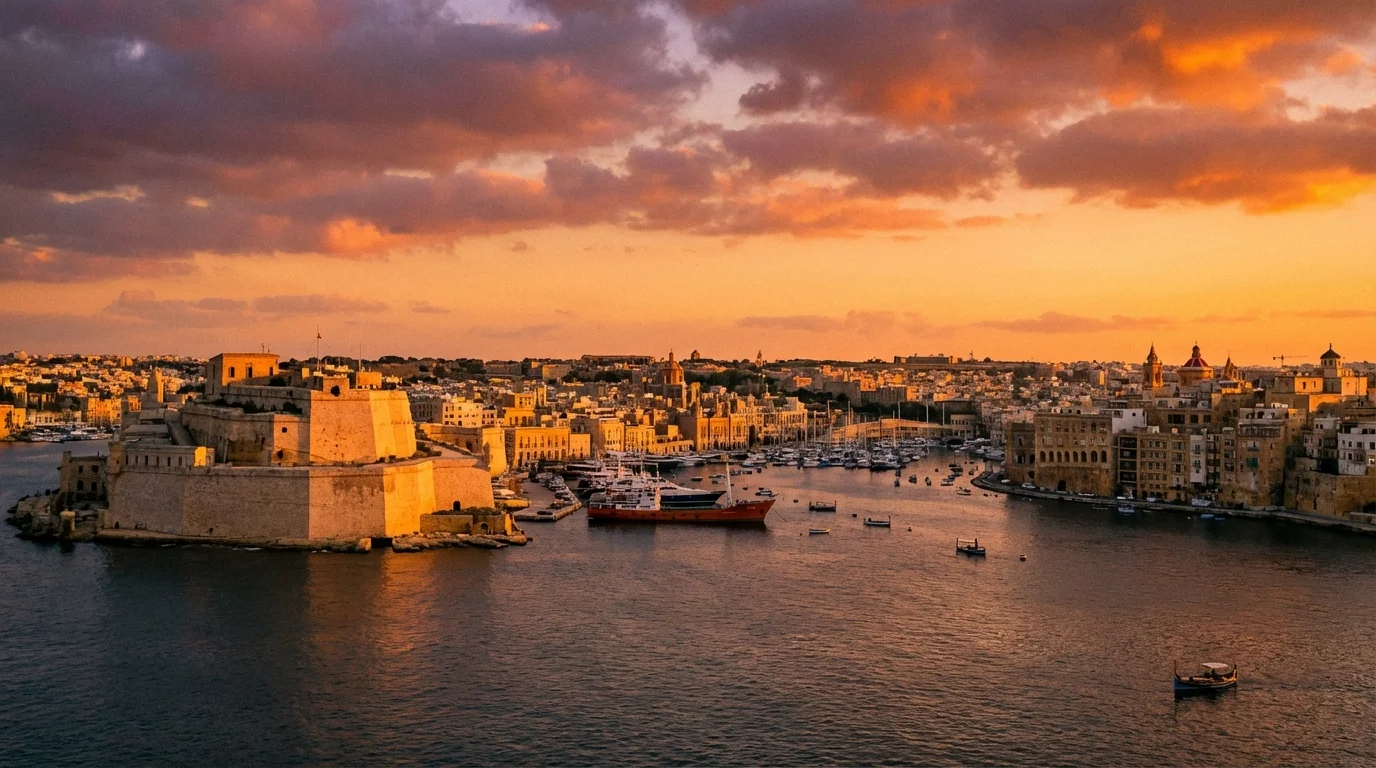
Day 1: Arrival in Valletta, the Capital the Knights Built
Today is about arriving and understanding the place you have come to.
Valletta was built by the Knights of St. John after the Great Siege of 1565, when a small force of Knights and Maltese held the island against the Ottoman Empire. When the siege ended, the Knights decided to build a city that could never be taken. They built it on the Sciberras Peninsula, surrounded by water on three sides, with fortifications that still define the skyline.
After checking into your hotel and settling in, a late afternoon walk through Valletta introduces your group to the city. The Upper Barrakka Gardens offer a view across the Grand Harbour that puts everything in context: the fortifications, the Three Cities across the water where the siege was fought, and the scale of what the Knights accomplished.
End the day with a group dinner in Valletta. The city’s restaurants are excellent, and eating together on the first evening sets the tone for the days ahead. This is a place built by people who believed they were defending something sacred. That context colors everything you will see.
Day 2: St. Paul’s Bay and the Biblical Heritage of the North
Today your group stands where the Apostle Paul stood.
In approximately 60 CE, Paul was shipwrecked on Malta during a storm described in detail in Acts 27. The ship carrying 276 people broke apart on a sandbar, and everyone reached shore safely, exactly as Paul had prophesied. The bay where this happened is still called St. Paul’s Bay.
The morning begins at St. Paul’s Bay itself. For a Christian group, this is the moment when Scripture meets geography. The water is real. The shoreline is real. Paul was here.
From the bay, your group travels to Rabat, the town adjacent to the old capital of Mdina. Here, beneath the streets, is the Grotto of St. Paul, a rock cave where Christian tradition holds that Paul lived during his three months on the island. Descending into the grotto is a quiet, powerful experience. The space is small, cool, and carved from the same golden limestone that makes up the entire island.
Nearby in Rabat is the Wignacourt Museum, which holds a lesser-known Caravaggio painting, “St. Jerome Writing,” and connects to underground passages and chambers that extend beneath the town.
The afternoon is for reflection. Your group has stood at the place of the shipwreck and descended into the cave where Paul is believed to have stayed. Let the day breathe.
Day 3: Mdina and Rabat, the Silent City, the Jewish Quarter, the Catacombs
Today covers two heritage narratives that share the same geography.
Mdina is Malta’s ancient capital, a walled medieval city that has earned the name the Silent City. Within its walls, the Giudecca, the old Jewish quarter, occupies a section of narrow streets that has not changed its layout since the 15th century. For Jewish heritage travelers, walking the Giudecca with a guide who knows its history is one of the most meaningful experiences Malta offers. There are no synagogues standing, no markers. But the community that lived here for over 1,500 years before the expulsion of 1492 left its imprint in the stone and the street plan.
Mdina also holds the Cathedral of St. Paul, built on the site traditionally identified as the house of Publius, the Roman governor of Malta. According to Acts 28, Paul healed Publius’s father of fever and dysentery. A church has stood on this site since the earliest centuries of Christianity in Malta. For Christian groups, standing in this cathedral means standing on ground where the Apostle is believed to have performed a healing miracle.
In the afternoon, your group descends into the catacombs beneath Rabat. The St. Paul’s Catacombs are the largest section, with their round stone tables where early Christians gathered for funeral meals. The Jewish section, identified by menorahs carved into the rock, lies nearby. For groups that include both Christian and Jewish members, this is a place where both traditions rest together in the same stone.
Day 4: Gozo, the Island Within the Island
Today your group takes the ferry to Gozo, Malta’s smaller sister island, and visits what may be the most ancient sacred site in the Mediterranean.
The Ggantija temples were built around 3,600 BCE. That makes them roughly 900 years older than Stonehenge and 1,000 years older than the Great Pyramid of Giza. They are among the oldest freestanding structures on earth, and they were built for religious purposes. The massive limestone walls, still standing after 5,600 years, enclose spaces where prehistoric Maltese gathered to worship.
For a faith traveler, Ggantija raises a question that predates all our traditions: what moved those builders to cut and stack these enormous stones? Whatever they believed, it was strong enough to create something that has outlasted almost everything else humans have built. Standing inside the temples, surrounded by walls that have witnessed five and a half millennia, is a humbling experience for a person of any faith.
After Ggantija, your group visits the Citadel in Victoria, Gozo’s main town. The Citadel is a fortified hilltop with a baroque cathedral and views across the entire island. Gozo is quieter and greener than Malta, and the pace of the day reflects that.
The ferry back to Malta in the late afternoon gives your group time to rest and talk about what they have seen.
Day 5: St. John’s Co-Cathedral, the War Museum, Departure
The final day belongs to the Knights of Malta and their cathedral.
St. John’s Co-Cathedral is the spiritual and artistic heart of the Knights’ legacy. From the outside, it looks austere, almost military. Inside, it is one of the most richly decorated churches in Europe. Gold, marble, painted vaults, and Caravaggio’s “Beheading of St. John the Baptist,” the only painting the artist ever signed.
But what makes St. John’s truly unforgettable for a heritage group is the floor. You walk across over 400 marble tombstones, each marking the grave of a Knight. Each stone bears a coat of arms, a name, a death date, a life given to the order. Three centuries of devotion are buried beneath your feet.
After the Co-Cathedral, the Malta at War Museum in Vittoriosa tells the story of Malta’s role in World War II, when the island endured one of the most intense bombing campaigns in history and was awarded the George Cross by King George VI. For groups interested in 20th-century heritage, this adds a powerful modern chapter to Malta’s story.
The afternoon allows time for a final walk through Valletta, last purchases, and a departure to the airport.
How Heritage Tours Customizes This for Your Group
This five-day framework is a starting point. Heritage Tours customizes Malta itineraries based on the specific character of your group.
Christian groups may want to spend more time at the St. Paul’s sites, add a devotional reading at the bay, or time the trip around Easter Week. Jewish groups may want to extend the Mdina and Rabat heritage visits, add the new Valletta synagogue, or adjust the itinerary for Shabbat observance. Groups that include both traditions can follow both threads through the island without conflict, because the sites are close together and the narratives complement each other.
Malta is small enough that five days covers everything thoroughly and large enough in spiritual significance that five days feels exactly right.
If you would like to explore what a heritage group trip to Malta looks like for your community, visit our Malta destination page or reach out to us directly. We would welcome the conversation.
Frequently Asked Questions
What heritage sites does a 5-day Malta itinerary cover? A standard five-day heritage itinerary covers Valletta (St. John’s Co-Cathedral, the Knights’ heritage), St. Paul’s Bay and the Grotto, Mdina (the Jewish quarter and the Cathedral), Rabat (the catacombs and the Wignacourt Museum), and a day trip to Gozo for the Ggantija temples and the Citadel.
Is Gozo worth including in a Malta heritage group trip? Yes. Gozo’s Ggantija temples, built around 3,600 BCE, are among the oldest religious structures in the world. The island’s Citadel and quieter character also provide a valuable contrast to Malta’s main island. Most heritage group itineraries include Gozo as a full day trip.
How do you get to Gozo from Malta with a large group? The Gozo Channel ferry runs frequently between Cirkewwa on Malta and Mgarr on Gozo, with a crossing time of about 25 minutes. Group buses drive onto the ferry. Heritage Tours coordinates the ferry crossing and local transport on Gozo as part of the itinerary.
What is the best base city for a heritage trip to Malta? Sliema or St. Julian’s on Malta’s northeast coast are the most common bases for heritage groups. Both have excellent hotels and are well-positioned for reaching Valletta, St. Paul’s Bay, Mdina, and the Gozo ferry terminal within short drives.
Can a 5-day Malta trip also include a Shabbat for a Jewish group? Yes. With advance planning, a Jewish group’s Malta itinerary can be structured to observe Shabbat. Heritage Tours works with the local Jewish community in Valletta to arrange Shabbat meals and ensure the group is based within walking distance of heritage sites for the day of rest.