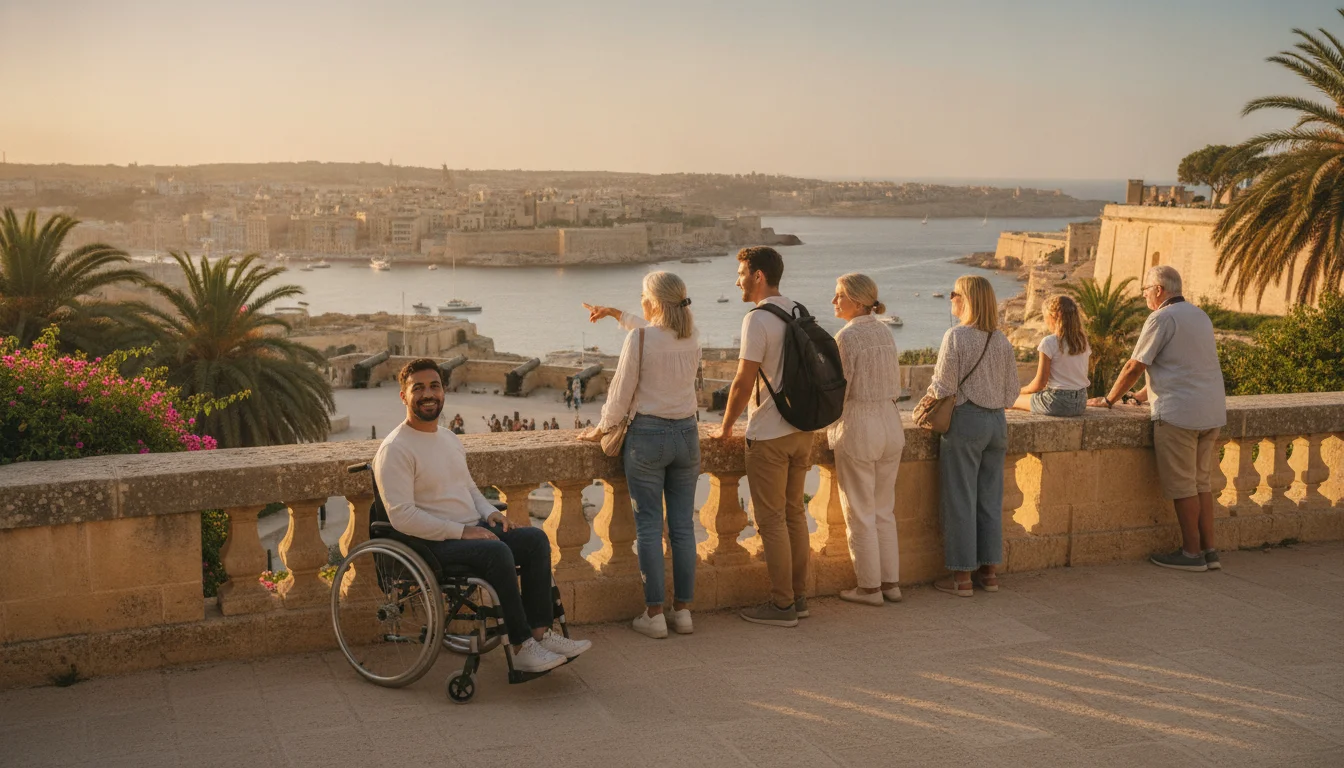
After I wrote about accessibility on Malta heritage tours, a synagogue administrator wrote back with a fair request. “This is helpful, but I don’t want a list of warnings. I want an actual itinerary I can hand to my board that shows how the days would work.” That is a reasonable thing to ask for, so here it is: a concrete, day-by-day adaptation of our standard 5-day heritage itinerary for Malta, built around a group with real mixed mobility rather than around the assumption that everyone walks the same.
This is not a different trip. It covers the same sites, in largely the same order, because the sites themselves have not changed. What changes is the pacing, the rest breaks, and how we handle the two or three stops that are genuinely difficult.
Day 1: Arrival and Valletta, at a Slower Pace
The arrival day stays the same in structure: land, settle into the hotel, and take a first walk through Valletta in the late afternoon. What changes is the route and the pace.
Instead of a longer freeform walk through the city, we plan a shorter loop that uses Republic Street, Valletta’s main pedestrianized thoroughfare, which is relatively level and easy for wheelchairs, canes, and slower walkers alike. For the Upper Barrakka Gardens, which sit above the harbor and give the group its first view of the Grand Harbour and the Three Cities, we use the public lift that connects the lower harbor area to the upper gardens rather than the stepped street route. It is a small adjustment that removes the single biggest obstacle on day one.
The group dinner stays exactly as planned in the standard itinerary. Arriving with everyone rested rather than winded from stairs matters more on day one than on any other day, since it sets the tone for how the group trusts the pacing for the rest of the trip.
Day 2: St. Paul’s Bay, Full Group Participation
This is genuinely good news, and I want to say it plainly: St. Paul’s Bay, the spiritual heart of a Christian Malta itinerary, is one of the most accessible stops on the entire trip. The bay is an open coastal area, reachable without significant walking, and the group can gather for a reading from Acts 27 and 28 without anyone being excluded by the terrain. This stop needs no adaptation at all.
The Grotto of St. Paul in Rabat is where day two requires real planning. The grotto is reached by a stairway with no elevator alternative, and there is no way around that. For a mixed-mobility group, we structure this stop in two parts. Those who can manage the stairs descend as a smaller group for the traditional visit, while those who cannot wait comfortably in the courtyard above, which sits right beside the site and has seating and shade. We schedule a second, shorter devotional moment in the courtyard itself for those who stay above, so no one experiences the stop as something that happened to everyone but them. It is not a perfect substitute for standing in the cave, and I tell groups that honestly, but it keeps the day meaningful for every traveler rather than sidelining anyone.
The Wignacourt Museum nearby, with its Caravaggio painting, has ground-level access to its main galleries, so this addition from the standard itinerary works well for the whole group.
Day 3: Mdina, Selectively
Mdina is the day that requires the most honest adjustment, and I said as much in our accessibility overview. The Silent City’s narrow stone streets are uneven throughout, with essentially no modern accessibility infrastructure inside the walls.
For a mixed-mobility group, we shorten this visit and focus it. Rather than a full walking loop of the old city, we plan a visit to Mdina Cathedral, built on the traditional site of the house of Publius from Acts 28, which has a more manageable approach from the main gate than the deeper interior streets. We keep the group closer together, moving at the pace of the slowest walker rather than splitting into a fast group and a slow group, which in my experience actually works better for group cohesion, not worse.
The Rabat catacombs in the afternoon present the same stairs-only challenge as the Grotto of St. Paul. We handle it the same way: those who can manage the descent go down as a group, and those who cannot are given time above at the Wignacourt Museum or a nearby café rather than standing and waiting with nothing to do. The goal on this day is not to force everyone through every doorway. It is to make sure nobody spends the day only watching others have the experience.
Day 4: Gozo, More Accessible Than Its Age Suggests
Gozo is a pleasant surprise on an accessibility-adapted itinerary. The Ġgantija temples, though older than the Egyptian pyramids, sit behind a modern visitor walkway with relatively level access to the main viewing areas, built specifically to protect the ancient stone from foot traffic. This makes the temples considerably more manageable than a site of that age would suggest, and I encourage every mixed-mobility group not to skip it.
The Gozo Channel ferry crossing itself is straightforward, with assistance available for boarding, and the crossing time of about twenty five minutes gives everyone a comfortable rest between activities. The Citadel in Victoria, Gozo’s main town, involves some hill and stair sections similar to Mdina, so for this stop we again plan a shorter, selective visit rather than the full hilltop circuit, with time built in simply to enjoy the views and the slower pace of the island.
Day 5: St. John’s Co-Cathedral and Departure
The final day works well for a mixed-mobility group with only minor adjustment. St. John’s Co-Cathedral has level access at its main entrance and largely flat interior circulation once inside, which means the group can experience the Caravaggio, the gilded vaults, and the marble tombstone floor together, without the split-group approach needed on other days. This is one of the most significant stops on the whole trip, and it is genuinely accessible to nearly everyone.
The Malta at War Museum in Vittoriosa, if included, has ground-level access to most of its exhibits. The final afternoon in Valletta before departure follows the same relatively level Republic Street route from day one, giving the group an easy last walk rather than a difficult one.
What Makes This Itinerary Work
The core idea is simple: keep the group together wherever the terrain allows it, and plan honestly for the two or three stops, the Grotto, the catacombs, parts of Mdina and the Citadel, where the terrain genuinely does not allow full participation for every mobility level. Build in rest breaks that are generous rather than minimal, and never leave a traveler standing with nothing to do while the rest of the group has an experience.
None of this changes the spiritual weight of the trip. St. Paul’s Bay, the most meaningful stop for many Christian groups, is also one of the easiest physically. That is a genuine gift for a mixed-mobility group, and it is worth building the week around.
If your group’s mobility needs are more specific than what a general itinerary can address, our companion post on what to do when your group has mixed mobility walks through the individual decisions in more depth.
FAQ: An Accessible Malta Itinerary
Does an accessible Malta itinerary skip any major heritage sites?
No sites are removed. The adaptation changes pacing, adds rest breaks, and splits the group for a small number of stairs-only stops, primarily the Grotto of St. Paul, the Rabat catacombs, and the Citadel on Gozo. Everything else on the standard 5-day itinerary remains in place.
Which stops need no adjustment at all for mixed-mobility groups?
St. Paul’s Bay and St. John’s Co-Cathedral are the two most accessible major stops on a Malta itinerary. Both can be experienced by the full group together, regardless of mobility level, with no splitting or waiting required.
How do you handle stops that involve stairs with no alternative, like the Grotto of St. Paul?
We split the group. Those who can manage the descent go down together, and those who cannot wait nearby, ideally with a seating area and a short alternative activity or devotional moment planned for them, rather than simply standing and waiting.
Is Gozo worth including on an accessibility-focused Malta trip?
Yes. The Ġgantija temples have a modern, relatively level visitor walkway that makes them considerably more manageable than their age suggests. The ferry crossing is also straightforward, with boarding assistance available.
How much extra time should we budget for an accessible Malta itinerary?
Plan for a similar overall structure to the standard five-day trip, but with more generous transition times between stops and built-in rest breaks, particularly after Mdina and the Gozo Citadel. We do not recommend adding extra days simply for accessibility. We recommend slowing the pace within the days you already have.
If you want this itinerary adjusted further for your group’s specific needs, I would be glad to walk through it with you stop by stop.
Contact us and let’s build a Malta trip that works for everyone you are bringing.