
A pastor called me a few years back and asked a question I respect every time I hear it. “My wife uses a cane, and two of our oldest members are in their eighties. Before I say a word to them about Malta, tell me the truth. Can they actually do this trip?” I gave him the same answer I give everyone who asks. Mostly yes, with real planning, and I am not going to pretend the stone streets of Mdina are flat when they are not.
This is a subject where I would rather lose a booking than oversell a trip and watch someone struggle on day two. So here is the honest picture of accessibility in Malta: what the terrain actually involves, what has genuinely improved, and where the limits are.
Malta’s Terrain, Honestly Described
Malta is an old stone island, and its heritage sites are old stone buildings. That combination means cobblestones, uneven paving, hills, and stairs show up more often than a first-time group leader expects.
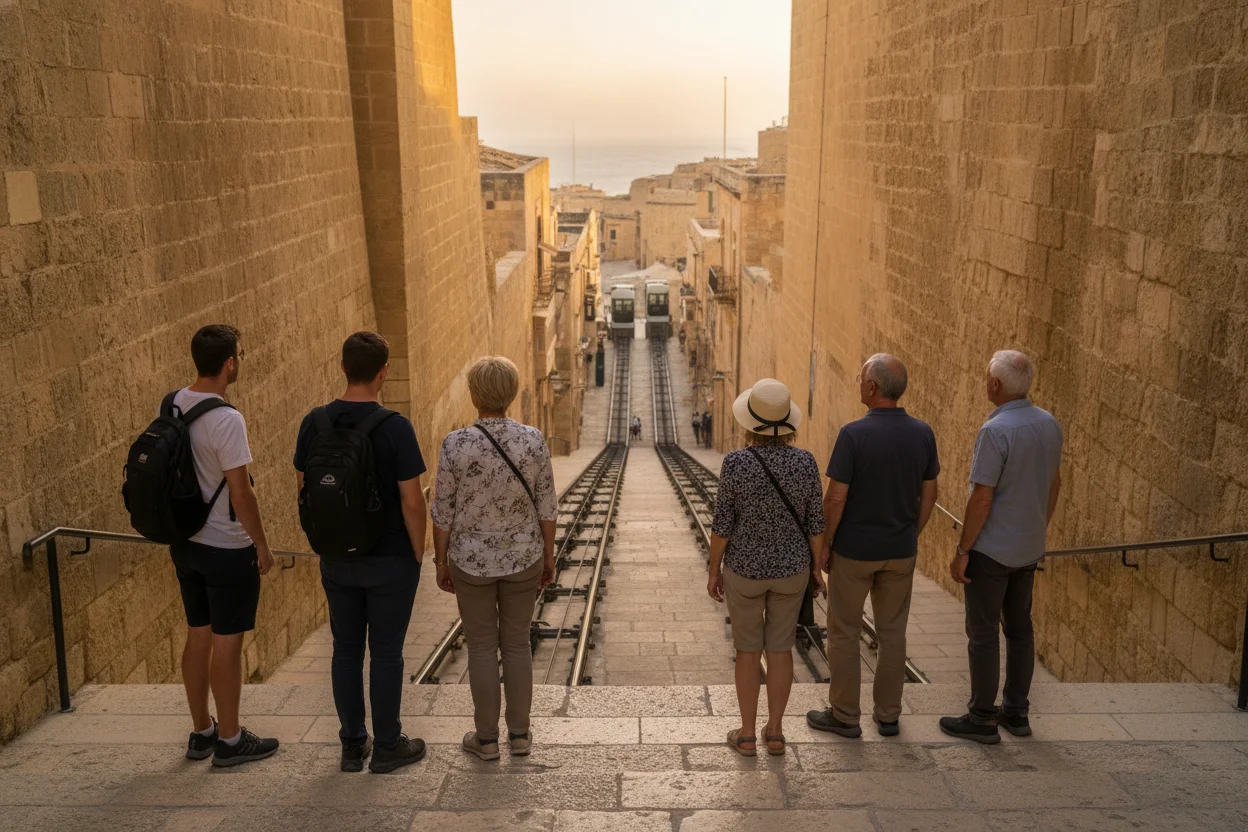
Valletta sits on a peninsula built by the Knights of St. John, and the city was designed on a grid, which helps, but it was also built on a slope, which does not. Several of the streets running from the harbor side up toward the main thoroughfare involve a genuine climb, and some are stepped rather than sloped. Mdina, the walled medieval capital, is worse in this respect: narrow stone lanes, uneven historic paving that has not been leveled for accessibility, and a general lack of curb cuts or ramps in large sections of the old town. The catacombs beneath Rabat and the Grotto of St. Paul both require descending stairs into underground spaces, with no elevator alternative at either site.
I say all of this not to discourage you but because a group leader planning around vague reassurance ends up with an afternoon where three members are stuck at the bottom of a staircase while the group is at the top. Planning around the honest picture avoids that entirely.
What Malta Has Genuinely Improved
I do not want to leave you with only the hard parts, because the picture has moved forward in real ways over recent years, and it would be unfair to travelers to leave that out.
Valletta has invested in accessibility more than most of Malta’s historic towns, partly driven by its status as a major cruise port and a UNESCO World Heritage city that receives significant EU and national attention. Several of the steeper connecting streets now have adjacent elevators or inclined lifts that bypass the stairs, connecting the lower harbor areas to the upper city. St. John’s Co-Cathedral, the centerpiece of a Valletta heritage day, has a level entrance and largely flat interior circulation once inside, even though the surrounding streets involve some grade. Major museums and several churches have added ramps at their main entrances in recent years.
Public buses and many taxis in Malta now include some wheelchair-accessible options, though availability is more limited than in a larger European capital, and coordinating this in advance through a local operator matters more here than in most destinations.
Site by Site: What to Expect
Valletta. Manageable with planning. The main thoroughfare, Republic Street, is relatively level and pedestrianized. Side streets toward the harbor involve slopes and steps, though inclined lifts now cover some of the steepest connections. St. John’s Co-Cathedral is accessible at the entrance and through most of the main nave.
Mdina. The most physically demanding heritage stop on a standard itinerary. Narrow, uneven stone streets throughout, with essentially no modern accessibility infrastructure inside the walls. A wheelchair user or a traveler with significant mobility limits will need to plan for a shorter, more selective visit here rather than a full walking tour of the old city.
St. Paul’s Bay. The bay itself is an open coastal area and is generally easy to reach and view without significant walking. This is one of the more accessible stops on a Malta itinerary, and it is also one of the most spiritually important, which works in your favor when planning around a mixed-mobility group.
The Grotto of St. Paul and the Rabat catacombs. Both require descending stairs into underground spaces with no accessible alternative. Members who cannot manage stairs will need to wait above while the rest of the group descends, or the group leader can plan a shorter visit that skips this stop for those travelers.
Gozo and the Ġgantija temples. The temple site itself has a modern visitor walkway with relatively level access to the main viewing areas, which makes it more manageable than its ancient age would suggest. The ferry crossing is straightforward for most mobility levels, with assistance available for boarding.
Planning Around the Reality Rather Than Around Hope
The single best thing a group leader can do is talk to me honestly about the specific mobility needs in the group before the itinerary is finalized, not after. Once I know who is using a cane, who has a wheelchair, and who simply walks slower and needs more rest breaks, we can build a day that keeps the group together at the sites that matter most and plans realistic alternatives at the two or three stops that are genuinely difficult.
This is also where group size and pacing come in. A congregation of thirty five moves at a different pace than a pilgrimage group of ten, and the itinerary should reflect that rather than pretending everyone moves the same. If you want to see what a full mobility-adapted itinerary looks like in practice, I have laid one out in our companion post on an accessible Malta heritage itinerary, and if your group is a genuine mix of ability levels, our guide on what to do when your group has mixed mobility goes through the practical decisions in more depth.
FAQ: Accessibility on Malta Heritage Tours
Is Malta accessible for older travelers or those with mobility limitations?
Partially, and unevenly. Valletta has made real accessibility improvements, including inclined lifts on some steep streets and level access at major sites like St. John’s Co-Cathedral. Mdina and the underground sites (the Grotto of St. Paul, the Rabat catacombs) remain genuinely difficult, with cobblestones, stairs, and no modern accessibility infrastructure. Planning around this honestly, rather than assuming it will work out, is what makes the trip succeed.
Can a wheelchair user visit Mdina?
A full walking tour of Mdina’s interior is difficult for a wheelchair user due to narrow, uneven historic streets with no ramps or curb cuts. A shorter, more selective visit, focused on the areas nearest the main gate, is more realistic. This is worth discussing directly with your tour operator so expectations are set correctly before the group arrives.
Are the catacombs and the Grotto of St. Paul accessible?
No. Both require descending stairs into underground spaces, with no elevator or ramp alternative. Travelers who cannot manage stairs will need to wait above while the rest of the group visits, or the itinerary can be adjusted to shorten or skip this stop for those travelers.
What is the most accessible major heritage site in Malta?
St. Paul’s Bay is one of the easiest stops on a standard itinerary, since it is an open coastal site reachable without significant walking. St. John’s Co-Cathedral in Valletta is also relatively accessible at the entrance and through most of the interior, though the surrounding streets involve some grade.
Should I tell my tour operator about specific mobility needs before booking?
Yes, and as early as possible. The single biggest factor in whether a mixed-mobility group has a good experience in Malta is whether the itinerary was built around the actual needs in the group from the start, rather than adjusted on the fly once problems appear on the ground.
If you are planning a Malta trip for a group with real mobility differences, tell me the specifics before we build the itinerary. It changes what I recommend, and it is far better handled on paper than in front of a staircase.
Contact us and let’s plan a trip that actually works for everyone in your group.