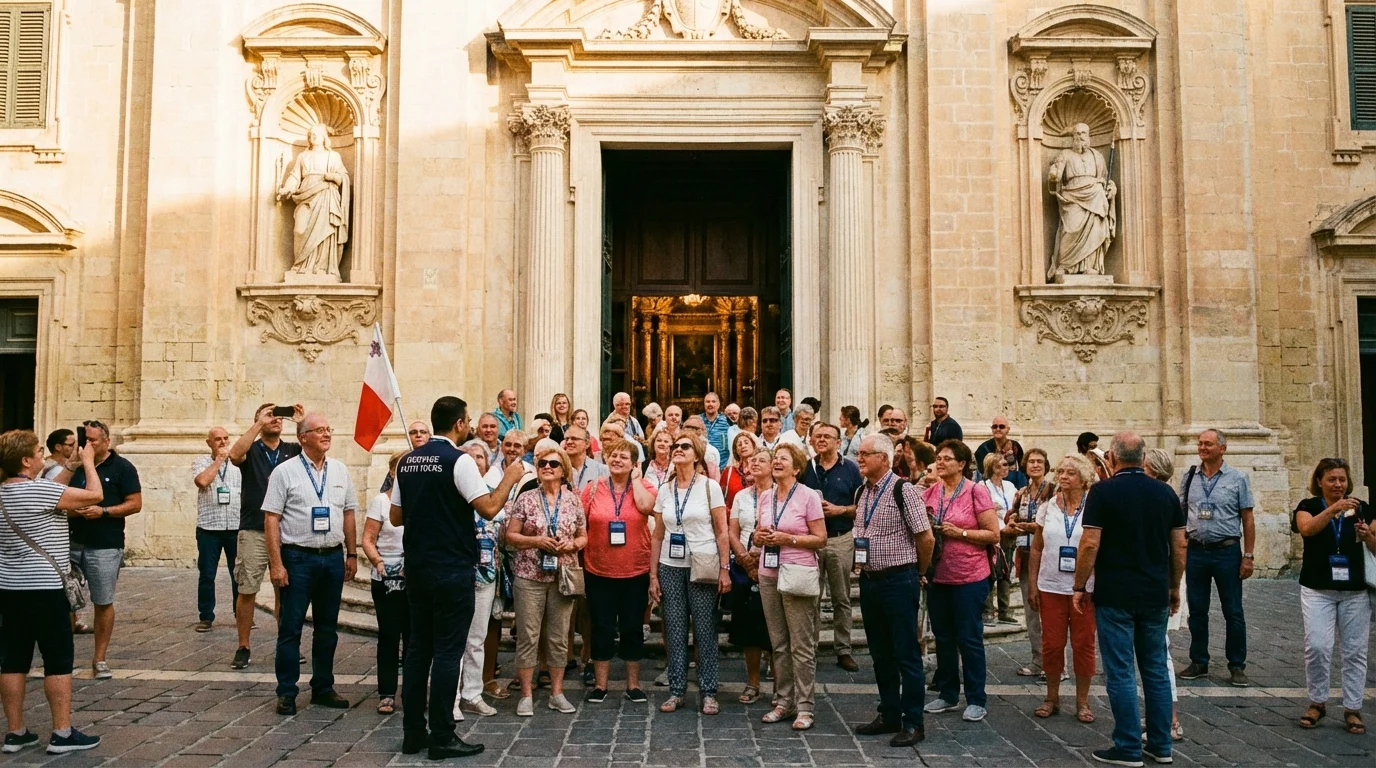
Why Malta Works Well for Faith Groups
Malta is one of the easiest heritage destinations in Europe to plan for a group. The reason is simple: the island is small. The main island is roughly 27 kilometers long and 14 kilometers wide. You can drive from any point to any other point in under 45 minutes. There are no internal flights. No train connections to coordinate. No border crossings. No need to change hotels mid-trip.
Your group arrives at Malta International Airport, checks into one hotel, and visits every major heritage site on the island from that single base. For a group leader who has organized a multi-city European tour and remembers the complexity of moving forty people between countries, Malta will feel like a gift.
The island also has something that most small Mediterranean destinations do not: profound spiritual and historical significance. This is where the Apostle Paul was shipwrecked. This is where the Knights of St. John built a fortress capital dedicated to God. This is where a Jewish community lived for 1,500 years before it was expelled in 1492. For a faith group, Malta is not a small destination. It is a concentrated one.
For Christian Groups: Building the St. Paul’s Itinerary
If you are a pastor organizing a group trip to Malta, the St. Paul’s narrative is likely why you are considering the island. Here is what you need to know.
The biblical connection is specific. Acts 27 and 28 describe Paul’s shipwreck in detail: the storm that lasted fourteen days, Paul’s vision promising the survival of all aboard, the ship breaking apart on a sandbar, and the entire company of 276 reaching shore safely. The bay where this happened is identified. It is still called St. Paul’s Bay.
A Christian heritage itinerary in Malta builds naturally around this narrative. St. Paul’s Bay in the north. The Grotto of St. Paul in Rabat, where tradition holds Paul lived during his three months on the island. Mdina Cathedral, built on the site of the house of Publius, the governor whose father Paul healed. The Church of St. Paul’s Shipwreck in Valletta, which claims to hold a relic of the Apostle. And St. John’s Co-Cathedral, the great church of the Knights, with Caravaggio’s masterwork and a floor made entirely of the Knights’ marble tombs.
This itinerary holds together as a narrative. It is not a random collection of churches. It follows the story of Paul from shore to grotto to cathedral, and then expands to the broader Christian heritage of the Knights who controlled the island for centuries.
For Jewish Groups: The Heritage Trail from Mdina to Rabat
Jewish heritage in Malta is modest in scale compared to the great Jewish centers of Europe, and I want to be straightforward about that. But the story is remarkable, and the physical traces that remain are real.
The Giudecca, the Jewish quarter of Mdina, still exists as a section of streets within the walled city. The Jewish catacombs beneath Rabat, with menorahs carved into the rock, are one of the few Jewish catacomb sites in the Mediterranean outside Rome. The story of the 1492 expulsion, parallel to Spain’s, is historically significant and almost entirely unknown.
And there is a hopeful development: a new synagogue is being established in Valletta, the first Jewish house of worship on the island since the expulsion.
A Jewish heritage itinerary in Malta typically takes two to three days within a broader Mediterranean circuit, or can be combined with the island’s general heritage sites for a full four to five day trip. For a rabbi leading a group, Malta offers the rare opportunity to tell a story that most of your community has never heard.
Practical Group Logistics on a Small Island
Malta’s size simplifies group travel in ways that larger destinations cannot match.
Hotels in the Sliema or St. Julian’s area, on the northeast coast, provide an ideal base for heritage groups. Valletta is a short drive or ferry ride away. St. Paul’s Bay is thirty minutes north. Mdina and Rabat are twenty minutes inland. The airport is fifteen minutes south.
Group buses navigate Malta’s roads easily, though the streets in Valletta and Mdina are pedestrian and your group will walk those sections on foot. Both cities are compact and manageable, though Valletta does involve some slopes and steps.
The ferry to Gozo takes about twenty-five minutes and runs frequently. A Gozo day trip for the Ggantija temples and the island’s heritage sites is a standard part of most Malta group itineraries.
Meals are straightforward. Malta has excellent restaurants with Mediterranean cuisine, and the island is accustomed to hosting group dining. English is widely spoken, often as a first language.
Faith-Specific Considerations
For Christian groups: Sunday Mass is widely available across Malta. The island has one of the highest concentrations of active Catholic churches per square kilometer in Europe. Your group will not have difficulty finding services.
For Jewish groups: Kosher food options in Malta are limited but present. The new Jewish community in Valletta can help coordinate Shabbat arrangements. Heritage Tours works with local contacts to ensure that Jewish groups have what they need for Shabbat observance, including meal arrangements and walking distance to heritage sites. Planning this in advance is important, so discuss it early with your tour operator.
Group Size and the Free Leader Policy in Malta
Heritage Tours offers a straightforward policy for group leaders: with 15 or more participants, the group leader travels free. This applies to Malta as it does to all Heritage Tours destinations.
Malta’s relatively accessible pricing compared to destinations like Israel or Western European multi-city circuits means that the free leader benefit goes further here. The cost structure of a Malta heritage trip is genuinely manageable for most congregations and community groups.
Groups of 8 to 14 work well for a more intimate pilgrimage-style experience. Groups of 15 to 40 work well for a congregational trip. Malta accommodates both sizes comfortably because the sites are close together and the infrastructure is built for group tourism.
What to Ask Your Tour Operator Before You Book
If you are a pastor or rabbi evaluating tour operators for Malta, here are the questions that matter.
Does the itinerary follow a faith narrative, or is it a general tourist circuit with a few churches added? Can the operator provide guides who know the St. Paul’s biblical connection in depth, or the Jewish heritage story with historical accuracy? Does the itinerary include Gozo? Does the operator handle the Gozo ferry crossing for the group? What happens if a site is closed on the day you planned to visit?
These questions separate operators who know Malta as a heritage destination from operators who are simply selling a Mediterranean island.
Heritage Tours has been organizing faith group travel to Malta for years. If you are considering Malta for your group, visit our Malta page or contact us to start the conversation. We would be glad to walk you through what a heritage itinerary looks like for your specific community.
Frequently Asked Questions
How many days does a heritage group trip to Malta typically take? Four to five days is the standard for a heritage group trip. This allows time for the St. Paul’s sites, Valletta and the Knights’ heritage, Mdina and Rabat, and a day trip to Gozo. Some groups combine Malta with a visit to Sicily for a longer Mediterranean heritage journey.
Can a pastor organize a group pilgrimage to St. Paul’s shipwreck site in Malta? Yes. St. Paul’s Bay, where the biblical shipwreck took place according to Acts 27 and 28, is accessible and visitable. The bay, the nearby Grotto of St. Paul in Rabat, and the associated churches in Valletta form a natural pilgrimage route that Heritage Tours organizes specifically for Christian groups.
Is there kosher food available in Malta for Jewish groups? Kosher options in Malta are limited but can be arranged with advance planning. The emerging Jewish community in Valletta can help coordinate, and Heritage Tours works with local contacts to arrange kosher meals and Shabbat accommodations for Jewish heritage groups.
What is the best way to travel around Malta with a group? A private group bus with a local driver is the standard and most practical option. Malta’s roads are manageable but can be narrow and congested, and a local driver knows the routes and parking logistics. Valletta and Mdina are pedestrian cities, so your group will walk those sections on foot.
Is Malta a good choice for a first faith group trip to Europe? Malta is an excellent first European heritage destination for faith groups. The island is English-speaking, compact, safe, and has deep spiritual significance for both Christian and Jewish travelers. The single-base logistics remove much of the complexity that makes larger European circuits challenging for first-time group leaders.