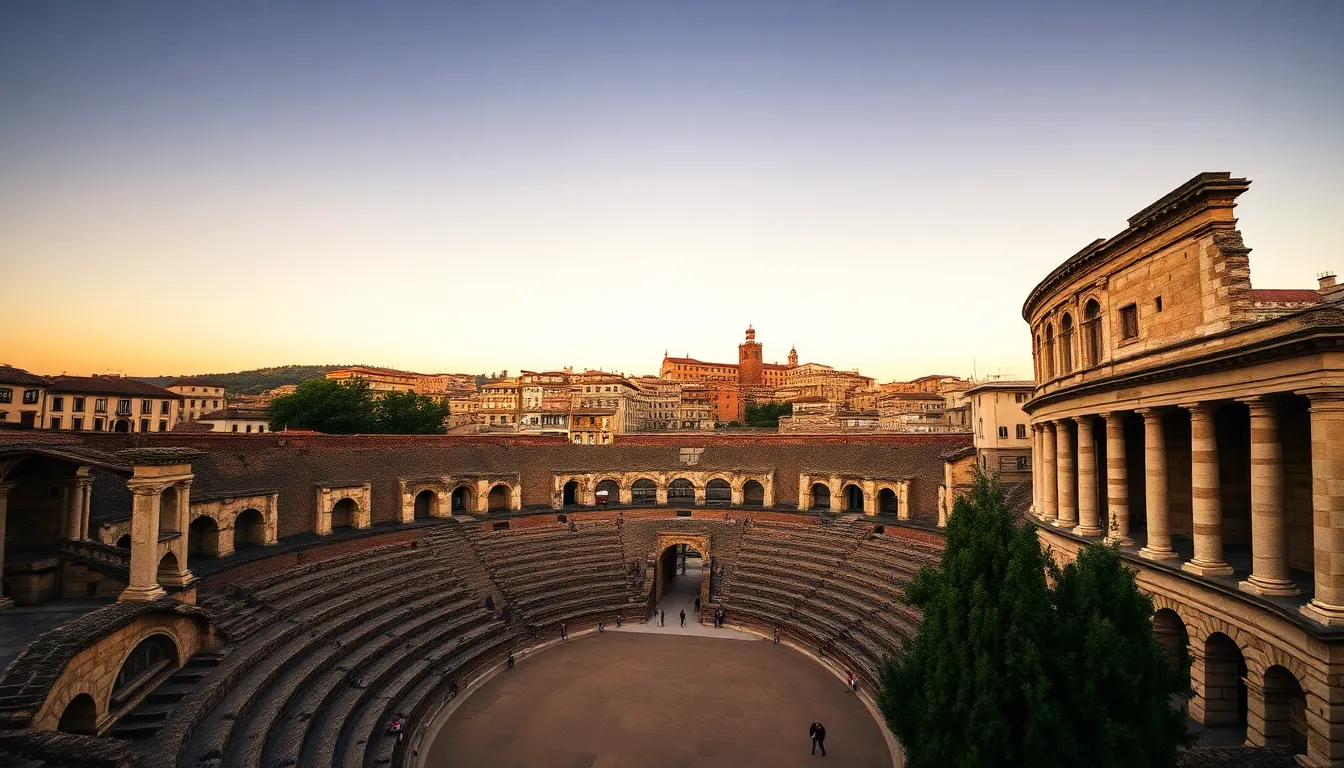
The first time I brought a group into Verona, a pastor in the back of the bus said something I’ve never forgotten. He looked at the Roman arena rising out of the modern piazza and said, “I expected a stop. This is a whole story.”
That is Verona in one line. Most groups treat it as a half-day on the way to Venice or Lake Garda. I tell every leader who asks: give it more than that. Verona holds Roman, Christian, and Jewish history layered on top of each other within a fifteen-minute walk, and it does it without the crowds of Rome or the logistics of Venice. For a faith group that wants depth without exhaustion, it is one of the easiest cities in northern Italy to lead.
Let me walk you through what your group will actually encounter, and how to orient them once you arrive.
Getting Oriented: A City Inside a River Bend
Verona sits inside a tight loop of the Adige River, which means the historic center is compact and walkable. Almost everything your group needs to see sits within the bend. That geography matters when you are leading twenty or thirty people, because it means you can move on foot for most of the day without buses, parking, or anyone getting separated.
The center of gravity is Piazza Bra, the wide square that holds the Roman arena. From there, the main pedestrian street, Via Mazzini, runs toward Piazza delle Erbe, the old Roman forum. The Jewish quarter, the Duomo, and the river crossings all branch off from this spine. If you anchor your group at Piazza Bra in the morning and work outward, the day organizes itself.
A practical note for leaders: the historic center is largely pedestrian, and tour buses drop off at designated points outside the bend. Build in a short walk from the drop-off, and confirm your guide knows the current bus regulations, because Verona enforces them.
The Roman Arena: Older Than the Colosseum
The arena is the first thing your group will see, and it deserves a real stop, not a photo and a move-on. Built in the first century, it predates the Colosseum in Rome and is one of the best-preserved Roman amphitheaters anywhere. It held thirty thousand spectators in a city that was a major Roman crossroads, and it is still in use today for opera in the summer.
For a Christian group, the arena is worth a moment of reflection. This is the kind of place where Roman entertainment and Roman violence happened in public, the world the early church grew up inside. Standing in the stands and imagining what filled that floor gives people a physical sense of the empire the first believers were navigating.
A word on timing. In summer the arena hosts the opera festival, which means staging and seating fill the interior and access changes. If you want your group inside the arena itself, check the festival calendar before you set the date, or plan a spring or autumn visit when the interior is open and quiet.
San Zeno: The Church Most Groups Miss
If you take one thing from this guide, let it be this: do not skip San Zeno. The Basilica of San Zeno Maggiore sits a little west of the center, far enough that most day-trippers never reach it, which is exactly why it is worth the walk.
San Zeno is one of the finest Romanesque churches in Italy. The bronze doors, cast across the eleventh and twelfth centuries, tell biblical stories in panels that ordinary people once read the way we read a book. Inside, the church is calm and high and unadorned in a way that lets a group actually pray and reflect. Above the altar hangs a Mantegna altarpiece that art historians travel for, but what stays with most groups is the quiet.
I always build San Zeno in as the spiritual center of a Verona day. The arena gives you Rome. San Zeno gives you the medieval faith that followed it.
The Crypt and Saint Zeno
Below the main floor is the crypt, where tradition holds the remains of Saint Zeno, the fourth-century bishop who is the city’s patron. For groups tracing the early bishops who held communities together as Rome fell apart, the crypt is a grounding stop. It is one of those spaces where the history stops being abstract.
The Old Jewish Quarter
Verona’s Jewish community is old and was, for centuries, confined. The ghetto sat just off Piazza delle Erbe, around what is today Via Mazzini and the streets near Piazza dei Signori. The Jewish community here dates back to the medieval period, and like Jewish communities across the Veneto, it lived under restrictions, expulsions, and returns over the centuries.
The historic synagogue stands on Via Portici, rebuilt in the nineteenth century after emancipation. For a Jewish group, the quarter rewards slow walking more than monument-hunting. The streets themselves are the heritage, narrow lanes where a community lived under constraint and held on. A knowledgeable local guide can point out where the ghetto gates once stood and trace the community’s path from confinement to the open city.
There is also a Holocaust memory here that should not be passed over. The Veronese Jewish community suffered deportations under the Nazi occupation, and there are memorial stones, the brass Stolpersteine, set into the pavement at the homes of those taken. For many groups, pausing at these stones is the most affecting moment of the day.
Christian and Byzantine Threads Beyond the Big Names
Verona’s Duomo, the cathedral, holds a Titian altarpiece of the Assumption and sits near the river in a quieter part of the center. Around it cluster older churches and a baptistery with a striking carved font. For groups interested in how Christian worship developed, the cluster around the Duomo shows the layers, late Roman foundations, medieval building, Renaissance art.
Verona is not a Byzantine city the way Ravenna is, but the trade routes that ran through here carried eastern influence, and you will see it in the iconography and in the way the early churches were laid out. A good guide can connect Verona to the wider story of how faith moved between Rome, Byzantium, and the medieval west along these northern Italian roads.
Leading a Group Here: What Makes It Easy
Verona is one of the friendlier cities to lead a faith group through, and it is worth saying why. The center is compact and flat. The major sites are close together. The crowds are real but nothing like Venice or Florence. And the city is well set up for groups, with restaurants near Piazza Bra used to seating twenty or thirty at once.
At Heritage Tours we usually pair Verona with Venice or with the Lake Garda area, building it as a full day rather than a rushed stop. We arrange the bus drop-off and pickup so your group moves together without anyone navigating the pedestrian zone alone, and we use local guides who know both the Jewish and Christian threads of the city, not just the romantic Romeo and Juliet story the day-trippers come for.
One thing many leaders appreciate: with fifteen or more participants, the group leader travels free. The person who carries the teaching and the responsibility should not also carry the cost. If Verona is on your route, a short conversation is the best place to start. You can see how we put northern Italy itineraries together in our Italy heritage travel guide, and look at related stops like Bologna and the Umbria heritage trail to see how they fit a longer route.
FAQ: Planning a Verona Heritage Visit
Is Verona worth more than a half-day stop for a faith group?
Yes. Most tours give it two hours and miss most of what makes it meaningful. With a full day you can do the Roman arena, San Zeno, the old Jewish quarter, and the Duomo cluster without rushing, and still leave time for reflection at each. The city is compact enough that a full day feels unhurried rather than packed.
What is the most important Christian site in Verona?
The Basilica of San Zeno Maggiore. It is one of the great Romanesque churches in Italy, with the famous bronze doors that retell biblical stories in cast panels, and the crypt of Saint Zeno, the city’s fourth-century bishop. It sits a little outside the tourist core, which is exactly why it stays quiet enough for a group to pray and reflect.
Can a Jewish group trace real heritage in Verona?
Yes. Verona had a longstanding Jewish community confined to a ghetto near Piazza delle Erbe, with a synagogue on Via Portici that still stands. The streets of the old quarter, the memorial Stolpersteine marking Holocaust deportations, and a guide who knows the community’s history make it a substantive stop, not a token one.
When is the best time to visit the Roman arena?
Spring and autumn, when the interior is open and uncluttered. In summer the arena hosts an opera festival, which fills the floor with staging and changes access. If seeing the inside of the arena matters to your group, check the festival calendar before setting your travel dates.
How does Verona fit into a larger Italy itinerary?
It pairs naturally with Venice, Lake Garda, or a northern loop that includes Bologna. It works as a full day or a strong overnight. Because the center is walkable and group-friendly, it is an easy city to slot in without adding logistical strain to a longer trip.
If Verona is somewhere on the route you are imagining for your community, I would be glad to talk it through. There is no pressure and no timeline, just a conversation about what this part of Italy could offer your group. Reach out whenever you are ready.