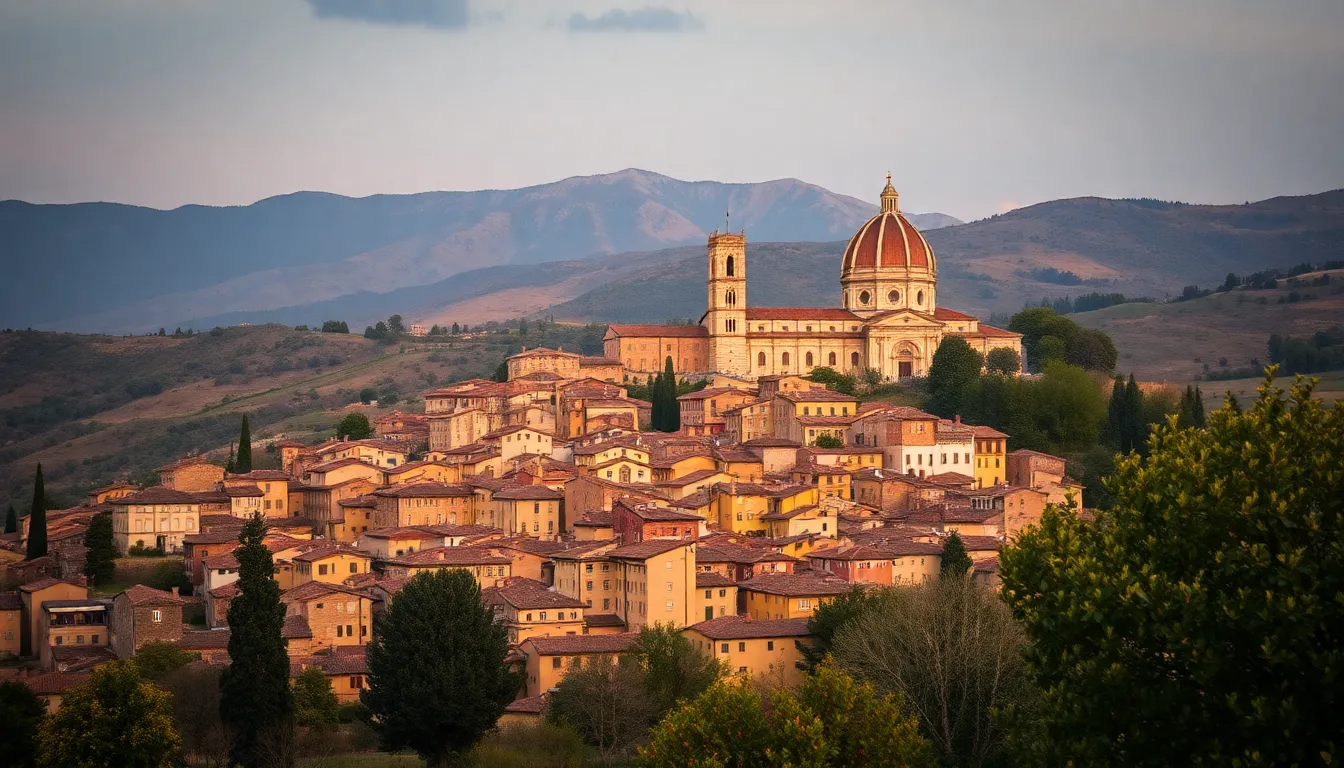
Umbria is the part of Italy I save for groups that want to slow down. Rome moves fast and loud. Umbria moves at the pace of the hill towns, green valleys, stone villages on ridgelines, churches that have held the same prayers for eight hundred years. When a pastor tells me their congregation is worn out and wants depth instead of a checklist, this is where I send them.
The heart of an Umbria itinerary is a trail of three towns: Assisi, where Saint Francis remade what it meant to follow Christ; Orvieto, with one of the great cathedrals of Italy and a Jewish history most visitors never hear; and Norcia, the birthplace of Saint Benedict, whose rule shaped Western monastic life. Together they form a heritage trail you can drive in a few days, and each one rewards a group that is willing to be still.
Let me orient you to the trail and how to lead it.
Getting Oriented: The Green Heart of Italy
Umbria sits in the center of the Italian peninsula, landlocked, between Tuscany and the Apennine mountains. It is often called the green heart of Italy, and the description holds. The landscape is hills, olive groves, and walled towns perched for defense, connected by winding roads through valleys.
For a group leader, the geography sets the rhythm. The towns are close, an hour or so apart by road, but they sit on hills, which means walking up. That is the one logistical truth to plan around: Umbrian hill towns ask your group to climb. The payoff is enormous, but for mixed-age groups you build in time, plan the steepest sections for the freshest part of the day, and let your guide manage the pace.
Most groups base in Assisi or in a central town and make day trips out to Orvieto and Norcia. A bus is essential here; public transit between hill towns is thin. We handle the routing and the drop-offs so your group is not negotiating mountain roads on its own.
Assisi: The Town Saint Francis Changed
Assisi is the spiritual anchor of any Umbria trip, and for good reason. This is where Francis, the son of a wealthy cloth merchant, gave up everything in the early thirteenth century to live in radical poverty and rebuild the church, first stone by stone and then in spirit. The movement he started reshaped Christianity, and the town he walked is still walkable today.
The Basilica of Saint Francis is the centerpiece. It is built on two levels, and the walls of both are covered in frescoes, including the cycle attributed to Giotto that tells the life of Francis in images. For seven hundred years those frescoes have taught the Gospel and the Franciscan story to people who could not read. Below the lower church lies the crypt with the tomb of Saint Francis himself, and it is one of the most quietly powerful spaces in Italy. Groups go silent there without being asked.
Beyond the Basilica
Assisi rewards more than the main basilica. The Basilica of Saint Clare holds the tomb of Clare, who followed Francis and founded the order of Poor Clares. The small chapel of San Damiano, just below the town, is where Francis heard the call to rebuild the church. And the Porziuncola, the tiny chapel now enclosed inside a vast church on the plain below, is where the Franciscan movement was born and where Francis died.
For a Christian group, I build in real reflection time across these sites. Assisi is not a place to rush. The whole point of Francis is slowing down, choosing less, paying attention. The town teaches that better when you let it.
Orvieto: The Cathedral on the Cliff
Orvieto sits on a flat-topped volcanic outcrop that rises sheer from the valley, a position that kept it safe for millennia. The town is reached by a funicular up the cliff, which your group will enjoy, and at the top waits one of the most striking cathedrals in Italy.
The Orvieto Duomo is famous for its facade, a vast front of golden mosaics and carved marble that catches the sun and stops people in their tracks. Inside, the Chapel of San Brizio holds a fresco cycle of the Last Judgment by Luca Signorelli that influenced Michelangelo. The cathedral was built in part to house a relic tied to a eucharistic miracle, and for a Christian group that history frames the whole building, a cathedral raised around a moment of belief.
The Jewish History of Orvieto
Here is what most visitors never learn. Orvieto had a Jewish community in the medieval and Renaissance periods, and like communities across the Papal States it lived under shifting tolerance and restriction. There was a Jewish quarter, and traces of that presence survive in the town’s history and street names. For a Jewish group, a guide who knows this layer turns Orvieto from a cathedral stop into a fuller story of Jewish life in central Italy under papal rule. It is a quieter heritage than Rome or Venice, but it is real, and it belongs on the trail.
Norcia: The Birthplace of Saint Benedict
Norcia sits in the mountains in the eastern corner of Umbria, and it is the birthplace of Saint Benedict, born here around the year 480. Benedict wrote the Rule that organized Western monastic life for fifteen centuries, the pattern of prayer, work, and community that shaped European Christianity and preserved learning through the dark centuries. To stand in the town where that began is to stand at a source of the whole monastic tradition.
I have to be honest with you about Norcia. In 2016 a series of earthquakes struck the town hard, and the Basilica of Saint Benedict, built over the traditional site of his birth, was severely damaged. Reconstruction has been ongoing, and the town has worked steadily to recover. When you plan, check the current state of access with your guide, because what is open evolves year to year.
What has not changed is the meaning of the place. The Benedictine community has continued, the town endures, and for a group tracing the roots of Christian monasticism, Norcia is the source. Pairing it with Assisi tells the two great stories of Italian spirituality side by side: Benedict’s stability and order, Francis’s poverty and movement.
Byzantine and Eastern Threads
Umbria is Latin Christian country, not Byzantine, but the early monasticism that Benedict shaped drew on the desert fathers of the Christian east, the hermits of Egypt and Syria whose example reached Italy in the early centuries. A good guide can connect Benedict’s Rule back to those eastern roots, which ties the Umbria trail to the wider story of how faith moved from the deserts of the east into the heart of Europe.
Leading the Trail: What to Plan For
The Umbria trail is a slower, gentler itinerary than the big cities, and that is its strength. The challenge is the hills and the driving between towns, both of which we handle. We base groups centrally, route the bus through the trail, manage the drop-offs at the foot of each hill town, and build the day around your group’s energy rather than a rigid schedule.
The towns are used to pilgrim groups, so guides, lodging, and group meals are well established. We use guides who know both the Franciscan and Benedictine stories and the quieter Jewish history of towns like Orvieto, so your group gets the full heritage rather than the postcard version.
As always, the group leader travels free with fifteen or more participants. If Umbria sounds like the pace your community needs, a conversation is the place to begin. You can see how we build longer Italy routes in our Italy heritage travel guide, and look at how it connects to Bologna and the Amalfi Coast for a fuller central and southern itinerary.
FAQ: Planning the Umbria Heritage Trail
What is the Umbria heritage trail?
It is a route through three central Italian towns that together hold the roots of Italian Christian spirituality: Assisi, the town of Saint Francis; Orvieto, with its cliff-top cathedral and a quieter Jewish history; and Norcia, the birthplace of Saint Benedict. The towns sit about an hour apart and can be covered in a few days, making a focused, reflective itinerary.
Why visit both Assisi and Norcia?
Because together they tell the two foundational stories of Western monasticism and Italian faith. Benedict, born in Norcia, wrote the Rule that organized monastic life for fifteen centuries. Francis, in Assisi, remade Christian devotion through poverty and simplicity seven hundred years later. Seeing both gives a group the full arc, from monastic order to the Franciscan movement.
Is the Orvieto Duomo worth the trip?
Yes. Its golden mosaic facade is one of the most striking in Italy, and inside, the Chapel of San Brizio holds Signorelli’s Last Judgment frescoes that influenced Michelangelo. The cathedral was raised around a eucharistic relic, which frames it for Christian groups. Orvieto also held a medieval Jewish community, a layer a good guide can open up for Jewish groups.
How physically demanding is the Umbria trail?
The towns sit on hills, so there is climbing, and that is the main thing to plan around. With a bus handling the routing, the steep sections scheduled for the freshest part of the day, and a guide managing the pace, it works well for mixed-age groups. It is gentler overall than a fast city itinerary, but the inclines are real.
Is Norcia accessible after the earthquakes?
The 2016 earthquakes damaged Norcia, including the Basilica of Saint Benedict, and reconstruction has been ongoing since. The town has recovered steadily and remains a meaningful stop, but the exact state of access changes year to year, so confirm current conditions with your guide when you plan. The significance of the place as Benedict’s birthplace is unchanged.
If a slower, deeper journey through the green heart of Italy is what your community is ready for, I would be glad to talk it through. No pressure and no timeline, just a conversation about what this trail could mean for your group. Reach out whenever you are ready.