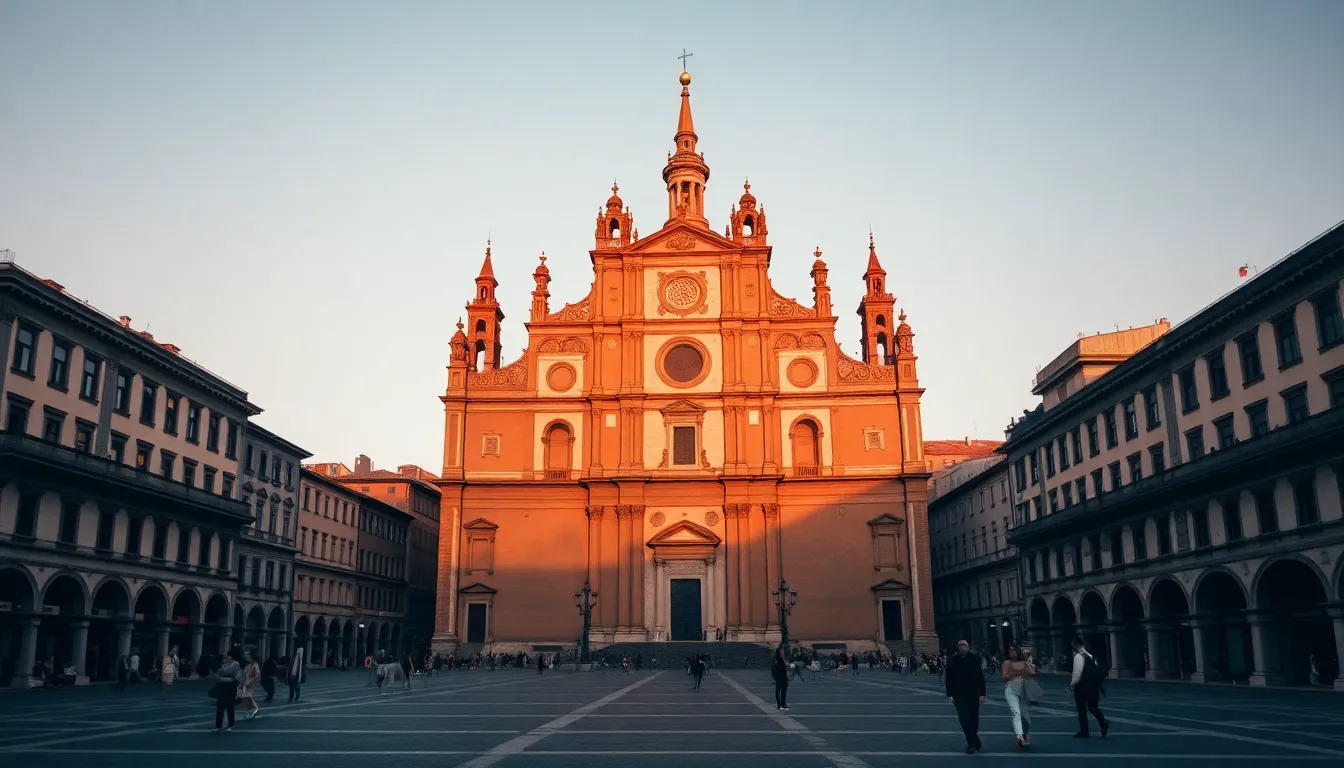
Groups come to Italy with Rome, Venice, and Florence on the list. Bologna almost never makes the first draft. I have learned to push for it anyway, because Bologna gives a faith group something the famous cities cannot: a working medieval city you can walk end to end under porticoes, with a Jewish history and a Christian history that sit close enough to teach from the same street corner.
It is also home to the oldest university in the continuous Western world, founded in 1088, which means this was a city of scholars and argument for a thousand years. That intellectual weight shows up in the churches, in the way faith and learning grew up together here. For pastors, rabbis, and educators, that is a thread worth following.
Here is how to orient your group once you arrive.
Getting Oriented: The City of Porticoes
Bologna’s defining feature is its porticoes, nearly forty kilometers of covered arcades that line the streets of the historic center. For a group leader this is a genuine gift. You can walk your people across the old city in shade or shelter from rain, and the arcades naturally keep a group moving in a single column rather than spreading across open squares.
Everything centers on Piazza Maggiore, the main square, which holds San Petronio and faces the city hall. From the square, the medieval core radiates out: the university quarter to one side, the old market streets and the former Jewish ghetto to another, the two leaning towers marking the eastern edge. Anchor at Piazza Maggiore, and the city organizes itself around you.
The historic center is compact and flat, which makes it forgiving for mixed-age groups. A practical note: Bologna is a real working city, not a tourist set piece, so the streets near the market get busy with locals. Build that into your timing and your guide’s route.
San Petronio: The Unfinished Giant
San Petronio dominates Piazza Maggiore, and the first thing to know about it is that it was never finished. The lower front is clad in marble; the upper front is bare brick. The Bolognese began building in 1390 with the ambition of raising a church larger than St. Peter’s in Rome, and the story goes that Rome would not allow it to outscale the Vatican. Whether that is literal history or civic legend, the church is still enormous, one of the largest brick churches in the world.
Inside, two things stop most groups. The first is the sheer scale, a vast Gothic interior that holds the eye. The second is the meridian line set into the floor, a long brass strip laid by the astronomer Cassini in the seventeenth century that the sun strikes through a hole in the roof. It is a reminder that this was a church inside a university city, where faith and the new science stood in the same building.
For a Christian group, San Petronio is a strong opening stop. It frames Bologna as a place where belief and learning argued under one roof for centuries.
The Seven Churches of Santo Stefano
If San Petronio is the showpiece, the Seven Churches are the heart. Santo Stefano is not one church but a connected complex of chapels and courtyards, built and rebuilt from late Roman times, designed to evoke the holy places of Jerusalem. Bolognese tradition holds that an early bishop modeled it on the sites of Christ’s passion and resurrection so that pilgrims who could not reach the Holy Land could walk a version of it here.
This is the stop I build reflection time into. Your group can move through the courtyards and chapels slowly, and a knowledgeable guide can connect each space to the Jerusalem site it echoes. For a faith group, it becomes a small pilgrimage within the day, a place to pause rather than just observe. The central church holds a basin tied to local tradition about Pontius Pilate, and the older chapels carry late Roman and early medieval foundations that ground the whole complex in the first centuries of the faith.
Why It Matters for Heritage Groups
The Seven Churches show how medieval Christians brought the Holy Land home when travel was impossible. That instinct, to make the sacred accessible, is the same instinct that brings groups to Italy today. Standing in Santo Stefano and explaining that connection tends to land with people.
The Medieval Jewish Ghetto
Bologna’s Jewish history runs deep and was, for a long stretch, painful. Jews lived and worked in the city through the medieval period, and the community produced scholars and bankers who were part of Bologna’s intellectual and commercial life. In 1556, following papal decree, the community was confined to a ghetto in the streets behind what is now the Two Towers, a tangle of narrow medieval lanes near Via Zamboni.
Walk those streets today, Via dell’Inferno, Vicolo Mandria, Via de’ Giudei, and the geography of confinement is still legible. The lanes are tight, the buildings tall, the space deliberately small. A Jewish Museum of Bologna sits nearby and tells the fuller story of the community across the region of Emilia-Romagna, including the expulsion that followed and the eventual return.
For a Jewish group, the ghetto is best walked slowly with a guide who can read the streets. The community here was eventually expelled and the city went centuries with few Jews before a community re-formed. That arc, presence, confinement, expulsion, return, is the story of so much of Italian Jewry, and Bologna tells it in a few square blocks you can cover on foot.
Byzantine and Eastern Threads
Bologna is not Ravenna, which sits just an hour east and holds the greatest Byzantine mosaics in the western world. But the two cities were tied by trade and church politics, and Bologna’s older churches carry eastern influence in their layouts and iconography. The Santo Stefano complex in particular reflects the early Christian and eastern instinct to model sacred space on Jerusalem.
For groups with time, I often pair Bologna with a day in Ravenna precisely to complete the Byzantine thread that Bologna only hints at. The two cities together tell a fuller story of how faith and art moved between Rome and Constantinople through this part of Italy.
Leading a Group Here: What Makes It Work
Bologna is an easy city to lead. The porticoes shelter your group and keep it together. The center is flat and compact. The food is excellent and the restaurants are used to seating groups, which matters more than leaders expect when you are managing thirty people at lunch. And because Bologna is not a primary tourist target, the major sites are rarely as crammed as Florence or Venice.
At Heritage Tours we often use Bologna as a base for the wider region, pairing it with Ravenna for the Byzantine mosaics and with the smaller heritage towns of Emilia-Romagna. We handle the bus drop-off and pickup, arrange guides who know both the Christian and Jewish threads of the city, and build in real reflection time at Santo Stefano and the ghetto rather than rushing the schedule.
As with all our trips, the group leader travels free with fifteen or more participants. If Bologna fits the route you are imagining, a conversation is the easiest first step. You can see how we structure these journeys in our Italy heritage travel guide, and look at nearby stops like Verona and the Turin heritage guide to see how northern Italy comes together.
FAQ: Planning a Bologna Heritage Visit
Why include Bologna when Rome and Venice are the obvious choices?
Bologna gives a faith group a complete, walkable medieval city without the heavy crowds of the famous destinations. It holds San Petronio, the Seven Churches of Santo Stefano, and a well-preserved medieval Jewish ghetto, all within a compact, portico-covered center. It also sits an hour from Ravenna’s Byzantine mosaics, which makes it a strong base for the wider region.
What are the Seven Churches of Santo Stefano?
Santo Stefano is a connected complex of chapels and courtyards built over many centuries to evoke the holy places of Jerusalem. Tradition holds it was modeled on the sites of Christ’s passion so pilgrims who could not reach the Holy Land could walk a version here. It is the most reflective stop in the city for a Christian group, a small pilgrimage within the day.
Is there real Jewish heritage to see in Bologna?
Yes. The medieval Jewish ghetto, in the lanes behind the Two Towers near Via Zamboni, is still legible in its tight streets and tall buildings. The community was confined here by papal decree in 1556 and later expelled, then re-formed centuries on. The Jewish Museum of Bologna tells the regional story, and a guide can read the geography of the ghetto on the ground.
How much time should a group spend in Bologna?
A full day covers San Petronio, Santo Stefano, the ghetto, and Piazza Maggiore without rushing. If you want to add Ravenna’s Byzantine mosaics, plan two days and use Bologna as your base. The compact, flat center makes either option comfortable for mixed-age groups.
Is Bologna easy to lead a group through?
Among the easier cities in Italy. The porticoes shelter and naturally funnel a group, the center is flat and walkable, the crowds are lighter than the headline cities, and restaurants are set up for group dining. It removes a lot of the friction that wears on a leader managing twenty or thirty people.
If Bologna belongs on the route you have in mind for your community, I would welcome the chance to talk it through. No pressure, no timeline, just a conversation about what this city could mean for your group. Reach out whenever you are ready.