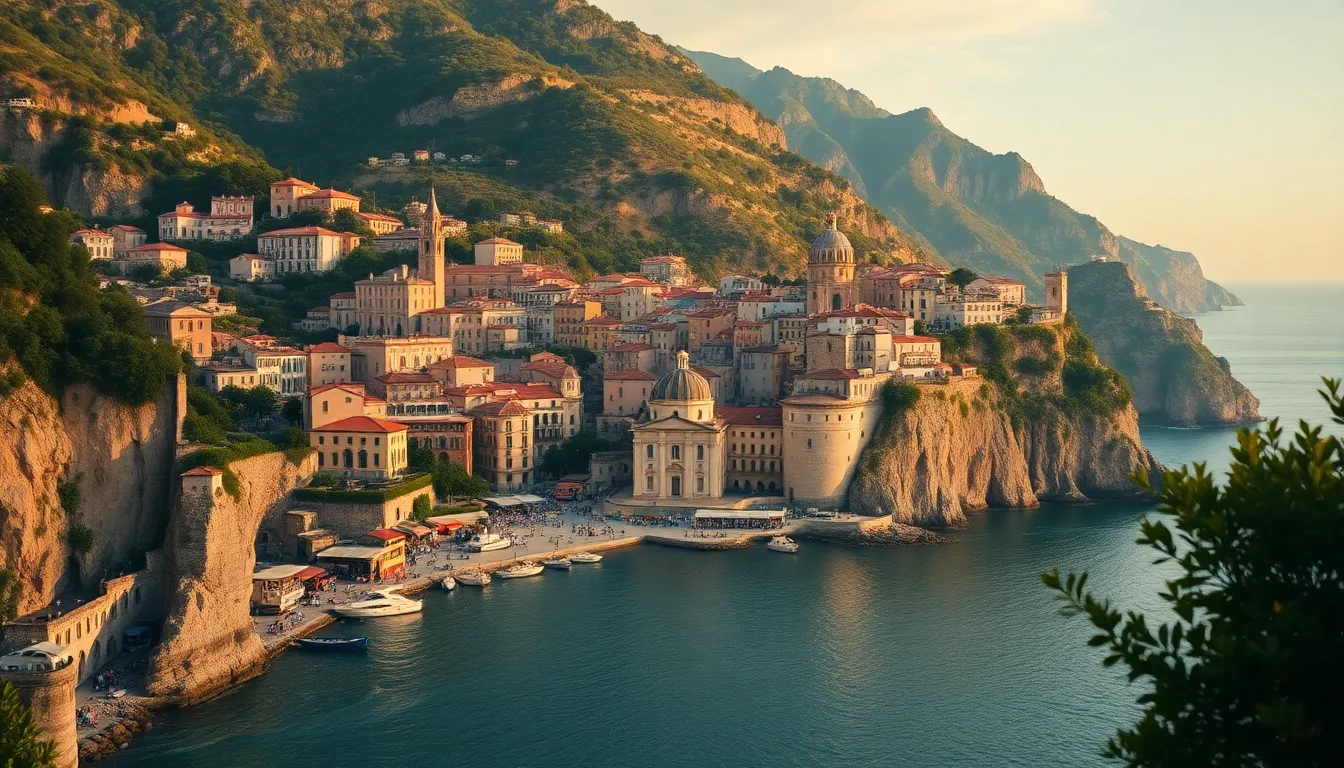
Most groups arrive on the Amalfi Coast expecting scenery, and the scenery delivers. Cliffs drop straight into a blue sea, towns cling to the rock, lemon groves terrace the hillsides. What groups do not expect is the heritage underneath the beauty. The town of Amalfi was once a great maritime republic, a rival of Venice and Genoa, and at the top of its cathedral steps rest the relics of Saint Andrew, the apostle and brother of Peter. The coast that draws tourists for its views holds, for a faith group, something much deeper.
I always tell leaders not to treat the Amalfi Coast as the rest stop on a southern Italy trip. Built right, it is a heritage destination in its own right, with a Christian story that reaches back to the apostles and a coastal history that shaped the medieval Mediterranean. Let me orient you to it.
Getting Oriented: A Coast of Cliffs and Switchbacks
The Amalfi Coast is a stretch of dramatic coastline south of Naples, where the Sorrento peninsula meets the sea. The towns, Amalfi, Ravello, Positano, and others, are strung along a single cliff-hugging road that twists through tunnels and switchbacks above the water. It is beautiful and it is slow, and that is the first thing a group leader must plan around.
The coastal road is narrow, winding, and often jammed in high season. Large buses are restricted on parts of it, and timing matters enormously. This is not a place to improvise transport. We handle the routing with appropriately sized vehicles, plan around the traffic windows, and often use boat transfers between towns, which is faster, easier on the group, and a far better experience than another hour on the switchbacks.
The town of Amalfi sits at the center of the coast and is the heritage anchor. Ravello rises on the cliff above it. Positano lies to the west. Most groups base in or near one town and make day trips along the coast.
Amalfi Cathedral and the Relics of Saint Andrew
Amalfi Cathedral is the heart of any heritage visit to the coast. You climb a long, steep flight of steps from the main piazza to reach it, and at the top stands a striking facade of striped stone and gold mosaic, with bronze doors cast in Constantinople in the eleventh century. The cathedral is dedicated to Saint Andrew, and it holds his relics.
Andrew was one of the first disciples Jesus called, the brother of Simon Peter, and tradition holds he was martyred in Greece. His relics were brought to Amalfi in 1208, carried from Constantinople during the Fourth Crusade, and they have rested in the crypt of the cathedral ever since. For a Christian group, descending into that crypt to stand before the tomb of an apostle, one of the Twelve who walked with Christ, is a genuinely significant moment. It connects the coast directly to the first generation of the faith.
The Manna of Saint Andrew
There is a tradition particular to Amalfi worth knowing about as a leader. A liquid, called the manna of Saint Andrew, is said to form on the tomb and is gathered on certain feast days, especially around the feast of Saint Andrew in late November. Whatever a group makes of the tradition, it is part of the living devotion of the place, and a guide can explain it without overstating it. For groups timing a visit, the feast days bring particular ceremony to the cathedral.
The Cloister of Paradise
Beside the cathedral is the Chiostro del Paradiso, the Cloister of Paradise, a thirteenth-century courtyard built as a burial ground for the town’s nobles. Its interlaced white arches show a clear Arab-Norman influence, a reminder of how this coast sat at the crossroads of Mediterranean cultures. It is a quiet, shaded space, good for a group to gather and reflect away from the heat and the crowds on the steps.
The Maritime Republic: Why Amalfi Mattered
To understand the cathedral, a group needs to understand the town. Amalfi was one of the four great maritime republics of medieval Italy, alongside Venice, Genoa, and Pisa. At its height in the tenth and eleventh centuries, Amalfi’s ships traded across the Mediterranean, its merchants reached Constantinople and the Holy Land, and its maritime laws governed commerce across the region. The bronze doors of the cathedral, cast in Constantinople, and the eastern influence in its art are direct evidence of those trade routes.
This matters for a faith group because it explains how an apostle’s relics came to rest here. Amalfi was connected, by ship and by trade, to the Christian east and to the Holy Land. The coast was not a remote backwater; it was a hub of the medieval Christian Mediterranean. Telling that story turns the cathedral from a beautiful building into a node in the wider history of the faith.
Byzantine and Eastern Threads
The Amalfi Coast carries strong eastern threads, more than most of Italy outside Ravenna. The bronze doors from Constantinople, the mosaic facade, the Arab-Norman cloister, all of it reflects a coast that faced east as much as west. Amalfi merchants maintained a presence in Constantinople and in Jerusalem, where Amalfitan traders helped found the hospital that gave rise to the Knights Hospitaller. For a group interested in how the Christian east and west connected, the coast is a vivid case study.
Up the cliff in Ravello, the cathedral and the Moorish-influenced villas continue the eastern theme. Ravello rewards a group that wants a quieter, higher stop with extraordinary views and its own Christian heritage, including a cathedral with a relic tradition and a beautiful bronze pulpit.
A Note on Jewish Heritage
I want to be straight with leaders here. The Amalfi Coast is not a primary Jewish heritage destination the way Rome, Venice, or Turin are. Jewish merchants were part of the medieval Mediterranean trade that ran through Amalfi, and the broader region of Campania had Jewish communities in antiquity and the medieval period. But the coast itself does not hold standing synagogues or a preserved Jewish quarter for a group to walk. For a Jewish heritage focus, I pair the coast’s scenery and Christian history with the Jewish heritage of Naples and the wider region, where the story is more visible. A good guide can frame the coast’s place in the Mediterranean Jewish trade world without overstating what survives on the ground.
Leading a Group Here: What to Plan For
The Amalfi Coast is one of the more logistically demanding places to lead a group, and it is worth being honest about that. The road is the challenge. Traffic, narrow switchbacks, bus restrictions, and the long climb of cathedral steps all need planning. The reward is enormous, but it does not happen by accident.
At Heritage Tours we manage the transport carefully, using right-sized vehicles, boat transfers between towns where they help, and timing that avoids the worst of the traffic. We build in the steps and the heat when we plan the cathedral visit, scheduling it for the cooler part of the day and giving older members time. We arrange the cathedral and crypt visit and use guides who can tell both the apostolic story of Saint Andrew and the maritime history that brought him here.
As always, the group leader travels free with fifteen or more participants. If the Amalfi Coast belongs on the southern Italy route you are imagining, a conversation is the place to begin. You can see how we structure these journeys in our Italy heritage travel guide, and look at how the coast connects to the Umbria heritage trail and the Turin heritage guide for a fuller picture of Italy north to south.
FAQ: Planning an Amalfi Coast Heritage Visit
Are the relics of Saint Andrew really in Amalfi?
Yes. The relics of the apostle Andrew, brother of Simon Peter, rest in the crypt of Amalfi Cathedral. They were brought from Constantinople in 1208 during the Fourth Crusade and have been venerated there ever since. For a Christian group, standing before the tomb of one of the Twelve is one of the most significant moments on the coast.
What is the manna of Saint Andrew?
It is a liquid said to form on the apostle’s tomb, gathered on certain feast days, especially around the feast of Saint Andrew in late November. It is part of the living devotion of the cathedral. A guide can explain the tradition for a group without overstating it, and the feast days bring particular ceremony to the church.
Is the Amalfi Coast just scenery, or is it a real heritage stop?
It is a real heritage destination. Beyond the famous views, Amalfi was one of the four great medieval maritime republics, a hub of Mediterranean trade with the Christian east. That history explains how an apostle’s relics, bronze doors from Constantinople, and Arab-Norman architecture all came to rest on this coast. The scenery is the surface; the heritage runs deep.
Is the Amalfi Coast suitable for a Jewish heritage group?
It is not a primary Jewish heritage destination. There are no standing synagogues or preserved Jewish quarter to walk on the coast itself, though Jewish merchants were part of the medieval trade that ran through Amalfi. For a Jewish focus, the coast pairs best with the Jewish heritage of Naples and the wider region, where more survives. A guide can frame the coast’s place in the Mediterranean Jewish trade world honestly.
What is the hardest part of leading a group on the Amalfi Coast?
The transport and the terrain. The coastal road is narrow, winding, restricted for large buses, and crowded in season, and Amalfi Cathedral sits at the top of a long, steep flight of steps. With right-sized vehicles, boat transfers between towns, careful timing, and the cathedral visit scheduled for the cooler part of the day, it works well, but it needs real planning rather than improvisation.
If the Amalfi Coast and its apostolic heritage fit the journey you have in mind for your community, I would be glad to talk it through. No pressure and no timeline, just a conversation about what this stretch of Italy could mean for your group. Reach out whenever you are ready.