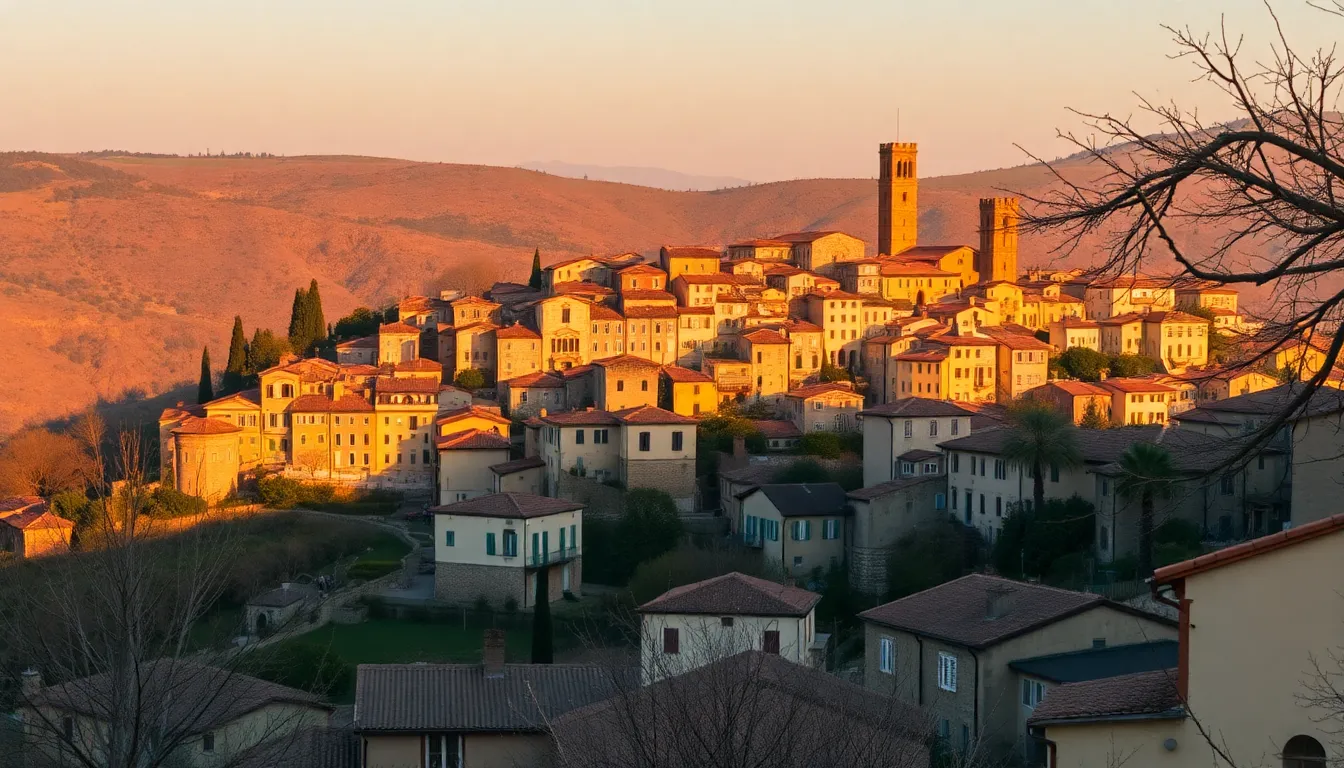
When people think of Jewish Italy, they think of Rome and Venice. They rarely think of Tuscany. But over the years I have come to believe Tuscany holds one of the most rewarding Jewish heritage routes in the whole country, precisely because it is not the obvious one. It is a trail of synagogues and old quarters scattered across hill towns and port cities, each with its own character, that together tell the story of how Jews lived, traded, and survived in this corner of Italy for centuries.
What makes Tuscany work as a trail rather than a single stop is the variety. You have a tiny hilltop town that called itself “Little Jerusalem,” a grand synagogue in a famous medieval city, a port that became a haven when Jews were unwelcome almost everywhere else, and the Florence of the Medici and one of Europe’s most beautiful synagogues. Strung together, they make a route that gives a group both the high points and the quiet, human texture of Italian Jewish life.
Let me walk you through the trail the way I would build it for a group, and how to plan the connections.
Pitigliano: La Piccola Gerusalemme
I always start groups here, in the most surprising place. Pitigliano is a small town in southern Tuscany, dramatically set on a ridge of volcanic tufa rock, and for centuries it was known as “La Piccola Gerusalemme,” Little Jerusalem.
From the 16th century, Jews settled here under the relatively tolerant rule of the local counts and later the Medici. The community grew to become a real presence in the town’s life, and Jews and Christians lived in unusual closeness. At its heart stood a synagogue, built into the rock, alongside a cluster of communal spaces carved directly into the tufa: a kosher butcher, a ritual bath, a bakery for unleavened bread, a wine cellar, and a dyeing workshop. Walking your group through these cave-like rooms, cool and quiet inside the rock, is one of the most intimate experiences on the whole trail.
The community here dwindled over the 20th century and was devastated by the Holocaust, and only a handful of Jewish residents remained afterward. But the synagogue was restored, and the site is now lovingly maintained as a museum. There is a poignant local memory worth telling your group: during the war, Christian neighbors in Pitigliano sheltered Jewish families, a small story of decency that the town has not forgotten. Pitigliano sets the emotional tone for everything that follows.
Siena: A Synagogue in the Heart of the Medieval City
From the hill country, the trail moves to Siena, one of the great medieval cities of Tuscany. Most groups come to Siena for the Piazza del Campo and the cathedral. Fewer know that tucked into the streets near the Campo is a beautiful neoclassical synagogue, hidden from the street as ghetto-era synagogues had to be.
Jews lived in Siena from the medieval period, and a ghetto was established here in the 16th century under Medici rule. The current synagogue, built in the late 18th century behind a plain exterior, opens into an elegant, richly decorated interior that surprises everyone who steps inside. It is still in use. Visiting it places a group right in the middle of a living Italian city, a reminder that Jewish heritage here is not only ruins and museums but ongoing community. The narrow lanes of the old ghetto around it repay a slow walk.
Livorno: The Port of Refuge
Livorno is the turning point of the trail, and the story that surprises groups most.
In the late 16th century, the Medici grand dukes did something almost unheard of in that era. Seeking to build Livorno into a great trading port, they issued laws, the Livornine, that invited Jews and other persecuted peoples to settle freely, with rights and protections offered nowhere else in Italy. Crucially, Livorno never had a ghetto. Jews fleeing the Inquisition in Spain and Portugal came here in large numbers, and a wealthy, cosmopolitan, confident Jewish community grew, deeply woven into the city’s trade and culture. For a time it was one of the most important Jewish communities in the Mediterranean.
Livorno’s magnificent old synagogue was destroyed in the Second World War, and a striking modern synagogue stands in its place today. But the community’s legacy survives in its history, its old cemetery, and the small Marini oratory that preserves furnishings from the lost grand synagogue. I tell groups that Livorno is the counter-story to the ghetto. It shows what Jewish life in Italy could be when a ruler chose welcome over walls, and it shaped a community whose influence reached across the Jewish world.
Florence: Grandeur and the Great Synagogue
The trail finishes in Florence, the cradle of the Renaissance, and it ends on a high note. Jews lived in Florence under the Medici, who at times protected them and at times, under papal pressure, confined them to a ghetto established in the 16th century near the present Piazza della Repubblica.
The crown of Jewish Florence is the Great Synagogue, the Tempio Maggiore, completed in 1882. Built after emancipation, when the old ghetto was demolished and the community could finally build openly and proudly, it is one of the most beautiful synagogues in Europe: a soaring Moorish-Byzantine structure with a green copper dome that rises above the city’s rooftops, its interior covered in intricate polychrome decoration. After centuries of synagogues forced to hide behind plain walls, Florence’s stands tall and visible by design. Bringing a group here after Pitigliano’s hidden rock-cut rooms makes the arc of the whole trail land: from concealment and survival to open, confident presence. The adjoining museum tells the community’s story, including its suffering under Fascism and the Holocaust.
Building the Trail: Practical Orientation
Tuscany’s Jewish sites are spread across the region, so the trail is really a driving route, and the connections need planning.
A few things I tell every group leader:
- Think geography. Pitigliano sits in the far south, Florence and Siena in the center, Livorno on the western coast. Plan a logical loop rather than crisscrossing. A common shape runs Florence and Siena in the center, out to Pitigliano in the south, and over to Livorno on the coast.
- A coach is essential. These sites do not connect well by train. A private coach with a driver who knows the region is what makes the trail flow.
- Call ahead for every synagogue. The synagogues at Siena, Livorno, and Florence, and the museum site at Pitigliano, welcome groups but operate on set hours and often require advance booking, especially around Shabbat and Jewish holidays.
- Allow time, not just stops. Four to six days lets the trail breathe alongside Tuscany’s landscape and towns. Rushing it turns a moving route into a checklist.
- Let the contrast teach. The power of this trail is the comparison between the towns. Give your group the through-line out loud, from hidden hilltop rooms to the open grandeur of Florence.
This trail connects naturally to the wider Jewish heritage of Italy. Many of my groups extend it northward toward Venice, Ferrara, and Padua, or southward to the very different story of the vanished Jewish world of Sicily. Tuscany also pairs easily with the broader Christian and Byzantine heritage of central and northern Italy.
FAQ: Planning the Tuscany Jewish Heritage Trail
What towns make up the Tuscany Jewish heritage trail?
The core route runs through Pitigliano, the hilltop “Little Jerusalem” with rock-cut Jewish spaces; Siena, with its hidden neoclassical synagogue; Livorno, the port that welcomed Jews without a ghetto; and Florence, home to the magnificent Great Synagogue. Together they show the full range of Jewish life in the region.
How many days does the trail need?
Four to six days is comfortable for the full route, given the driving distances across the region. You can shorten it to a focused two- or three-day version centered on Florence, Siena, and Pitigliano if time is tight, but Livorno’s unique story is worth including when you can.
Why is Livorno special among Italian Jewish communities?
Livorno never had a ghetto. In the late 16th century the Medici invited Jews to settle freely with full rights, and a wealthy, cosmopolitan community grew that became one of the most important in the Mediterranean. It is the counter-story to the walled ghettos found elsewhere in Italy.
Can groups visit the synagogues on the trail?
Yes. The synagogues in Siena, Livorno, and Florence are active and welcome group visits, and Pitigliano’s restored synagogue and rock-cut quarter operate as a museum. All require advance arrangement, particularly around Shabbat and Jewish holidays, so book group visits ahead.
Is the trail suitable for a mixed-age group?
Largely yes, with planning. The synagogues themselves are accessible, though Pitigliano is a steep hill town with cobbled lanes and some climbing. A good coach, an unhurried pace, and spring or autumn timing keep the trail comfortable for older travelers.
If the Jewish heritage of Tuscany speaks to your community, I would be glad to talk it through. Begin with our full Italy heritage travel guide, see our Italy destination page, or read how our group heritage tours are built for faith communities. When the time feels right, reach out and we will plan the trail together.