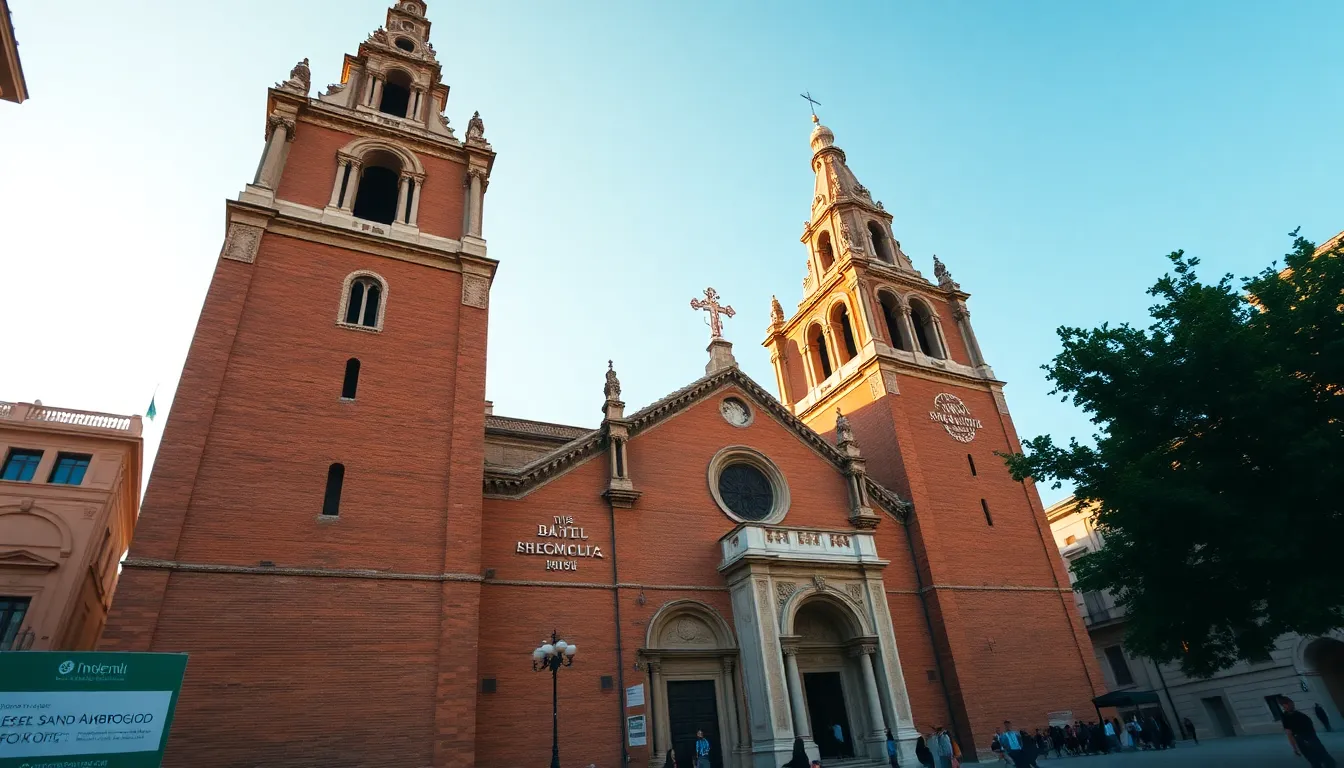
Milan surprises faith groups. Most people arrive thinking of fashion and finance, of the Last Supper and the Duomo, and they leave realizing they have been standing in one of the most important cities in the entire history of the early church. I have watched that realization land on a group more than once, usually inside the Basilica of Sant’Ambrogio, when a rabbi or a pastor reads the inscription and understands whose bones are lying a few feet away.
For a stretch of the fourth century, Milan, not Rome, was the working capital of the Western Roman Empire, and the stage on which Christianity moved from a persecuted minority to the faith of emperors. Two men anchor that story here: Constantine, who issued an edict in this city that changed everything, and Ambrose, the bishop who showed the church how to stand up to imperial power. If your group wants to understand the hinge moment when the Roman world turned Christian, Milan is where you go.
The Edict of Milan: The Turning Point
In the year 313, the emperors Constantine and Licinius met in Milan and issued the agreement history remembers as the Edict of Milan. In a single stroke, it granted Christians the legal right to practice their faith openly across the empire and ordered the return of property that had been confiscated during the persecutions.
It is hard to overstate what this meant. For nearly three centuries, to be a Christian had carried the risk of arrest, torture, and death. The catacombs of Rome exist precisely because believers had to bury their dead and worship in secret. Then, in Milan, the persecution legally ended. Christianity was no longer an outlawed sect. Within a few generations it would become the official faith of the empire.
Standing in Milan and telling a group that this is the city where that decree was issued reframes everything they have seen elsewhere. The catacombs, the martyrs, the hidden churches, all of that fear and risk gave way here, in this place, to legal freedom. For groups who have visited or will visit the Roman catacombs, Milan completes the arc: from persecution underground to public faith above ground.
Saint Ambrose: The Bishop Who Stood Up to Emperors
Ambrose became bishop of Milan in 374, and his story is one of the more remarkable in the early church. He was not even baptized when the people of Milan acclaimed him bishop. He was the Roman governor of the region, a trained administrator, sent to keep order at a contested episcopal election, and the crowd unexpectedly demanded that he himself become bishop. He was baptized, ordained, and consecrated within a week. From reluctant governor to bishop in days.
What he did with that office is why we remember him. Ambrose insisted that the church was not subordinate to the emperor in matters of faith and conscience. When the emperor Theodosius ordered a massacre of civilians in Thessalonica, Ambrose refused him communion until he did public penance, and the emperor submitted. A bishop made an emperor kneel. That precedent, that there is a moral authority above even the throne, echoed through the entire history of church and state in the West.
Ambrose was also a teacher, a hymn-writer, and one of the four great Latin Doctors of the Church. He shaped how the Western church sang, preached, and thought. And he played a decisive role in one of the most famous conversions in Christian history.
Augustine’s Baptism in Milan
Augustine of Hippo, the future theologian whose writings would shape Western Christianity more than almost anyone after Paul, came to Milan as a restless, skeptical professor of rhetoric. He went to hear Ambrose preach, initially out of professional curiosity about the bishop’s eloquence. What he heard reached deeper than rhetoric.
The famous moment of Augustine’s conversion, hearing a child’s voice chanting “take up and read,” opening Paul’s letters, and feeling his resistance break, happened in Milan. And it was Ambrose who baptized him, traditionally at Easter in the year 387. Augustine tells the whole story in his Confessions. For a faith group, knowing that the conversion described in one of the most influential books ever written happened in this city, under this bishop, gives Milan a personal, human weight that the history books alone cannot.
The Basilica of Sant’Ambrogio
The place to encounter all of this is the Basilica of Sant’Ambrogio, one of the oldest churches in Milan, founded by Ambrose himself in 379. The current Romanesque building, with its severe brick facade and twin towers, is a masterpiece of medieval architecture, but its foundations and its meaning reach back to Ambrose’s own lifetime.
Inside, beneath the high altar, lie the remains of Ambrose himself, displayed alongside two early martyrs, Gervasius and Protasius, whose relics Ambrose discovered and enshrined. Seeing the bishop’s body, in his vestments, in the church he founded, is the moment the visit becomes real for most groups. A few feet of glass separate you from a man who baptized Augustine and faced down emperors.
The basilica also holds a remarkable golden altar from the ninth century, early mosaics, and a quiet, weighty atmosphere that the crowded Duomo across town cannot match. For faith travelers, Sant’Ambrogio is the spiritual center of Milan in a way the cathedral is not. It connects directly to the wider story told in our guide to Italy’s spiritual sites.
Planning Milan for a Faith Group
Milan is easy to reach, with a major international airport, fast rail links to the rest of Italy, and excellent infrastructure, which makes it a practical opening or closing point for an Italy heritage tour. The Basilica of Sant’Ambrogio sits a short distance from the city center and is straightforward to visit. As with any active church in Italy, modest dress is expected.
I usually suggest pairing Sant’Ambrogio with the Duomo and, for groups who plan ahead, Leonardo’s Last Supper, which requires timed tickets booked well in advance. But I tell group leaders not to let the famous sites crowd out the one that actually matters most for the faith story. Give Sant’Ambrogio real time. Stand at Ambrose’s tomb. Read the Augustine connection aloud. That is the heart of Christian Milan.
For congregations building Milan into a wider route, it links naturally north to Ravenna’s Byzantine mosaics and south toward Rome, and the full picture lives on our Italy destination page. One practical note worth raising with your community: with Heritage Tours, the group leader travels free when fifteen or more participants join, which makes building a thoughtful itinerary much easier to propose.
FAQ: Saint Ambrose and Early Christian Milan
What was the Edict of Milan and why does it matter?
The Edict of Milan was an agreement issued in 313 by the emperors Constantine and Licinius that legalized Christianity across the Roman Empire and ordered confiscated church property returned. After nearly three centuries of persecution, it gave Christians the legal right to worship openly. It marks the turning point from a persecuted faith to one that would soon become the empire’s official religion.
Who was Saint Ambrose?
Ambrose was the bishop of Milan from 374, famous for insisting that the church’s moral authority stood above even the emperor’s power. When Theodosius ordered a massacre, Ambrose required him to do public penance before receiving communion. Ambrose was also a hymn-writer, a Doctor of the Church, and the bishop who baptized Augustine. He founded the Basilica of Sant’Ambrogio, where he is buried.
Where was Augustine baptized?
Augustine of Hippo was baptized in Milan, traditionally at Easter in the year 387, by Saint Ambrose. Augustine had come to the city as a professor of rhetoric and went to hear Ambrose preach, an encounter that led to the conversion he describes in his Confessions. Milan is therefore the setting for one of the most influential conversions in Christian history.
What can a group see at the Basilica of Sant’Ambrogio?
The basilica, founded by Ambrose in 379, holds his remains beneath the high altar, displayed alongside the early martyrs Gervasius and Protasius. Visitors can also see a famous ninth-century golden altar, early mosaics, and the striking Romanesque architecture. For faith groups it is the spiritual heart of Milan, more so than the more famous Duomo.
Is Milan a good starting point for an Italy heritage tour?
Yes. Milan has a major international airport, fast rail connections, and strong infrastructure, which makes it a practical opening or closing point for a tour. From Milan, groups can travel naturally to Ravenna in the northeast or south toward Rome, weaving early Christian Milan into a fuller heritage route.
If early Christian Milan belongs in your community’s journey, I would be glad to help you place it well. Contact us and we will start shaping the route.