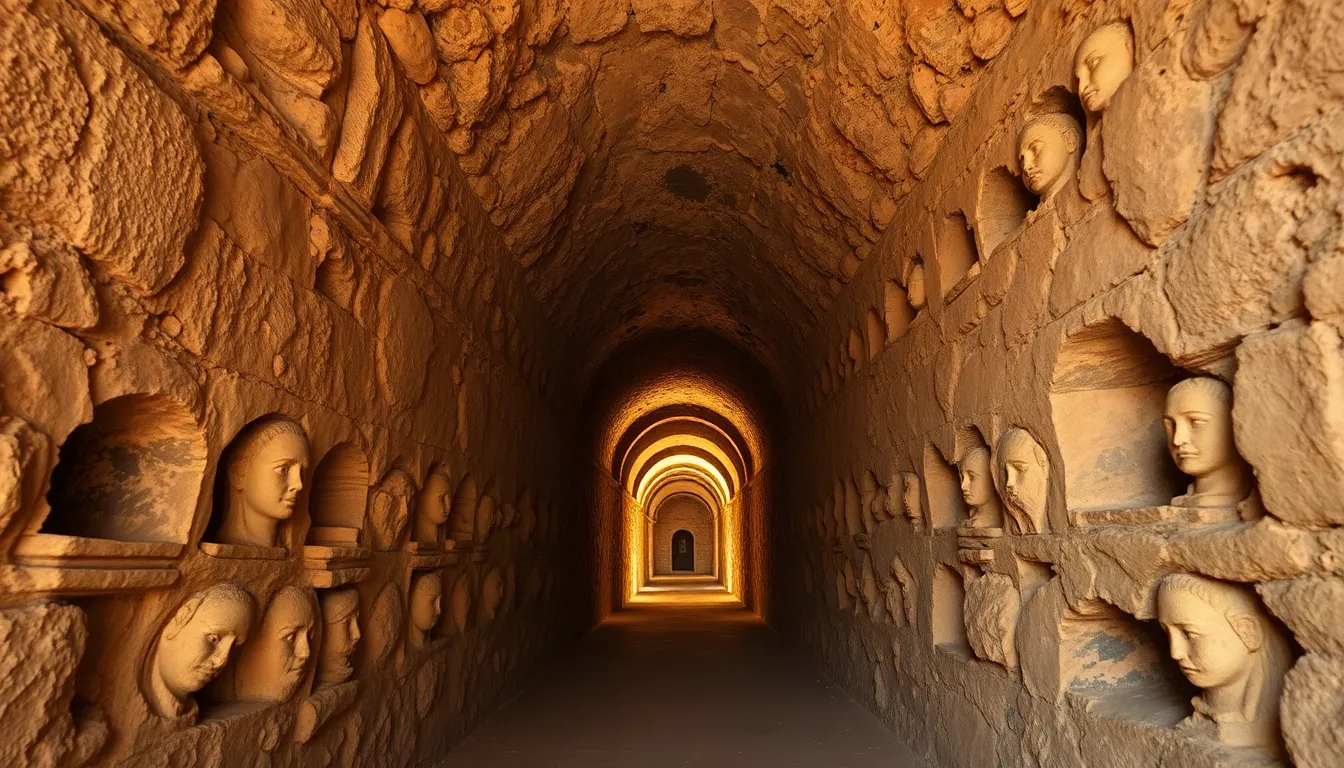
I tell every group the same thing before we go underground in Rome: this is not a tourist attraction. The catacombs are the place where the earliest Christians buried their dead and gathered to worship when doing both could cost them their lives. Walk in expecting a thrill and you will miss the point entirely. Walk in expecting to meet your own faith at its roots, and you will come back up changed.
The catacombs are one of the most meaningful stops in all of Rome for a faith group, and also one of the most misunderstood. People picture something gothic and macabre. The reality is quieter and far more moving. These are the tunnels where a hunted faith kept going, where believers carved hope into the rock by hand. This guide is meant to orient your group before you descend, so you arrive understanding what you are about to see.
What the Catacombs Actually Are
The catacombs are vast underground burial networks dug into the soft volcanic rock outside the walls of ancient Rome. Roman law forbade burial inside the city, so cemeteries lined the roads leading out of it. Christians, who unlike their pagan neighbors did not practice cremation because of their belief in bodily resurrection, dug downward to create room for their dead.
Over time these became enormous. Galleries branched off galleries, sometimes on four or five levels stacked beneath one another, lined with rectangular niches called loculi cut into the walls to hold the bodies. Some catacombs run for miles. The catacombs of San Callisto alone hold an estimated half a million burials across some twelve miles of tunnels.
One myth worth clearing up for your group: Christians did not primarily live in the catacombs to hide from persecution. The catacombs were known to the authorities. They were cemeteries first. But they were also places where the community gathered to honor its martyrs and celebrate the Eucharist at the tombs of the dead, especially during the periods when public Christian worship was dangerous. The fear was real, the risk was real, but the catacombs were sacred ground more than a hiding place.
For where this fits in the wider map of Rome and Italy, our guide to Italy’s spiritual sites connects the catacombs to the rest of the journey.
The Main Catacombs Groups Visit
Several catacombs are open to visitors, all of them along the ancient roads outside the city. A few stand out for faith groups.
San Callisto
The largest and most historically significant. San Callisto holds the Crypt of the Popes, the burial place of nine bishops of Rome from the second and third centuries, and the tomb of Saint Cecilia. Its scale is staggering, and its guides are excellent at conveying both the history and the meaning. For many groups this is the essential one.
San Sebastiano
Smaller and more intimate than San Callisto, San Sebastiano takes its name from the martyr buried here. It contains early Christian graffiti and inscriptions scratched into the walls by ordinary believers, the kind of detail that makes the early church feel close enough to touch. Groups who want a quieter, more personal experience often prefer it.
Domitilla and Priscilla
The catacombs of Domitilla are among the oldest and most extensive, and include an underground basilica. The catacombs of Priscilla, on the other side of the city, are famous for some of the earliest Christian art anywhere, including what many consider the oldest known image of the Virgin and Child. Each catacomb has its own character, and a good itinerary usually chooses one or two rather than trying to see them all.
Reading the Symbols on the Walls
Part of what makes a catacomb visit so powerful is learning to read what the early Christians left on the walls. Before the cross became the dominant symbol, believers used a quiet visual language, often understood only by other Christians.
- The fish. The Greek word for fish, ichthys, formed an acrostic for “Jesus Christ, Son of God, Savior.” A simple fish scratched on a tomb was a confession of faith.
- The anchor. A symbol of hope, and sometimes a disguised cross.
- The Good Shepherd. Christ carrying a lamb on his shoulders, the most common image in the catacombs, a picture of care and rescue.
- The dove, the vine, the orant. Peace, the life of the believer, and a figure standing with arms raised in prayer.
When a guide points these out and a group realizes that frightened, faithful people carved these by hand in dim lamplight, the abstraction of “the early church” becomes a community of real human beings. That recognition is the heart of the visit.
What the Catacombs Mean for a Faith Group
What makes the catacombs essential is the scale of commitment they represent. These were not symbolic gestures. The people buried here chose their faith knowing the cost, and many of them paid it. Walking the tunnels with your congregation, seeing the fish and the anchor and the shepherd carved into the rock, creates a shared experience that connects your group’s faith directly to its earliest roots.
It is also, I want to be clear, not frightening or morbid. It is humbling. Groups consistently describe it as one of the quietest, most reflective stops of the entire trip. Whatever your community has built its faith on, the catacombs show you the foundation it was built on, laid by people who had no basilicas, no freedom, no certainty that any of it would survive. It did. You are standing in the proof.
This pairs naturally with the story of how that persecution finally ended, which our piece on Saint Ambrose and the Edict of Milan tells, and with the broader arc of Italy as a heritage destination.
Practical Notes for Planning a Group Visit
A few things make a catacomb visit go smoothly.
- Book in advance. Walk-in access for large groups is not reliable. The catacombs are run by guided tour only, and group entry should be reserved ahead of time.
- Dress in layers. The catacombs hold a cool, stable temperature year-round, around 15 degrees Celsius. Bring a layer even in the heat of a Roman summer.
- Mind the footing. The tunnels are dim, narrow, and uneven in places, with stairs. Most groups manage well, but tell us about any mobility needs in advance.
- Photography is generally restricted. This is part of preserving the fragile art and the reverence of the space. Encourage your group to be present rather than behind a screen.
- Children are welcome. Most catacombs admit children over about age six, and many find it genuinely memorable.
Our group tour structure makes it easy to fold a catacomb visit into a fuller Rome itinerary. One detail worth raising with your congregation as you plan: with Heritage Tours, the group leader travels free with fifteen or more participants, which helps the numbers work and makes building a meaningful, unhurried day in Rome much simpler.
FAQ: The Catacombs of Rome
Are the catacombs of Rome appropriate for a faith group?
Yes, absolutely. The catacombs are one of the most meaningful stops for any Christian faith group. They are the burial places and gathering sites of early Christians who practiced their faith under threat of death. The experience is not frightening or morbid but humbling. The tunnels, the carved symbols, and the burial niches tell a story of courage that connects directly to the foundations of Christian practice.
Which catacomb should a group visit?
San Callisto is the most popular for groups because of its scale and its Crypt of the Popes, where nine early bishops of Rome are buried. San Sebastiano is smaller and more intimate, with early Christian graffiti. Domitilla and Priscilla hold some of the oldest Christian art, including an early image of the Virgin and Child. Most itineraries focus on one or two rather than trying to see them all.
Did Christians live in the catacombs to escape persecution?
This is a common misconception. The catacombs were cemeteries first, dug because Roman law forbade burial inside the city and because Christians buried rather than cremated their dead. The authorities knew about them. Christians did gather there to honor martyrs and celebrate the Eucharist at the tombs, especially when public worship was dangerous, but they were sacred ground more than hiding places.
What should we wear and bring?
Dress in layers. The catacombs maintain a cool, stable temperature year-round, around 15 degrees Celsius, so bring a light jacket even in summer. Wear comfortable, sturdy shoes, since the tunnels are dim, narrow, and uneven with some stairs. Photography is generally restricted to protect the fragile art, so plan to experience the visit rather than document it.
Do we need to book in advance for a group?
Yes. The catacombs are visited by guided tour only, and walk-in access for large groups is not reliable. Group entry should be reserved ahead of time. Booking in advance also lets you secure a knowledgeable guide who can read the symbols and history, which transforms the visit from a walk through tunnels into a genuine encounter with the early church.
If a meaningful descent into the early church belongs in your community’s Rome itinerary, I would be glad to help you plan it well. Contact us and we will build it into your journey.