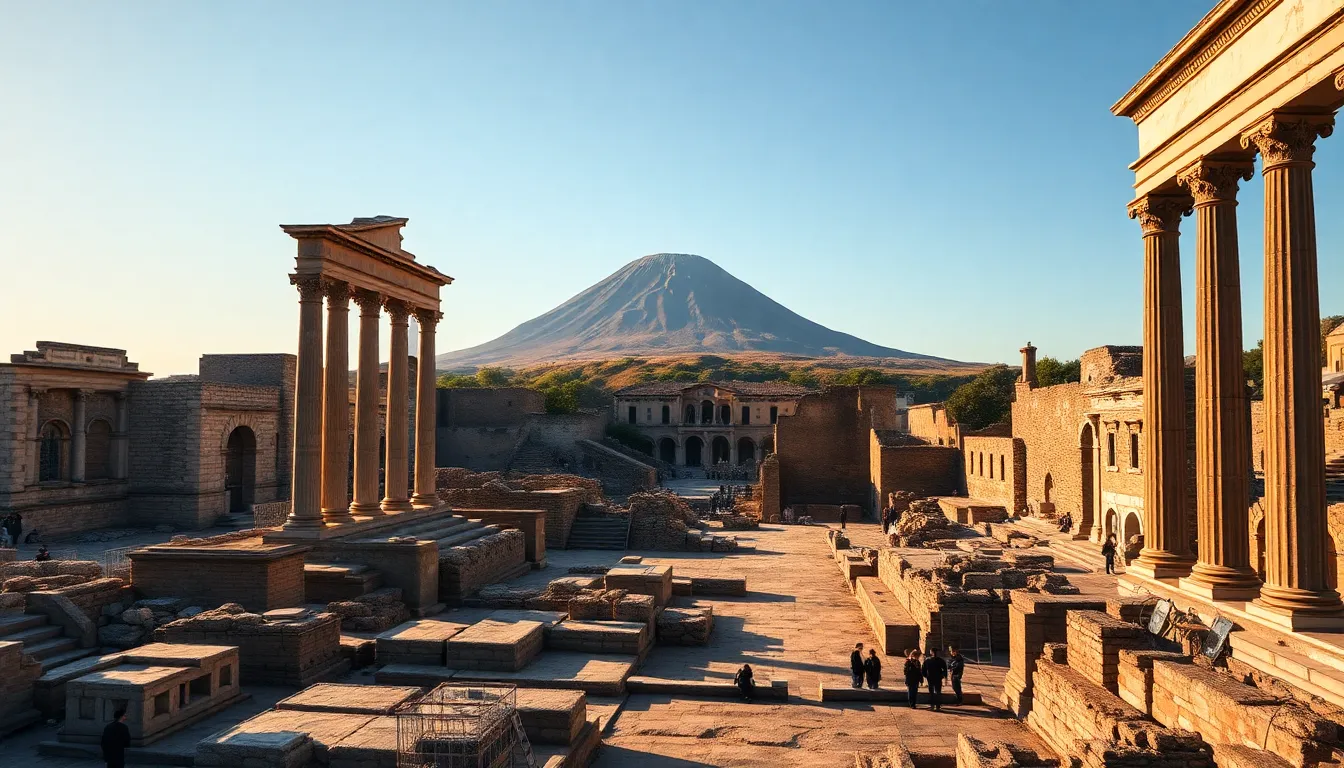
Most groups arrive in the Bay of Naples with one site in mind: Pompeii. And Pompeii deserves the attention. But when I lead a faith group through this region, I tell them on the first morning that we are standing in a place the Apostle Paul actually walked, near catacombs where the earliest Christians of southern Italy buried their dead, in a city that has kept the relationship between life, death, and faith closer to the surface than almost anywhere I know.
Naples is intense. It is loud, layered, and alive in a way that surprises people who expected a tidy heritage stop. Underneath the modern city sits a Greek foundation, a Roman city, early Christian catacombs, and centuries of devotion built one on top of another. Add the Roman cities frozen by Vesuvius in 79 CE, and you have one of the richest single regions in all of Italy for a heritage group willing to look past the postcard.
Here is how I frame the region, and how to plan it so the famous ruins land in their real context.
Paul’s Landing at Puteoli: A New Testament Site on the Ground
This is the part most groups have never heard, and it changes how they see the whole region.
In the Book of Acts, chapter 28, Paul, a prisoner being taken to Rome, comes ashore in Italy at a port called Puteoli. The text says he found believers there and stayed with them seven days before continuing on toward Rome. Puteoli is modern Pozzuoli, a town on the Bay of Naples just west of the city. This is not a tradition or a maybe. It is a named New Testament location that you can stand in today.
Pozzuoli still holds a remarkably preserved Roman amphitheater, one of the largest in Italy, with intact underground chambers, the kind of structure Paul would have known. The old harbor area, the macellum often mislabeled the Temple of Serapis, and the volcanic landscape of the Phlegraean Fields around it give a group a real sense of the working Roman port where Paul stepped onto Italian soil for the first time. For a Christian group, reading Acts 28 aloud while standing in Pozzuoli is one of those moments that does not need any embellishment from me. The text and the place do the work.
The Catacombs of San Gennaro: Naples Underground
Naples sits over a network of early Christian catacombs, and the most important are the Catacombs of San Gennaro, named for the city’s patron saint.
These underground burial galleries date back to the 2nd and 3rd centuries and grew in importance after the body of Saint Januarius, San Gennaro, was brought here in the 5th century. Unlike many catacombs, these are spacious, with wide vaulted galleries on two levels, early Christian frescoes, and some of the oldest surviving images of Neapolitan saints. They were places of burial and of worship during the centuries when Christianity in the region was still young and at times persecuted.
I find these catacombs more moving than the better-known ones in Rome, partly because they are less crowded and partly because they are run by a local cooperative of young Neapolitans who have brought the neighborhood back to life through guided visits. For a group, that human dimension matters. You are not just looking at old graves. You are seeing a community that has kept its faith in this exact ground for nearly two thousand years.
It is also worth knowing about San Gennaro himself for the city’s living devotion. Several times a year, a sealed vial said to hold the saint’s blood is brought out at the cathedral, and the people of Naples gather and wait to see whether it liquefies. The square fills, the city holds its breath, and the moment matters enormously to Neapolitans regardless of how an outsider reads it. Whatever a visitor makes of that, it tells you how alive faith remains in this city, and it gives a group a window into a devotion that has shaped Naples for centuries.
Pompeii in Context: More Than a Ruin
Now to the site everyone comes for. Pompeii was a prosperous Roman city of perhaps twenty thousand people when Mount Vesuvius erupted in 79 CE, burying it under ash within hours. What that catastrophe preserved is a complete Roman city, frozen mid-life: streets, shops, homes, public baths, temples, frescoes, and the haunting plaster casts of the victims in their final moments.
For a heritage group, I always set Pompeii in context rather than treating it as a spectacle. This was the Roman world exactly as it existed in the generation of the apostles. When your group walks the forum, the temples, and the homes of Pompeii, they are seeing the daily world of the New Testament era: the gods that were worshipped, the way wealth and slavery and commerce worked, the setting into which the early church spread. There is even debated evidence of an early Christian or Jewish presence in the city. Whether or not the faintest traces hold up, the larger point stands. Pompeii shows your group the world the Gospel entered.
Nearby Herculaneum is smaller, better preserved in some ways because it was buried differently, and far less crowded. For groups that want the experience without the scale and the heat of Pompeii’s vast site, I often recommend Herculaneum as the alternative or as a quieter companion visit.
Practical Orientation for Group Leaders
This region rewards planning and punishes improvisation. Naples is dense and the traffic is real. The sites are spread out, so transport and timing decide whether a day feels rich or frantic.
A few things I tell every group leader:
- Pompeii is huge and exposed. The site is enormous and offers little shade. Start early, bring water and hats, and accept that you cannot see all of it. A focused route with a good guide beats trying to cover everything.
- Pace the heat. From June through August this region is hot, and Pompeii in particular punishes midday visits. Spring and autumn are far kinder for a mixed-age group.
- Book the catacombs ahead. The San Gennaro catacombs are visited only on guided tours, so reserve group slots in advance.
- Pozzuoli is easy to fold in. Paul’s landing site is a short distance from Naples and rarely crowded. It makes a meaningful morning before or after the bigger sites.
- Watch your belongings in the city. Naples is wonderful and worth the trust, but it is a busy southern city. Keep groups together in crowded areas and brief them once, calmly, before you arrive.
This region pairs naturally with Rome to the north, and many of my groups travel down to Naples after time in the capital. If your group’s interest runs to the early church and the world it grew in, Naples and Pompeii connect well with the broader Italian story, including the Byzantine and early Christian art further north in Ravenna and the layered island heritage of Sicily to the south.
FAQ: Planning a Naples and Pompeii Heritage Visit
Is Pompeii really connected to the Bible?
Not directly, but it is deeply relevant. Pompeii was destroyed in 79 CE, in the generation of the apostles, and it preserves a complete Roman city exactly as it existed when Christianity was spreading. Walking it shows your group the daily world the New Testament entered. The directly biblical site in the region is nearby Pozzuoli, ancient Puteoli, where Paul landed in Acts 28.
How much time does the Naples region need?
I recommend at least two full days, three if you can. One day for Pompeii or Herculaneum, one for Naples itself with the catacombs and the city, and ideally time for Pozzuoli. Trying to do Pompeii and Naples in a single day leaves both thin and exhausts the group.
Are the Naples catacombs suitable for a group?
Yes. The Catacombs of San Gennaro are spacious, well lit, and visited on guided tours, which makes them comfortable for groups, including those who find tighter underground spaces difficult. Book group slots in advance.
Is Naples safe for a faith group?
Naples is a busy southern city and deserves normal urban caution, especially with bags in crowded areas, but heritage groups visit it constantly without trouble. Keep the group together in crowded spots and brief everyone calmly beforehand. The depth of the city is well worth it.
When is the best time to visit Pompeii and Naples?
Spring and autumn, roughly April to early June and September to October. Pompeii is large and offers little shade, so summer heat is genuinely difficult for outdoor walking, particularly for older travelers. The cooler shoulder seasons make the whole region far more comfortable.
If Naples, Pompeii, and the world of the early church draw your community, I would be glad to talk it through. Begin with our full Italy heritage travel guide, see our Italy destination page, or read how our group heritage tours are built for faith communities. When you are ready, reach out and we will start with a conversation.