Most groups think of Milan as the fashion city, the place you fly into and leave quickly. I push back on that every time. Milan is where one document changed the entire course of Christian history, and where one of the most important church fathers shaped the faith for centuries after. If your group cares about how Christianity went from a persecuted underground movement to the faith of the empire, Milan is not a stopover. It is the site of the turning point.
I have built Italy itineraries for over forty years, and Milan is the city I most often have to argue for. Once a group understands what happened here, the argument ends. This guide walks you through the layers, the imperial decision that legalized the faith, the church father who defended it, and the sacred art and architecture that followed.
For the wider national picture, our Italy heritage travel guide sets the context. This guide focuses on Milan.
The Roman and Imperial Layer: The Edict of Milan
In 313 CE, the emperors Constantine and Licinius met in Milan and issued an agreement that ended the official persecution of Christians across the Roman Empire. The Edict of Milan granted religious tolerance and allowed Christians to worship openly for the first time. Property seized during the persecutions was to be returned. Overnight, a faith that had survived in catacombs and house churches stepped into the light.
It is hard to overstate what this meant. Everything downstream, the great basilicas, the church councils, the public art that taught the Gospel to millions, flows from this decision made here. For a Christian group, standing in the city where the Edict was issued reframes the whole story. Milan is where the persecuted church of the catacombs, which your group may have walked through in Rome, became the public church of cathedrals.
Milan was a capital of the Western Roman Empire at the time, and traces of that imperial city remain, including the columns of San Lorenzo, a row of Roman columns that survived from the late imperial period and now stand before an ancient church. They are a tangible link to the Milan that Constantine knew.
The Early Church Layer: Sant’Ambrogio
If the Edict opened the door, Ambrose walked through it and built. Saint Ambrose, Ambrogio in Italian, became bishop of Milan in 374 CE and is one of the four great fathers of the Western church. He was a powerful preacher, a defender of orthodox faith against the Arian controversy, and the man who baptized Augustine of Hippo, an event that shaped the entire future of Christian thought. When you teach Augustine, you are teaching a story that runs through Milan.
The Basilica of Sant’Ambrogio is one of the oldest churches in Milan, founded by Ambrose himself in the fourth century, though the building your group sees took its current Romanesque form later. Beneath the altar lie the remains of Ambrose, displayed alongside two early martyrs. For a group, this is a direct physical connection to the generation that built the church in the decades right after it became legal. The catacombs in Rome show the church in hiding. Sant’Ambrogio shows the same church, one century later, standing in confidence.
This is the layer that makes Milan essential rather than optional. Our Rome heritage guide covers the underground church of the persecution era, and Milan shows what came next.
The Christian Art Layer: The Duomo and the Last Supper
Milan’s later Christian heritage is no less remarkable, and it is what most visitors come for.
The Duomo
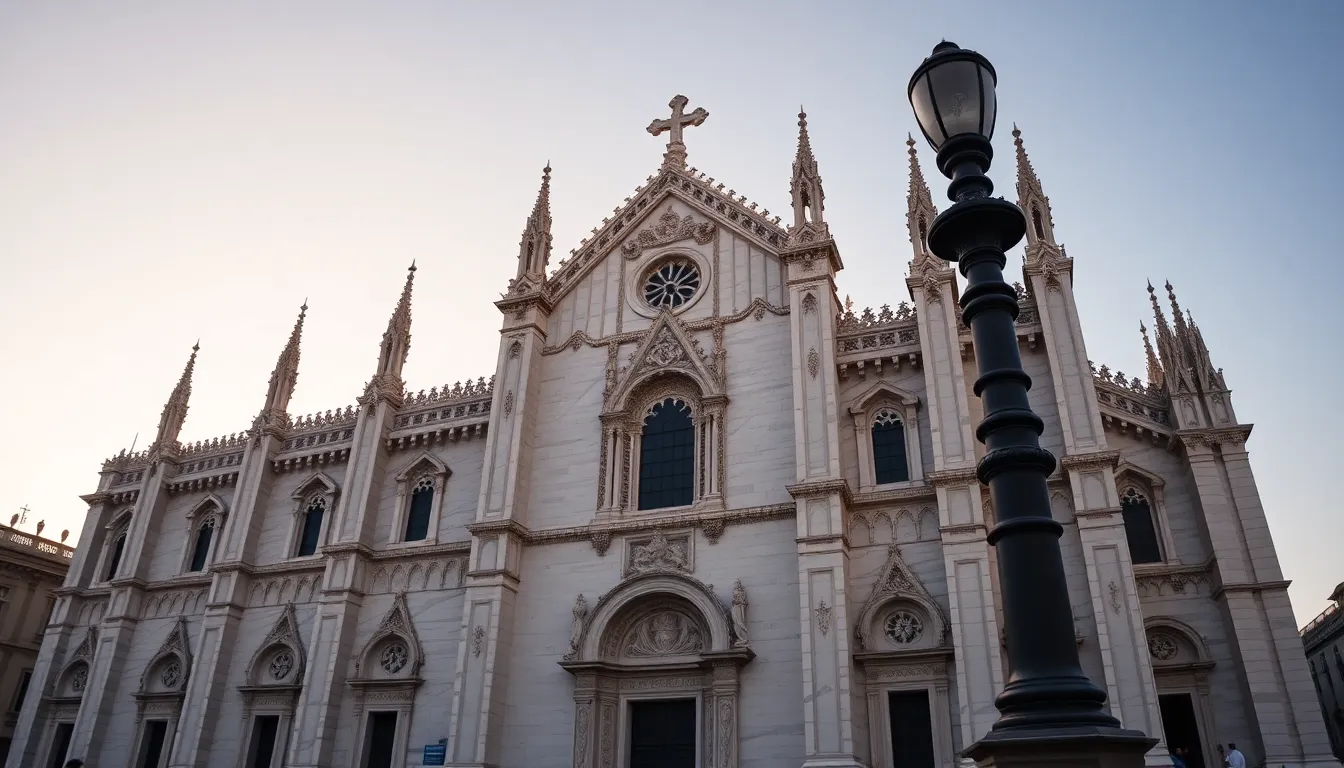
The Milan Duomo is one of the largest and most elaborate Gothic cathedrals in the world, a forest of marble spires and statues that took nearly six centuries to complete. Up close, the detail is staggering, thousands of carved figures covering the facade and roofline. Inside, the scale humbles a group instantly. The cathedral is dedicated to the Nativity of the Virgin Mary, and the rooftop terraces, which groups can walk, give a view across the city and a sense of the ambition that built it.
The Last Supper
A few blocks away, in the refectory of the convent of Santa Maria delle Grazie, is Leonardo da Vinci’s Last Supper. Painted in the 1490s directly onto the wall, it captures the moment Jesus tells the disciples that one of them will betray him, and Leonardo painted the shock rippling across their faces. For a Christian group, this is not a famous painting to check off. It is a meditation on a Gospel scene by one of history’s greatest minds, and standing before it in the silence of the refectory is a genuinely sacred few minutes.
A planning note that cannot be skipped: the Last Supper requires advance reservations, often weeks or months ahead, and visits are strictly timed and limited in group size. This is one site where booking early is the difference between seeing it and standing outside. We handle these reservations so your group does not miss it.
The Jewish Layer in Milan
Milan today has one of the largest Jewish communities in Italy, rebuilt and grown especially in the twentieth century. The Central Synagogue of Milan, the Tempio Centrale, serves a vibrant community and survived bombing during the Second World War, its facade preserved and the interior rebuilt. For groups tracing modern Jewish life in Italy alongside the ancient communities of Rome and Venice, Milan offers the contemporary chapter, a community that represents continuity and renewal rather than only memory. Our Venice heritage guide covers the historic Jewish heritage that pairs with it.
Planning Milan as a Group Leader
Milan is efficient and well connected, which makes it an easy anchor for an itinerary. A few things I tell leaders.
Book the Last Supper first. Before hotels, before anything, secure your Last Supper slot. Availability drives the rest of the Milan schedule, and groups that wait often cannot get in.
Give Milan a full day or two. One focused day covers the Duomo, Sant’Ambrogio, and the Last Supper if timed well. A second day lets you add San Lorenzo, the synagogue, and a slower pace.
Use Milan as a gateway. Its airport and rail connections make it a natural start or end point for an Italy heritage tour, and it pairs well with Venice to the east. We design routing so Milan strengthens the itinerary rather than sitting apart from it.
Mind the Jewish calendar. The Central Synagogue follows Shabbat and festival schedules. For Jewish groups, plan visits months ahead.
A note many leaders appreciate: with fifteen or more participants, the group leader travels free. The person who prepares the teaching and carries the responsibility should not also carry the cost. Our group heritage tours page shows how this works.
FAQ: Planning a Milan Heritage Trip
Why does Milan matter for a Christian heritage trip?
Milan is where the Edict of Milan legalized Christianity across the Roman Empire in 313 CE, ending the persecutions. It is also where Saint Ambrose shaped the early church and baptized Augustine. For groups studying how the faith moved from the catacombs to the cathedrals, Milan is the pivotal site, not a side trip.
Do I need to book the Last Supper in advance?
Yes, without exception. Leonardo’s Last Supper has strictly limited, timed entry, and tickets sell out weeks or months ahead. Group sizes are capped per slot. This is the one Milan site where booking early decides whether your group sees it at all. We secure these reservations as soon as your dates are set.
How long should a group spend in Milan?
A focused full day can cover the Duomo, Sant’Ambrogio, and the Last Supper if the timing aligns. A second day lets you add the Roman columns of San Lorenzo, the Central Synagogue, and a less rushed pace, which suits older travelers and groups wanting time to reflect.
Can Milan be combined with other Italian cities?
Yes. Milan’s airport and rail links make it an ideal start or end point for an Italy itinerary, and it connects easily to Venice. A heritage route might run Milan to Venice to Florence to Rome, moving from the Edict and the early church through the Byzantine East, the Renaissance, and finally the seat of the church. We plan the routing for smooth travel.
Is there Jewish heritage to see in Milan?
Yes. Milan has one of Italy’s largest Jewish communities and its Central Synagogue, which survived wartime bombing and serves a thriving community today. It offers the modern, living chapter of Italian Jewish life, complementing the ancient communities of Rome and Venice. For groups tracing Jewish continuity, it is a meaningful stop.
If Milan belongs on your community’s journey, we would welcome the chance to talk it through. No pressure, no timeline, just a conversation about what this city could mean for your group. Contact us when you are ready, or explore our Italy heritage tours to see how we build them.