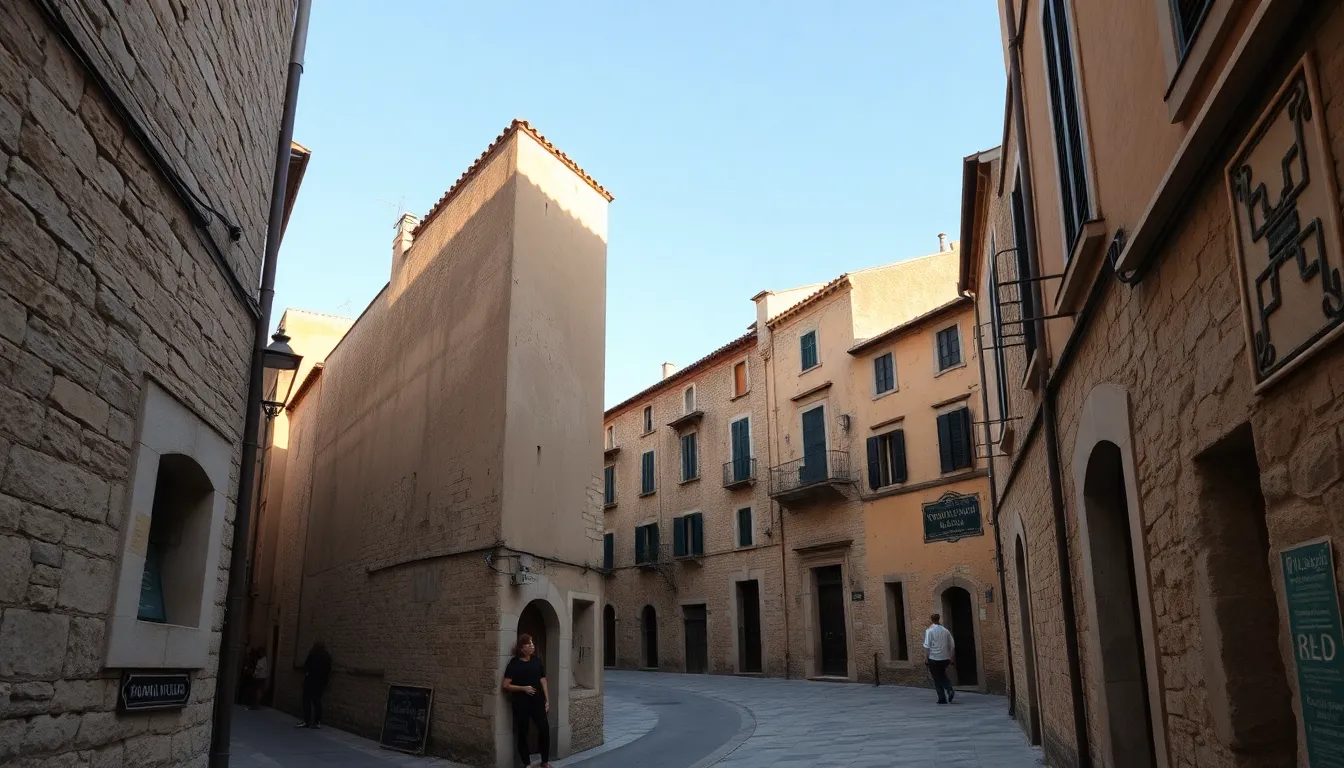
There is a kind of silence in the old Jewish quarters of Sicily that I have not felt anywhere else in Italy. In Rome and Venice you stand in a community’s history and the community is still there, smaller than it was, but present, still gathering for Shabbat. In Sicily you stand in the history of a community that was erased. The streets still carry the name Giudecca. The mikveh is still carved into the rock. But the people are gone, and have been for more than five hundred years. I tell groups before we go that Sicily is different. It asks something of you that Rome does not.
This is the part of Italy’s Jewish story that deserves far more attention than it receives, and I want to give it that attention here, with care, because it is a story of loss and the people in it deserve dignity.
One of the Largest Jewish Communities in Europe
Before 1492, Sicily held one of the largest and oldest Jewish populations anywhere in Europe. Estimates put the number around 35,000 to 40,000 people, spread across the island in dozens of communities. Jewish presence here was ancient. There is evidence of Jews in Sicily from Roman times, and the community grew and deepened across more than a thousand years.
These were not isolated outsiders. The Jews of Sicily were woven into the island’s life. They worked as dyers, weavers, metalworkers, physicians, merchants, and farmers. They lived in distinct neighborhoods, the giudecche, in cities including Palermo, Siracusa, Catania, Marsala, and many smaller towns. Under the various rulers who held Sicily, Arab, Norman, and eventually Aragonese, the community persisted, sometimes protected, sometimes taxed heavily, but continuous.
Palermo had perhaps the largest community, with a great synagogue that travelers of the time described with admiration. Siracusa, on the island’s eastern coast, held an important community in the seaside district of Ortigia, where Jewish life ran for centuries. When I want a group to feel the scale of what was here, I describe it plainly: this was not a small or marginal presence. For a thousand years, Sicily was one of the major centers of Jewish life in the Mediterranean.
The Giudecca: Where Jewish Sicily Lived
The word giudecca appears again and again on Sicilian maps and street signs, and it is the most visible trace of the community that remains. A giudecca was the Jewish quarter of a town. Unlike the later ghettos of northern Italy, these were generally not walled enclosures imposed to confine. They were neighborhoods where Jewish families clustered around their synagogue, their ritual bath, their schools, and their trades.
Walking a giudecca with a group is the closest you can come to the texture of daily Jewish life in medieval Sicily. The streets are narrow, the buildings old, and in places you can still read the shape of the community in the layout: the central lanes where the synagogue would have stood, the workshops, the houses pressed close together. In Siracusa, the Giudecca of Ortigia is among the best preserved, and it holds the single most significant surviving site of Jewish Sicily, which I write about separately in the guide to the ancient mikveh of Siracusa.
What I always make clear is that these neighborhoods outlived the people. The name survived because Sicilians kept calling the place by what it had been. The stones remember even where the families could not stay.
1492: The Expulsion
In 1492, the same year Ferdinand and Isabella expelled the Jews of Spain, the decree reached Sicily, which was under Aragonese rule. The Jewish communities of the island were given the same impossible choice: convert to Christianity, leave, or face death.
The scale of what happened is hard to hold. Tens of thousands of people, families whose roots in Sicily ran back a thousand years, had a matter of months to abandon everything. Homes, workshops, fields, the graves of their ancestors, all of it left behind. The community had to sell what it could at whatever price desperation allowed, often a fraction of its worth. Synagogues passed into other hands. The great synagogue of Palermo was eventually taken for a church.
Some families chose conversion and stayed, becoming what were called New Christians, carrying their identity quietly, in some cases for generations, in secret. Others fled. They went to Naples and Rome, to the Ottoman lands that welcomed Sephardic exiles, to North Africa. The routes scattered across the Mediterranean, and over generations some of those families, through paths scholars are still tracing, eventually reached the land of Israel.
I do not rush through this with a group. The expulsion was not an abstraction or a policy. It was the end of a world, the severing of a thousand-year continuity in a single year. When we stand in a giudecca and I tell the people what happened to the families who lived in these exact houses, I let the weight of it sit. That is the right response to this history. Not to soften it, and not to dwell in it for its own sake, but to honor it honestly.
What Survives, and Why It Matters
After 1492, organized Jewish life in Sicily effectively ended for centuries. This is the crucial difference between Sicily and the rest of Italy. The communities of Rome and Venice were confined, restricted, and persecuted, but they survived. Sicily’s did not. Both truths belong in the story of Jewish Italy, and a group that visits only the surviving communities of the north gets only half of it.
What remains in Sicily is fragmentary but real. The giudecca quarters survive in their street names and layouts. The mikveh beneath Ortigia in Siracusa, sealed for five centuries and rediscovered in the modern era, is one of the most significant Jewish archaeological sites in southern Europe. In recent decades there have been small signs of return, with renewed Jewish interest in the island and the first stirrings of revived community life, but the medieval world is gone and will not come back.
For a rabbi or educator, Sicily is the chapter that gives the whole Italian story its urgency. It is where you take a group to feel what was lost, not just what endured. It pairs naturally with the hub guide to Jewish heritage in Italy and with the story of the Sephardic heritage of Italy after 1492, because the Jews driven from Sicily were part of that same great scattering that reshaped Jewish life across the peninsula and the Mediterranean.
Visiting Jewish Sicily With a Group
A Sicily heritage segment usually centers on the eastern side of the island, with Siracusa and the Giudecca of Ortigia as the anchor, and often Palermo on the western side for the scale of what the largest community once was. The two ends of the island can be combined into a focused three- or four-day extension to a mainland Italy tour, or built into a dedicated Sicily journey for groups that want to go deep into the expulsion story.
This is sensitive ground, and it calls for a guide who can hold it with the right tone, someone who knows the history and treats it with the dignity it requires rather than reciting dates. Heritage Tours arranges those guides specifically, coordinates access to the mikveh and other sites that need advance booking, and builds in time for a group to reflect and process. We keep the group together with hotel pickup and dropoff so the focus stays on the experience. With fifteen or more participants, the group leader travels at no cost. You can see how we structure these journeys on our group heritage tours page and our Italy destination page.
FAQ: Jewish Heritage of Sicily
How large was the Jewish community in Sicily before 1492?
Estimates place Sicily’s Jewish population at roughly 35,000 to 40,000 people before the expulsion, spread across dozens of communities. It was one of the largest and oldest Jewish populations in Europe, with roots reaching back to Roman times. Major communities existed in Palermo, Siracusa, Catania, Marsala, and many smaller towns, and Jews were deeply integrated into the island’s economic and social life as craftsmen, merchants, physicians, and farmers.
What is a giudecca?
A giudecca was the Jewish quarter of a Sicilian town, where Jewish families lived clustered around their synagogue, ritual bath, and trades. Unlike the walled ghettos imposed later in northern Italy, giudecche were generally open neighborhoods rather than enclosures of confinement. The name survives today on street signs and maps across Sicily, often the most visible remaining trace of a community that was expelled more than five centuries ago.
What happened to Sicily’s Jews in 1492?
In 1492, the expulsion decree of Ferdinand and Isabella was extended to Sicily, which was under Aragonese rule. Tens of thousands of Jews were forced to convert, leave, or face death, ending a continuous presence of more than a thousand years. Some converted and remained, sometimes preserving their identity in secret. Many fled to Naples, Rome, the Ottoman lands, and North Africa, joining the wider Sephardic diaspora. Organized Jewish life on the island effectively ended for centuries.
What can you still see of Jewish Sicily today?
The clearest surviving traces are the giudecca quarters, preserved in street names and the layout of old neighborhoods, and the medieval mikveh carved deep beneath Ortigia in Siracusa, one of the most significant Jewish archaeological sites in southern Europe. The great synagogue of Palermo was lost, having been converted after the expulsion. In recent decades there have been small signs of renewed Jewish interest and community life on the island.
How does Sicily fit into an Italy heritage tour?
Sicily provides the chapter of loss that the surviving communities of Rome and Venice cannot. It usually centers on Siracusa and Ortigia in the east, often paired with Palermo in the west, as a three- or four-day extension to a mainland tour or as a dedicated Sicily journey. Because the subject is the end of a thousand-year community, it calls for a guide who handles the history with dignity, which Heritage Tours arranges specifically.
Sicily is not an easy chapter, but it may be the most important one for a community that wants the whole truth of Jewish Italy. If you are considering it, I would be honored to help you plan it well. Reach out whenever you are ready, and we will give this history the care it deserves.