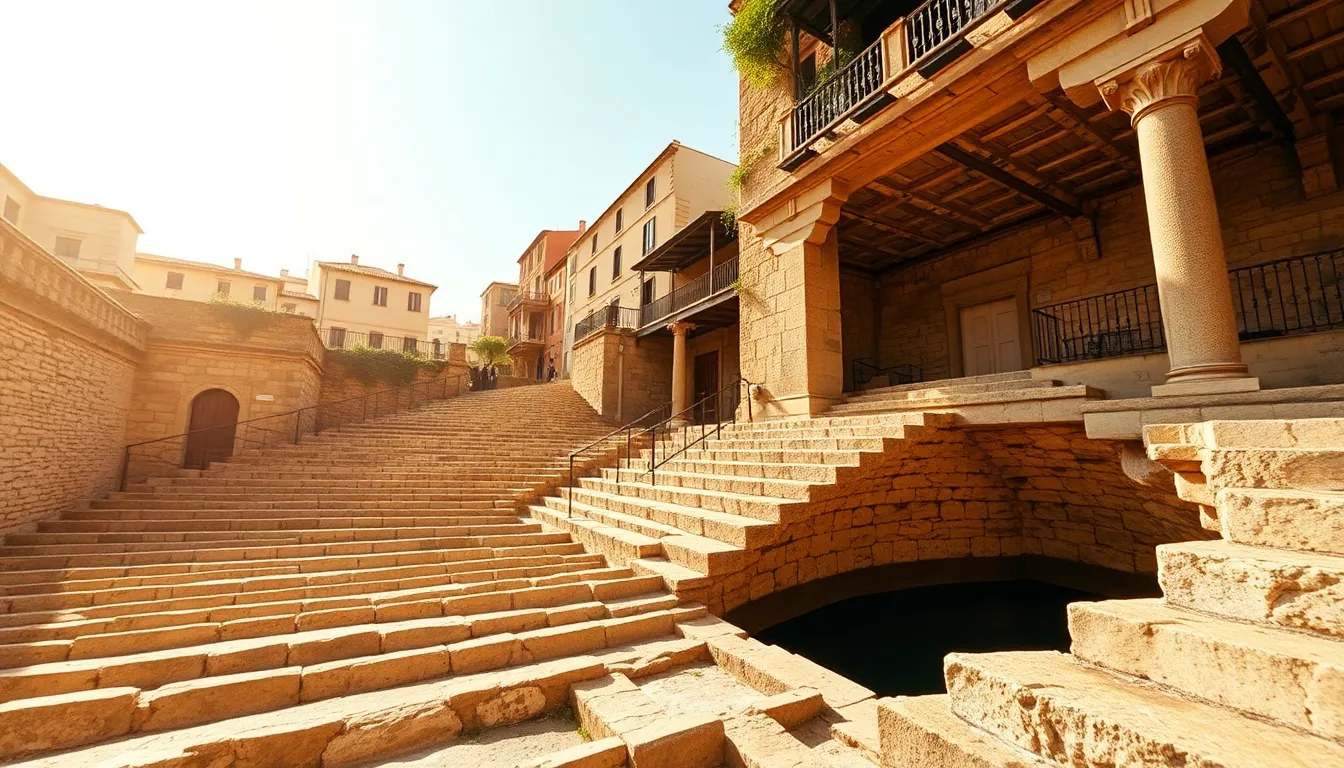
You descend a long stone staircase, narrow and worn, deeper than you expect, the air cooling and dampening as you go. Then the steps open into a small carved chamber, and there, fed by fresh spring water rising from the rock, are the pools. This is the mikveh of Ortigia, and the first time I brought a group down those steps, an educator who had spent her career teaching Jewish history put her hand flat against the wet stone and said, very quietly, that she had never stood inside something this old that was still exactly what it was made to be. That is the experience I want to prepare you for, because it is unlike any other site I take groups to in Italy.
This is one of the oldest and best-preserved ritual baths in Europe, carved into the rock beneath the old Jewish quarter of Siracusa, in eastern Sicily. It sits inside the larger story of Jewish Sicily, a vanished world, but it deserves a full account of its own, because of what it is and how it survived.
What a Mikveh Is, and Why This One Matters
For travelers in a group who are not Jewish, or who are Jewish but have never seen one, I always start with what a mikveh is. It is a ritual bath used for purification in Jewish practice, central to the rhythms of communal and personal life. Jewish law requires that the water be living water, meaning it must come from a natural source such as a spring or rainwater rather than being drawn and poured. That requirement is exactly why this mikveh was carved so deep: the builders dug down through the rock of Ortigia until they reached the fresh spring water rising naturally from below.
That single fact, that the bath had to reach living water, explains the whole astonishing structure. The community did not build a basin and fill it. They cut a staircase eighteen meters down into the bedrock to bring the people to the water at its source. When you stand at the bottom, you are standing at the meeting point of Jewish law and Sicilian geology, and the pools around you are filled by the same spring that filled them for medieval worshippers.
Carved Beneath Ortigia
Ortigia is the small island that forms the historic heart of Siracusa, a dense maze of stone streets jutting into the Mediterranean. For centuries it held one of Sicily’s important Jewish communities, in the district still called the Giudecca. The mikveh lies beneath that quarter, accessed today through what is now a hotel that occupies the building above it.
The age of the mikveh is debated, and I am honest with groups about that. Some accounts date its origins to the Byzantine period, more than fifteen hundred years ago, which would make it extraordinarily ancient. What is certain is that it was in active use through the medieval period, serving the Jewish community of Ortigia, and that it represents an unbroken practice of ritual purification carried out at this exact spot for a very long time.
The structure is austere and moving. The main chamber holds several pools fed by the spring, with smaller ritual baths cut into side chambers nearby. There is no ornament, no decoration. It is purely functional sacred space, and that plainness is part of its power. Unlike a grand synagogue built to be seen, this was hidden underground by design, the most private and intimate act of the community’s religious life, performed below the streets where they lived.
Sealed in 1492
Here is the detail that gives the mikveh its particular weight. When the Jews of Sicily were expelled in 1492, the community of Ortigia, like every community on the island, had a matter of months to leave everything behind. Before they went, they sealed the mikveh. They filled the staircase and the chamber with rubble and stone, closing it off completely, and walked away.
We do not know exactly what was in their minds, and I am careful not to invent it. But the act tells us something. They did not simply abandon the bath. They buried it. Whether to protect it from desecration, or in the hope that someday Jews would return to uncover it, or out of reverence for sacred space that should not be left exposed, they took the trouble to close it carefully. And then it stayed sealed, under the streets of Ortigia, for roughly five hundred years.
It was rediscovered in the modern era, during renovation work on the building above, when workers cutting into the rock broke through into the hidden chamber. The rubble the community had packed in five centuries earlier was cleared away, and the staircase and pools emerged almost exactly as they had been left. The spring was still flowing. The water that fills the mikveh today is the same living water that filled it before the expulsion. I find that almost unbearable to think about, in the best sense, and groups feel it too.
Standing in the Chamber With a Group
This is a place that asks for quiet. The descent itself sets the tone, eighteen meters down a narrow stair, and by the time a group reaches the bottom, the chatter has usually stopped on its own. I do not over-narrate down there. I give the essential facts at the top of the stairs, and then in the chamber I let people be. Some pray. Some put a hand to the water. Some simply stand. The combination of great age, the survival through five sealed centuries, and the fact that it is still fed by its original spring tends to move people in a way that no plaque or display case can.
It is also a logistically real site. The space is small, the stairs are steep and can be slippery, and groups go down in stages rather than all at once. The temperature is cool below ground even when Sicily is hot above. For mixed-age groups this needs planning, and anyone with serious mobility limits should know in advance about the long descent. None of this is a reason to skip it. It is a reason to prepare for it properly.
The mikveh anchors a visit to the Giudecca of Ortigia and connects to the wider arc of the Sephardic heritage of Italy after 1492, the great scattering that the people who sealed this bath were part of. It is, for many of the groups I lead, the single most affecting site in all of Sicily.
Planning a Visit
Access to the mikveh is controlled and requires advance arrangement, since the entrance runs through a working hotel and group sizes underground are limited. Heritage Tours books the visit, coordinates timing so your group is not rushed or split awkwardly, and arranges a guide who can give the history and then know when to fall silent. We pair the mikveh with a walk through the Giudecca and the rest of Ortigia, and connect it to the broader Sicily and Italy itinerary.
We keep the group together with hotel pickup and dropoff, and we handle the bookings that this kind of site requires. With fifteen or more participants, the group leader travels at no cost, which for a rabbi or educator often makes the difference in bringing a community to a place like this. You can see how we structure these journeys on our group heritage tours page and our Italy destination page.
FAQ: The Ancient Mikveh of Siracusa
What is the mikveh of Ortigia?
It is a medieval Jewish ritual bath carved roughly eighteen meters deep into the bedrock beneath the old Jewish quarter, the Giudecca, on the island of Ortigia in Siracusa, Sicily. It is one of the oldest and best-preserved ritual baths in Europe. The pools are fed by fresh spring water rising naturally from the rock, which is why the structure was cut so deep, to reach the living water that Jewish law requires.
How old is the Siracusa mikveh?
Its exact age is debated. Some accounts trace its origins to the Byzantine period, more than fifteen hundred years ago, which would make it extraordinarily ancient. What is certain is that it was in continuous use through the medieval period, serving the Jewish community of Ortigia until the expulsion of 1492. It represents centuries of unbroken ritual practice at the same spot.
Why was the mikveh sealed?
When the Jews of Sicily were expelled in 1492, the community of Ortigia sealed the mikveh before leaving, filling the staircase and chamber with rubble and stone. The reasons can only be inferred, perhaps to protect the sacred space from desecration, perhaps in hope of an eventual return, but the care they took to bury it rather than abandon it is itself meaningful. It remained sealed for roughly five hundred years.
How was it rediscovered?
The mikveh was found in the modern era during renovation work on the building above it, when workers cutting into the rock broke through into the hidden chamber. The rubble packed in five centuries earlier was cleared, and the staircase and spring-fed pools emerged almost exactly as the community had left them, with the original spring still flowing. The water in the mikveh today comes from that same source.
Can groups visit the mikveh, and is it accessible?
Yes, but access is controlled and requires advance booking, since the entrance is through a working hotel and the underground space limits group sizes. The visit involves a long, steep, sometimes slippery descent of about eighteen meters, so anyone with significant mobility limitations should be aware in advance. The chamber stays cool year-round. Heritage Tours arranges the booking, timing, and a suitable guide as part of a Sicily itinerary.
The mikveh of Ortigia is one of those rare places where Jewish history is not described but physically present, exactly as it was. If you want to bring your community down those stairs, I would be honored to help you plan it. Reach out whenever you are ready.