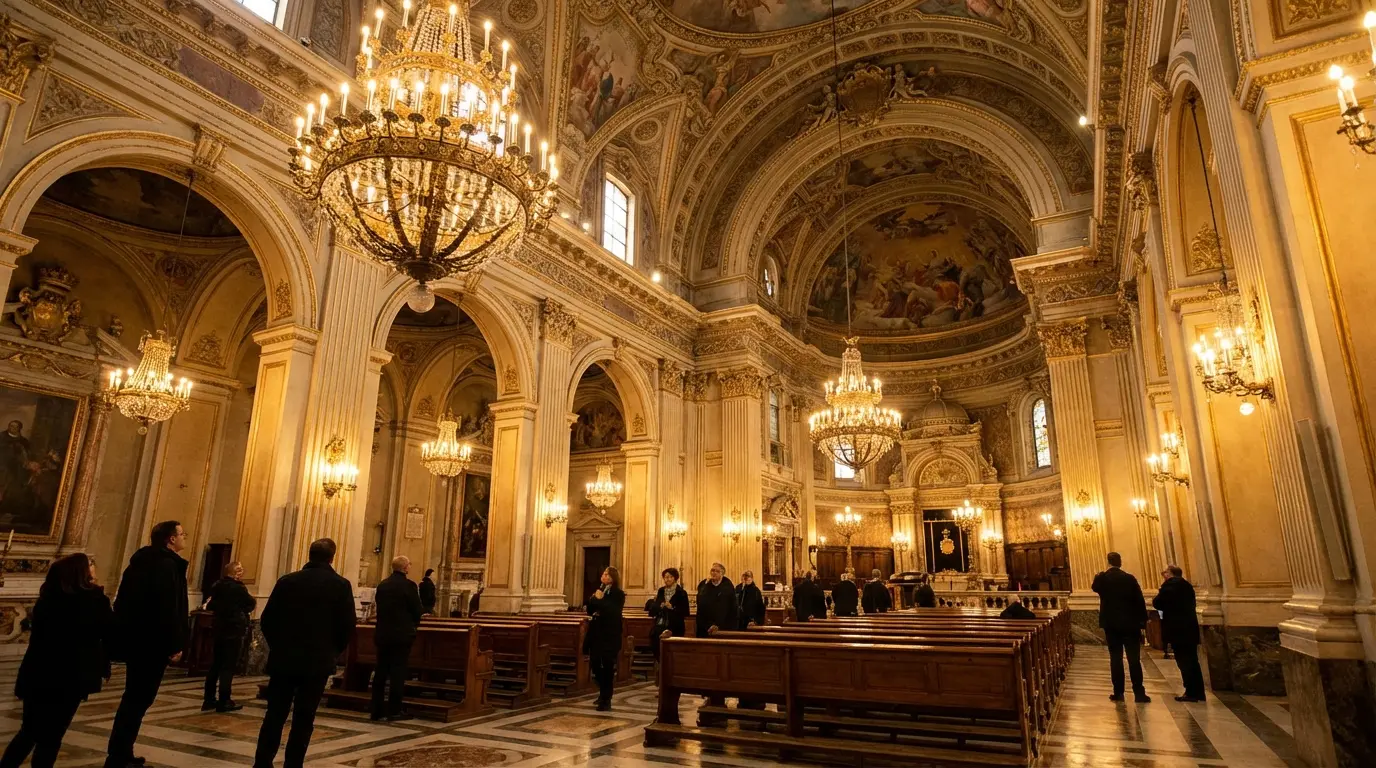
Rome: The Oldest Continuously Inhabited Jewish Neighborhood in Europe
Jewish families were living in Rome in the 2nd century BCE. Before the destruction of the Second Temple. Before the Common Era. Before most of the European Jewish communities that would come centuries later even existed. That is the fact I begin with whenever a rabbi asks me about Italy, because it changes the frame of the entire trip.
The Rome Ghetto, formally enclosed by papal decree in 1555, sits on the banks of the Tiber in one of the most central parts of the city. But the Jewish presence in this neighborhood predates the ghetto walls by more than a thousand years. When Pope Paul IV ordered the gates built, he was not creating a Jewish quarter. He was walling off one that had already been there for centuries.
The Great Synagogue of Rome, completed in 1904, was built deliberately large and deliberately visible. After more than three hundred years behind ghetto walls, the community chose a building that declared, without apology, that Jewish life in Rome was not over. The square-domed roof is visible from across the river. Beneath it, the Jewish Museum of Rome houses artifacts spanning two millennia.
For a group visiting Rome, the Ghetto is not a stop on the itinerary. It is the foundation. Understanding that Jewish life in this city is older than the Colosseum gives everything else you see a different weight.
Venice: The City That Invented the Word “Ghetto”
The word “ghetto” entered the world’s vocabulary in Venice. In 1516, the Venetian authorities decreed that the city’s Jewish residents must live on a small island near a copper foundry. The Venetian word for foundry was “geto,” and the name attached itself to the place, and then to every similar enclosure that followed, across Europe and across centuries.
The Venetian Ghetto is small. You can walk its perimeter in ten minutes. But within that space, five distinct synagogues were built, each by a different community: the Scola Tedesca (German), the Scola Canton, the Scola Italiana, the Scola Levantina, and the Scola Spagnola (Spanish). The buildings are unremarkable from outside, because Jewish law in Venice prohibited any outward display of worship. Step inside the Scola Spagnola, and you enter a room of carved wood, gilded arches, and quiet grandeur that rivals anything in the city.
The Scola Levantina, built by Jews from the Ottoman lands, has a wooden bimah (pulpit) that is considered one of the finest pieces of Baroque woodwork in Venice. It was built by people who were confined to a few acres of island but who refused to let that confinement diminish their sacred spaces.
What your group needs to know before they arrive is that the ghetto was not a relic of the Middle Ages. It was enforced until Napoleon’s arrival in 1797. Gates were locked at sunset. Jewish residents paid for their own guards. The walls were real, the restrictions were real, and the community that persisted inside them was real. Standing in the campo today, surrounded by the buildings where this happened, is a different experience than reading about it.
Florence and the Medici Connection
Florence’s relationship with its Jewish community was shaped by power, pragmatism, and contradiction. The Medici family, who controlled Florence for much of the Renaissance, alternately protected and restricted Jewish residents depending on the political moment. Cosimo I invited Jewish merchants to settle in the city. His successors confined them to a ghetto.
The Great Synagogue of Florence, completed in 1882, is one of the most architecturally striking Jewish buildings in Europe. Its green copper dome, Moorish arches, and ornate interior were designed to be unmistakably visible from the surrounding streets. Like Rome’s Great Synagogue, it was built in the period after emancipation as a statement of belonging.
During World War II, the synagogue was used as a German military garage and storage depot. The Torah scrolls and sacred objects were hidden by members of the community and by sympathetic Florentine families. The building was damaged but survived. The community, diminished but unbroken, restored it after the war.
For groups with an interest in how Jewish communities navigated the intersection of Renaissance culture, Christian authority, and survival, Florence offers a story that is both specific and universal.
Sicily: The 1492 Expulsion and Its Living Legacy
This is the part of Italy’s Jewish story that deserves more attention than it receives. Before 1492, Sicily held one of the largest Jewish populations in Europe, numbering perhaps 35,000 people. Jewish communities had been present on the island since Roman times. They were woven into the economic and intellectual life of Sicilian cities, particularly Palermo and Syracuse.
Then, in 1492, Ferdinand and Isabella issued their expulsion decree. The same decree that drove Jews from Spain applied to Sicily, which was under Aragonese rule. The Jewish communities of the island were given the same choice: convert, leave, or die.
The scale of what was lost is difficult to grasp. Entire neighborhoods emptied. Synagogues were converted to churches. Family histories spanning centuries were severed in a matter of months. Some families converted and remained, carrying their identity in secret. Some fled to Naples, Rome, or the Ottoman territories. Some, over generations and through routes that scholars are still tracing, made their way to the land of Israel.
In Syracuse, the old Giudecca quarter still carries its name. The mikveh discovered beneath Palazzo Cataldi, sealed for five centuries, is one of the most significant archaeological finds related to Jewish life in southern Italy. It is a small room, carved from stone, with steps leading down to the water. Standing in it, you are standing in a space that was sacred to people whose world was about to end.
For a rabbi preparing to take a congregation to Italy, Sicily is not an optional addition. It is the chapter of the story that gives everything else its urgency. The Jewish communities of Rome and Venice survived. Sicily’s did not. Both truths need to be told.
The Synagogues Worth Traveling For
Italy holds more historic synagogues than many people realize, and several are worth building an itinerary around.
The Scola Spagnola in Venice, as mentioned, is among the most beautiful Jewish interiors in Europe. The Great Synagogue of Rome combines architectural ambition with communal memory in a way that no photograph can capture. Florence’s Great Synagogue, with its distinctive green dome, is both a landmark and a testament to post-emancipation confidence.
Beyond these, there are smaller, less visited synagogues that carry their own weight. The synagogue in Pitigliano, a hilltop town in southern Tuscany once known as “Little Jerusalem,” served a community that lived in relative harmony with its Christian neighbors for centuries. The building was restored in the early 2000s and now functions as a museum and occasional place of worship.
In Casale Monferrato, in the Piedmont region, a Baroque synagogue from the 18th century holds ornamental work of remarkable delicacy. It is rarely visited by international travelers, which means your group may have the space entirely to themselves.
Each of these synagogues tells a local story, but together they tell a continental one: Jewish communities in Italy adapted, persisted, and built places of worship that reflected both their faith and their circumstances. Seeing several of them in the course of a single trip gives your group a sense of range and resilience that no single site can provide on its own.
What a Jewish Heritage Tour of Italy Actually Looks Like
A serious Jewish heritage tour of Italy is not a general sightseeing trip with a few synagogue visits added on. It is an itinerary designed around the story of Jewish life in Italy, structured so that each day builds on the one before.
A typical route might begin in Rome, with the Ghetto and the Great Synagogue, grounding the group in the oldest chapter of the story. From there, the tour moves north to Florence, where the relationship between Jewish communities and Christian power during the Renaissance becomes tangible. Venice follows, with the original Ghetto and the five synagogues that tell the story of a community organized by origin, confined by walls, and sustained by faith.
From the mainland, an extension to Sicily adds the dimension of loss, the 1492 expulsion and its visible traces in Syracuse and Palermo. Alternatively, stops in Ferrara, Livorno, or Pitigliano add depth for groups that want to explore the diversity of Jewish experience across the Italian peninsula.
Throughout, Heritage Tours arranges local guides who specialize in Jewish history, coordinates access to sites that require advance arrangements, and builds in time for your group to reflect, discuss, and process what they are seeing. Hotel pickup and dropoff keep the group together without the stress of navigating unfamiliar cities.
With fifteen or more participants, the group leader travels at no cost. For a rabbi organizing a congregation trip, this removes a barrier that can make the difference between the trip happening and the trip staying on a wish list.
FAQ
What is the oldest Jewish community in Italy?
Rome’s Jewish community dates to the 2nd century BCE, making it the oldest continuously inhabited Jewish neighborhood in Europe. Jewish residents were established in Rome before the destruction of the Second Temple, and the community has maintained a continuous presence through more than two thousand years of upheaval, restriction, and renewal.
Why is Venice’s ghetto historically significant?
The Venetian Ghetto, established in 1516, is the origin of the word “ghetto.” It was the first formally designated area in Europe where Jewish residents were required to live, and its name, derived from the Venetian word for the nearby foundry, became the universal term for every such enclosure that followed. The five synagogues built within its walls represent five distinct Jewish communities.
What happened to Sicily’s Jews in 1492?
In 1492, the same year as the Spanish expulsion, Ferdinand and Isabella’s decree was extended to Sicily, which was under Aragonese control. An estimated 35,000 Jews were forced to convert, leave, or face death. The expulsion ended centuries of Jewish presence on the island. Traces of this community survive in the old Giudecca quarter of Syracuse and in the mikveh discovered beneath Palazzo Cataldi.
Which synagogues in Italy are open to visitors?
Several historic synagogues welcome visitors, though many require advance arrangements. The Great Synagogue of Rome, the Scola Spagnola and Scola Levantina in Venice, Florence’s Great Synagogue, and the restored synagogue in Pitigliano are all accessible. Smaller sites in Casale Monferrato, Ferrara, and Livorno can be arranged through local Jewish community contacts, which Heritage Tours coordinates as part of the itinerary.
How do I plan a Jewish heritage group tour to Italy?
Start with a conversation about what matters most to your congregation. Heritage Tours builds custom itineraries for Jewish groups, incorporating major communities like Rome and Venice with lesser-known sites based on your group’s interests and available time. Planning twelve months ahead is recommended, especially for spring or autumn travel. With fifteen or more participants, the group leader’s costs are covered.
If you are a rabbi considering Italy for your community, we would welcome the chance to help you think it through. Learn more about our Italy heritage tours and reach out whenever you are ready. The conversation is always the first step.