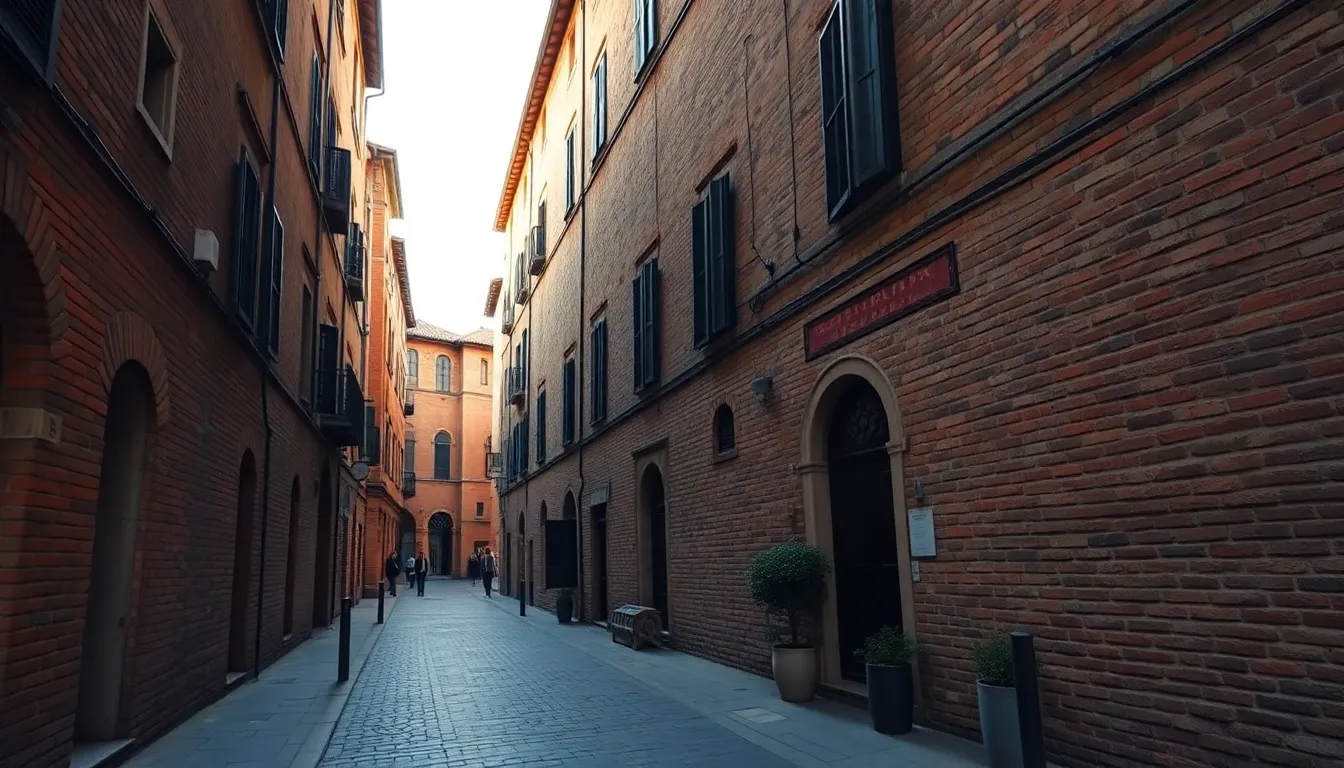
Ferrara is the city I bring groups to when I want them to understand that the Italian Jewish story is not only about confinement. Because for a remarkable stretch of history, this quiet Renaissance city on the plains of Emilia did something most of Europe was not doing. It opened its gates. When Spain expelled its Jews in 1492, and when Portugal followed, and when other Italian states tightened their grip, the dukes of Ferrara said, in effect, come here. Live here. Trade here. Be safe here.
That makes Ferrara a different kind of stop, and a meaningful one for a faith group. It is the story of refuge before it becomes, much later, the story of a ghetto and then of loss. It is also home to Italy’s national museum of Jewish history, which means a visit here can frame the entire journey your group is taking. Let me walk you through it.
The Este Dukes and the Open Gate
For much of the fifteenth and sixteenth centuries, Ferrara was ruled by the Este family, and the Este dukes pursued a policy that was, for its era, genuinely unusual. They actively welcomed Jewish exiles, including Sephardic Jews fleeing the expulsions from Spain and Portugal and conversos seeking to return openly to Jewish life.
The dukes did this partly for principle and partly for pragmatism. These were skilled merchants, physicians, scholars, and financiers, and Ferrara prospered from their presence. The result was a flourishing community of remarkable diversity, Italian Jews, Ashkenazi Jews from the north, and Sephardic Jews from the Iberian world, living together in one city, each with their own traditions and synagogues.
I make a point of this with groups because it complicates the picture in a good way. The same era that produced the locked gates of Venice in 1516 also produced Ferrara, where a ruling family chose to be a refuge. Both happened in Renaissance Italy, at the same time, a few days’ travel apart. Italy is not one Jewish story. It is many, running in parallel, and Ferrara is the one that restores some hope to the sequence before the harder chapters arrive.
The Ghetto Comes Late
The open era did not last forever. When Ferrara passed from Este rule to direct papal control at the end of the sixteenth century, the policy changed. In 1627, under the papacy, a ghetto was finally established, and the community that had lived freely in the city was enclosed behind gates, with the same restrictions imposed elsewhere in the Papal States.
The ghetto in Ferrara lasted, like the others, until Italian unification in the nineteenth century brought emancipation. You can still walk the streets of the old ghetto today, around Via Mazzini, Via Vittoria, and Via Vignatagliata, narrow Renaissance lanes that held the enclosed community for more than two centuries. The synagogue complex on Via Mazzini served the community across its different rites.
For a group, walking these streets after hearing the story of the Este welcome creates a particular feeling. You are walking ground that was first a refuge and only later a ghetto. The order of events matters, and your group will feel the loss of the open era differently for having understood that it existed.
MEIS, the National Museum of Italian Judaism
Here is the reason Ferrara has become, in my itineraries, one of the most useful single stops in the whole country. The city is home to MEIS, the National Museum of Italian Judaism and the Shoah, Italy’s official national museum of Jewish history, housed in a complex that was once the city’s prison.
What MEIS does, and does well, is tell the entire two-thousand-year arc of Jewish life in Italy in one place. It runs from the ancient community of Rome, through the medieval and Renaissance centers, through the ghetto centuries, through emancipation, and into the racial laws and the Shoah. For a group at the start or the heart of an Italian heritage journey, this is an extraordinary orientation. It gives people the whole map before, or after, they walk the individual sites.
I often use MEIS to frame a trip. We visit early, so that when the group later stands in the Roman Ghetto or before the Great Synagogue of Rome, they already hold the context. Or we visit later, as a way of gathering everything they have seen into a single coherent story. Either way, MEIS turns a series of stops into a narrative, and that is exactly what a thoughtful faith group is looking for.
The museum handles the Shoah chapter with care and honesty, including the deportations that struck Italian Jewry, Ferrara’s community among them. For a congregation carrying that memory, the museum offers a setting that holds it with dignity rather than spectacle.
Ferrara’s own community has a particular literary echo that I sometimes share with a group, because it makes the loss concrete. The city and its Jewish families are the setting of one of the most beloved Italian novels of the twentieth century, a story of a wealthy Ferrarese Jewish family in the years the racial laws closed in around them. Many of the people who visit have read it, or seen the film made from it, and standing in the real streets where that fictional but deeply truthful story is set gives the abstraction of the racial laws a human face. I do not lean on it heavily. But for the right group, it turns Ferrara from a place on a map into a place they already, in some way, know.
How a Group Visits Ferrara
Ferrara is compact and walkable, which makes it comfortable for a group. The old ghetto streets, the synagogue complex on Via Mazzini, and MEIS are all within the historic center, and the city itself, a UNESCO-listed Renaissance capital, is a pleasure to move through on foot.
A visit here benefits from advance planning, particularly for guided access to MEIS and to the synagogue, and for an English-speaking guide who can connect the Este story, the ghetto, and the museum into one coherent walk. Heritage Tours arranges that access ahead of time and builds Ferrara into the wider itinerary at the right point, as an orientation or as a gathering-up, depending on your group’s route.
Ferrara pairs naturally with the rest of the journey. Groups often combine it with the great urban communities of Rome and Venice, and with Pitigliano for a smaller community story. Our Jewish heritage in Italy overview shows how the full arc comes together.
When a group reaches fifteen or more participants, the group leader travels at no cost, which for many congregations is what makes a fuller, more thoughtful itinerary reachable.
FAQ: Jewish Ferrara
Why was Ferrara important for Jewish refugees?
Under the Este dukes in the fifteenth and sixteenth centuries, Ferrara actively welcomed Jewish exiles, including Sephardic Jews and conversos fleeing the expulsions from Spain and Portugal. While much of Europe was expelling or confining Jews, the Este rulers offered refuge, and a diverse, prosperous community of Italian, Ashkenazi, and Sephardic Jews flourished in the city.
When was the Ferrara ghetto established?
The ghetto came late, in 1627, after Ferrara passed from Este rule to direct papal control. The community that had previously lived freely in the city was enclosed behind gates, with the restrictions common to the Papal States, until Italian unification brought emancipation in the nineteenth century.
What is MEIS?
MEIS is the National Museum of Italian Judaism and the Shoah, Italy’s official national museum of Jewish history, located in Ferrara in a complex that was once the city prison. It tells the entire two-thousand-year story of Jewish life in Italy in one place, from the ancient Roman community through the ghettos, emancipation, and the Shoah, which makes it an excellent orientation for a heritage journey.
Can you still see the old Jewish quarter in Ferrara?
Yes. The streets of the old ghetto, around Via Mazzini, Via Vittoria, and Via Vignatagliata, can be walked today, along with the historic synagogue complex on Via Mazzini. The whole historic center is a UNESCO-listed Renaissance city and is compact and walkable for a group.
Should Ferrara come early or late in an itinerary?
Either works, and both have advantages. Visiting MEIS early gives your group the full context before they walk the individual sites in Rome, Venice, and elsewhere. Visiting later lets the museum gather everything they have seen into one coherent narrative. We help you decide based on your group’s route.
If Ferrara and its national museum sound like the kind of anchor your community’s journey could use, I would be glad to help you place it well. Learn more about our Italy heritage tours and our group heritage tours, and reach out whenever you are ready to start the conversation.