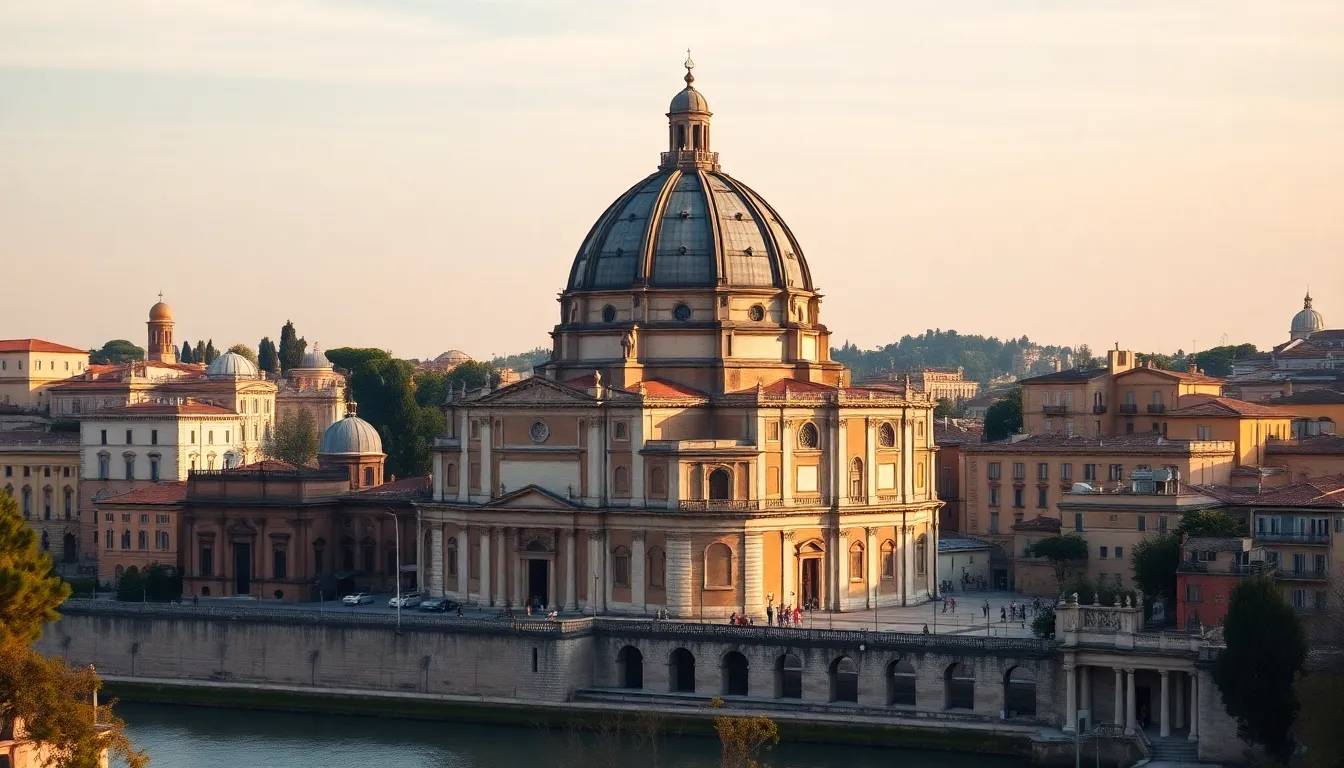
There is a moment I plan for when a group reaches the Great Synagogue of Rome. We come at it from the river side, and I want them to see the dome before they see anything else. It is squared, aluminum-grey, and it rises clearly above the rooftops along the Tiber. I tell them to look at it and then I tell them why it looks like that. After three centuries of being forced to worship out of sight, behind ghetto walls, in buildings that could show nothing to the street, this community built a synagogue with a dome you can see from across the river. That was the whole intention. To be seen.
Understanding that single fact changes how a group reads the building. It is not just a beautiful synagogue. It is an argument made in stone, and the Jewish Museum beneath it is where the argument gets its evidence. Here is how I present both to a group.
A Building Made to Be Seen
The Great Synagogue of Rome, the Tempio Maggiore, was completed in 1904, just over thirty years after the ghetto walls came down with Italian unification in 1870. The timing is everything. For the first time in more than three hundred years, the community was legally free, and one of the first things it chose to do was build.
It built deliberately large, on the bank of the Tiber, at the edge of the old ghetto, with that distinctive squared dome that breaks from the round domes of Rome’s churches. The style draws on Assyrian and Babylonian motifs as well as Art Nouveau, a deliberate choice to be unmistakably its own thing rather than to imitate the architecture around it. The interior is richly painted in deep blues and golds, the ceiling worked like a sky.
I make sure groups grasp the statement behind the choices. The community could finally show itself, so it did, in a building that no one could mistake and no one could miss. After the centuries behind the ghetto walls, this was the architectural answer. We are still here, and we will be seen.
It stands in deliberate contrast to what I show groups in Venice, where the five synagogues are hidden on the upper floors because the law forbade any outward display. Same faith, two opposite architectural fates, separated by emancipation. Setting the two side by side in a group’s mind is one of the most effective things you can do on an Italian itinerary.
The Roman Rite
One detail I never skip. The Great Synagogue follows the Italian, specifically the Roman, rite, a liturgical tradition distinct from both the Ashkenazi and Sephardic worlds. It is one of the oldest continuous Jewish rites still in use anywhere, carried by a community that has prayed in this city for two thousand years.
For a rabbi or an educated group, this is a genuinely meaningful thing to encounter. The Nusach Italki is not a museum curiosity. It is a living tradition, prayed in this building every week, and it connects the modern congregation directly to the ancient community I describe in our guide to the Roman Ghetto. The continuity is not just architectural. It is liturgical, carried in the words themselves.
The Jewish Museum of Rome
Beneath the synagogue, the Jewish Museum of Rome holds the physical evidence of that two-thousand-year story. This is where I let groups slow down, because the objects do work that no lecture can.
The collection includes precious textiles, some of the finest Jewish ceremonial silver in Italy, illuminated manuscripts, and marble fragments and inscriptions recovered from the ancient Jewish catacombs of Rome, evidence of the community reaching back to the early Roman Empire. There are Torah ornaments, embroidered ark curtains, and ritual objects that survived the ghetto centuries.
The museum also documents the darker chapters with the same honesty. It holds material on the ghetto period, on the conversion sermons the community was forced to attend, and on the deportation of October 16, 1943, when more than a thousand Roman Jews were seized and sent to Auschwitz. The museum does not separate the beauty from the suffering. It presents both, which is exactly right, because the community lived both.
For a group, the museum and the synagogue work as one visit. You move from the objects of two thousand years of continuity downstairs to the great free-standing statement of the building above. The sequence tells the whole story, antiquity, confinement, loss, and renewal, in the space of an hour.
One object I always point a group toward is the marble and inscriptions recovered from the ancient catacombs. We are used to thinking of Jewish history in Europe as a medieval story, but these stones are Roman, carved when the community was already old and the Empire was at its height. A group that has just walked the modern quarter outside, full of restaurants and schoolchildren, and then stands in front of a Jewish inscription nearly two thousand years old, understands the word continuous in a way no sentence from me can deliver. That is the gift of this museum. It closes the distance between the ancient community and the living one, and it does it with physical evidence you can stand in front of.
How a Group Visits
The Great Synagogue and the Jewish Museum are visited together, by guided tour, with security screening on entry, as you would expect at a major active synagogue. Visits are timed and the synagogue is closed to tourism on Shabbat and Jewish holidays, when it returns fully to its purpose as a house of prayer.
This is a site that rewards advance arrangement. Heritage Tours books the timed guided visit ahead of your arrival, coordinates an English-speaking guide who knows both the building and the museum collection, and places the visit within the wider walk through the Roman Ghetto so it connects to the living quarter around it rather than standing alone. We handle the security and access logistics so your group can focus on the experience.
It pairs naturally with the rest of an Italian heritage itinerary. Many groups combine Rome with the Venice Ghetto and its five hidden synagogues for the architectural contrast, and the full journey is laid out in our Jewish heritage in Italy overview.
When a group reaches fifteen or more participants, the group leader travels at no cost, which for many congregations is what brings a trip like this within reach.
FAQ: The Great Synagogue of Rome
When was the Great Synagogue of Rome built?
The Tempio Maggiore was completed in 1904, just over thirty years after the ghetto walls were removed with Italian unification in 1870. Its scale and visibility were deliberate, a statement of belonging by a community newly free after more than three centuries of enforced confinement.
Why does the synagogue have a square dome?
The squared aluminum dome was a deliberate break from the round domes of Rome’s churches, intended to make the building unmistakably its own. After centuries of being forced to worship out of sight behind ghetto walls, the community chose a design that could be seen from across the Tiber and could not be confused with anything around it.
What is in the Jewish Museum of Rome?
The museum, beneath the synagogue, holds ceremonial silver, precious textiles and ark curtains, illuminated manuscripts, and marble fragments from Rome’s ancient Jewish catacombs. It also documents the ghetto period, the forced conversion sermons, and the deportation of October 16, 1943, presenting both the beauty and the suffering of the community’s history.
Can you visit the Great Synagogue of Rome?
Yes, by guided tour with security screening, together with the Jewish Museum. The synagogue is closed to tourist visits on Shabbat and Jewish holidays, when it functions as an active house of prayer. Heritage Tours arranges the timed guided visit and an English-speaking guide in advance.
What liturgical rite does the Great Synagogue follow?
It follows the Italian, specifically Roman, rite, the Nusach Italki, one of the oldest continuous Jewish liturgical traditions still in use. It is distinct from both the Ashkenazi and Sephardic rites and connects the modern congregation directly to a community that has prayed in Rome for two thousand years.
If Rome is on your mind for your community, I would be glad to help you plan a visit that does this remarkable building justice. Learn more about our Italy heritage tours and our group heritage tours, and reach out whenever you are ready to begin the conversation.