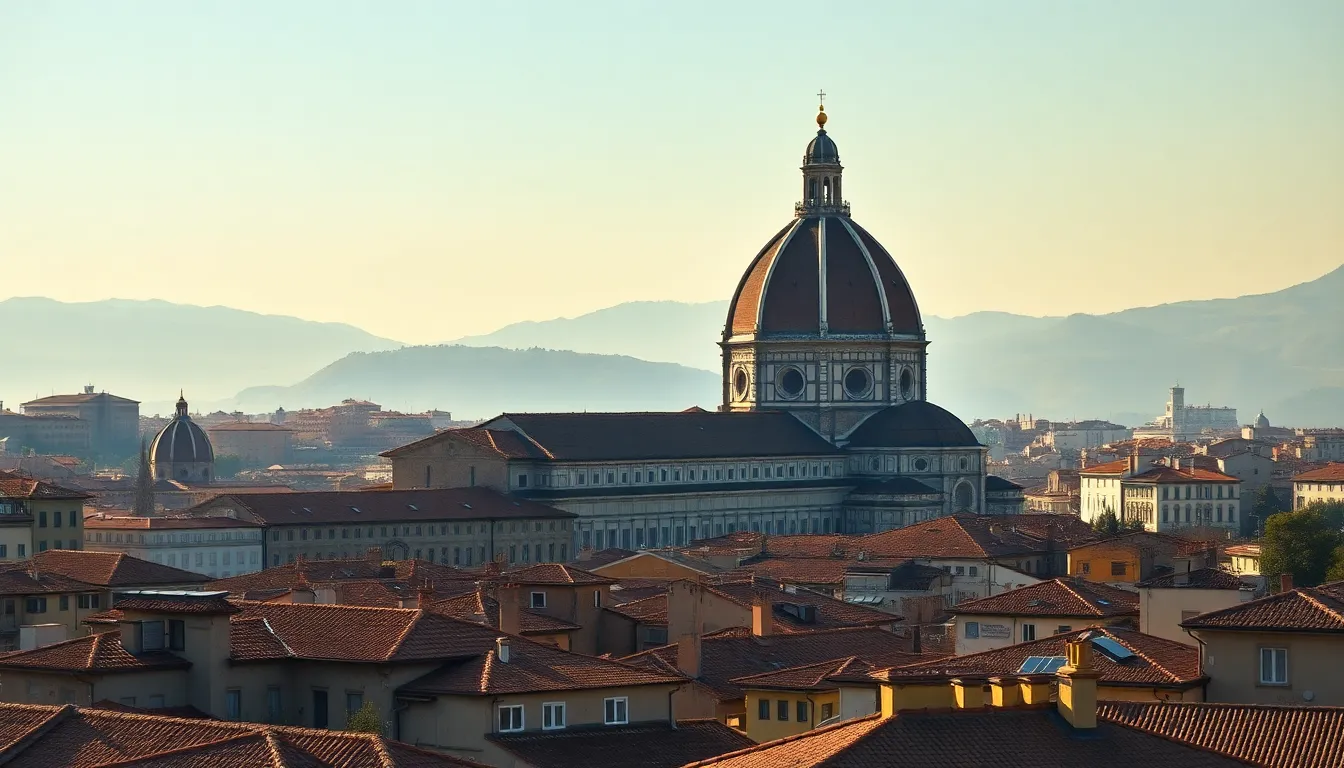
I tell every group leader the same thing about Florence: do not treat it as an art stop. Treat it as a faith stop that happens to hold the greatest concentration of Christian art on earth. The difference matters. A group that walks into Florence looking only at brushwork leaves impressed. A group that walks in understanding that these works were sermons in paint and marble, made to teach the Gospel to people who could not read, leaves changed.
I have built itineraries here for decades, and Florence still surprises me. It is compact enough to walk, dense enough to fill a week, and layered with a Jewish story most visitors never discover. The Renaissance was born here, and the Renaissance was, at its heart, a Christian project. This guide walks you through the city’s layers so your group sees Florence for what it is.
The wider context lives in our Italy heritage travel guide. This piece focuses on Florence.
The Christian Layer: The Duomo and Renaissance Faith
Florence’s skyline is its theology. The cathedral, Santa Maria del Fiore, crowned by Brunelleschi’s dome, was an act of collective faith and engineering ambition that took generations to complete. When your group steps into the piazza and looks up, they are seeing what a city of believers built to honor God when they had no proof the dome could even stand. It stood. It still does.
The Duomo Complex
The cathedral, the Baptistery, and Giotto’s bell tower form one of the most important religious complexes in Christendom. The Baptistery’s gilded bronze doors, which Michelangelo reportedly called the “Gates of Paradise,” tell the Old Testament story panel by panel. Inside, the Baptistery’s ceiling mosaics depict a vast Last Judgment in gold. For a Christian group, this is the biblical narrative made visible, the same teaching method San Marco uses in Venice, applied here with Renaissance precision.
Renaissance Christian Art
This is where Florence becomes overwhelming, and where a guide earns their keep. The city holds Michelangelo’s David, carved from a single block of marble and rooted in the story of faith against impossible odds. It holds Fra Angelico’s frescoes at the convent of San Marco, painted directly onto the walls of the monks’ cells as aids to prayer, not as decoration. It holds Botticelli, Ghiberti, and Donatello, much of it religious art created for churches and chapels.
What I tell groups is this: slow down. Florence punishes the group that tries to see everything. Pick a handful of works, understand the faith behind them, and let those land deeply. The San Marco convent, where Fra Angelico painted scenes of the life of Christ into rooms meant for solitary prayer, is often the quietest and most affecting stop in the city precisely because it was never made for an audience.
The church of Santa Croce deserves a place on any heritage itinerary too. It is the largest Franciscan church in the world and the burial place of Michelangelo, Galileo, and Machiavelli, which makes it a kind of map of the Renaissance mind. For groups that want to understand how faith and the explosion of human achievement sat together in this city, often in tension, Santa Croce holds both under one roof. The frescoes by Giotto in its chapels carry the same visual-Gospel tradition you see at the Duomo, applied to the lives of the saints.
The Jewish Layer: The Great Synagogue of Florence
Here is the part of Florence most visitors never see. Tucked a few blocks from the tourist core stands the Great Synagogue of Florence, the Tempio Maggiore, and it is one of the most beautiful synagogues in Europe.
Built in the 1870s after Italian unification finally granted Jews full civil rights, the synagogue rises in a Moorish revival style, with a green copper dome visible across the rooftops and an interior of intricate patterned color that takes most groups by surprise. It was a declaration: after centuries confined to a ghetto established in 1571, the Jewish community of Florence built something proud and visible, in the open, for the first time.
The building carries hard memory too. During the Second World War it was desecrated and used as a depot, and the retreating German army mined it. Members of the Florentine resistance defused the explosives and saved it. The Jewish Museum housed inside tells the full arc of the community, from the ghetto years through emancipation, persecution, and survival.
For a Jewish group, the Great Synagogue is essential and moving. For a Christian group, it is the layer that turns Florence from an art tour into a heritage one, a reminder that this Renaissance city held a Jewish community living its own story of restriction and resilience the whole time. Our Rome heritage guide and Venice heritage guide cover the other essential Jewish heritage cities, and Florence completes the picture.
The Roman Foundations Beneath the Renaissance
Florence did not begin in the Renaissance. It began as Florentia, a Roman colony founded in the first century BCE, and the grid of the old Roman city still shapes the streets your group will walk. The Piazza della Repubblica sits on the site of the ancient Roman forum. Beneath the modern surface, the Roman past is the foundation everything else was built on.
For groups that want the deeper layer, this Roman origin connects Florence to the same imperial world that shaped Rome and the early church. The Renaissance masters who worked here looked back consciously to classical antiquity, and understanding that helps a group read the art correctly. These were Christians reaching back through Rome to express their faith in a new visual language.
Planning Florence as a Group Leader
Florence is walkable, which is a gift, but it is intense, which is a warning. A few things I tell every leader.
Give Florence at least two full days. One day cannot hold the Duomo, the Accademia, the Uffizi, and the synagogue without exhausting your group. Two days, ideally three, lets the art breathe.
Pre-book everything. The Accademia, where David stands, and the Uffizi have lines that can swallow hours. We reserve timed entries so your group walks in while others wait outside.
Mind the Jewish calendar. The Great Synagogue and its museum follow Shabbat and festival schedules. For Jewish groups, plan this months ahead.
Pace the art. Museum fatigue is real, and a tired group misses the meaning. We build in rest and reflection so the experience stays spiritual rather than becoming a marathon.
A note many leaders appreciate: with fifteen or more participants, the group leader travels free. The person who prepares the teaching and carries the responsibility should not also carry the cost. Our group heritage tours page shows how this works.
FAQ: Planning a Florence Heritage Trip
Is Florence only an art destination, or does it work for faith groups?
It works powerfully for faith groups. Nearly all of Florence’s great art was religious art, created to teach and inspire faith. With a guide who frames the work theologically, the Duomo, the Baptistery, and the San Marco frescoes become an encounter with the Gospel, not just a gallery walk. The Great Synagogue adds a deep Jewish heritage layer most visitors miss.
What is the Great Synagogue of Florence?
It is the Tempio Maggiore, a stunning Moorish revival synagogue built in the 1870s after Jewish emancipation. It houses a Jewish museum telling the community’s story from the ghetto era through the Holocaust, when resistance fighters saved the building from German demolition. It is one of the finest synagogues in Europe and essential for Jewish heritage groups.
How many days does a group need in Florence?
At least two full days, ideally three. One day forces hard cuts between the Duomo, the Accademia, the Uffizi, and the synagogue, and leaves your group rushed. Two or three days lets you go deep on a focused selection of sites rather than skimming everything.
Can Florence be combined with Rome and Venice?
Yes, and it is the natural middle stop. Fast trains link Rome, Florence, and Venice in a few hours each. A common heritage route runs from Rome through Florence to Venice, moving from the early church and the Vatican, through the Renaissance, to the Byzantine East. We design the routing to keep travel efficient.
When is the best time to bring a group to Florence?
Spring and autumn are ideal, with comfortable weather and lighter crowds at the museums. Summer is hot and very crowded, which strains older travelers. Winter is quiet and atmospheric and works well for smaller, flexible groups. We plan around the season your community can travel.
If Florence belongs on your community’s journey, we would welcome the chance to talk it through. No pressure, no timeline, just a conversation about what this city could mean for your group. Contact us when you are ready, or explore our Italy heritage tours to see how we build them.