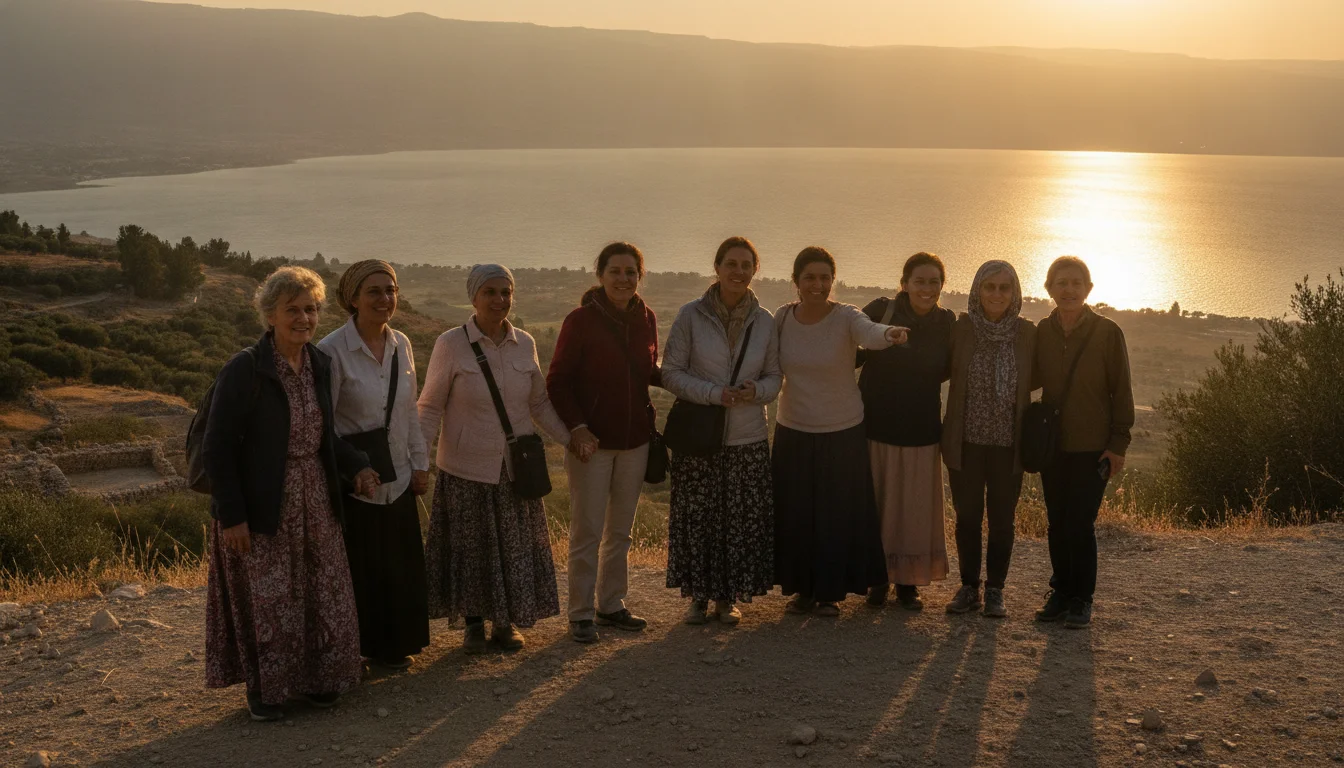
Most of the women’s ministry leaders who call me are not asking whether the trip is good. They already know Israel will move their group. What they are really asking is whether they can pull it off: whether enough women will sign up, whether they can lead it without carrying the cost themselves, and whether the itinerary will actually center the women of Scripture rather than treat them as a footnote. Those are organizer questions, and they have clean answers.
I have built heritage journeys for more than forty years, and a Women of the Bible tour of Israel is one of the trips I most enjoy helping a leader stand up. Not because it is exotic, but because it recruits itself when it is framed right, and because the free-leader model takes the personal cost off the person doing all the work. Let me walk you through how to organize it, lead it, and fill it.
What a Women of the Bible Tour of Israel Actually Is
The phrase gets used loosely, so let me be specific about what you are building. A Women of the Bible tour is a Holy Land itinerary organized around the places tied to the women of Scripture, told in their voice, with your group reading their stories on the ground where they happened.
It is still a full Israel journey. You are in Jerusalem, at the Galilee, along the Jordan, in the Judean hill country. What changes is the lens. At a well in Samaria you read the account of the woman Jesus met at the well. In Bethlehem and the fields of Boaz you tell Ruth and Naomi. Near Nazareth and at the Church of the Visitation outside Jerusalem you sit with Mary and Elizabeth. At the tomb you tell Mary Magdalene, the first witness. For a group drawn from a Jewish congregation, the same land carries Sarah and Rebecca, Deborah at her palm, Hannah at Shiloh, Esther read in her own season. The land holds both readings, which is why this trip works for a church women’s ministry and for a synagogue sisterhood alike.
Your job as organizer is not to memorize all of this. That is what the guide is for. Your job is to decide the shape of the trip and then bring your women to it.
Why This Trip Recruits Itself
Here is the thing I most want you to hear before you worry about filling fifteen seats. A Women of the Bible tour is one of the easiest faith trips to recruit for, because you are not asking women to travel with strangers. You are asking them to travel with each other.
Most women’s ministries and sisterhoods already have a core that studies together, prays together, and has quietly wanted to do something bigger for years. That group is your starting point. You do not begin by advertising to the whole congregation. You begin with the eight or ten women who will say yes before you finish the sentence, and you let them bring the rest. Friends bring friends. A Bible study travels as a unit. A mother brings a grown daughter. I have watched a group go from nine committed to nineteen in a single season simply because the first nine started talking about it at their small group.
If recruiting is the part that worries you most, that is normal, and it is the part I would spend your early energy on. Our guide on how to recruit for a church trip breaks down the practical steps, and they apply just as well to a women’s ministry.
The Free-Leader Model, and What It Means for You
Now the money question, because it is usually sitting underneath everything else. With fifteen or more paying participants, you as the group leader travel free. Your full trip is covered: international flights, hotel accommodation, ground transportation, site entry fees, and the group meals built into the itinerary.
This is not a discount or a partial credit. It is a complimentary seat built into the economics of a group booking. A group of fifteen paying travelers generates enough margin within the trip’s costing to carry one more person, and that person is the leader. You are the reason the group exists, so the model is built around your seat being the free one. If you want the fuller explanation of the mechanics, we lay it out in does the leader really travel free and in how many people you need for a free leader.
For a women’s ministry leader this matters more than it might for a senior pastor with a travel line in the budget. You are often the person who organizes everything and has no obvious way to fund your own seat. The free-leader model solves that directly. You are not asking your church or synagogue to send you on an expensive trip. You are organizing a journey your women pay into, and your participation is part of how it is structured.
What Happens Below Fifteen
Smaller groups are absolutely possible. We run Israel trips for ten to fourteen women regularly, and they are wonderful. They simply do not qualify for the free-leader benefit, because the economics that fund the complimentary seat start at fifteen. In that range you either pay a participant’s price like everyone else, or the group agrees to a small premium to cover your seat.
If you are close to the line, say you have twelve firm and a handful of maybes, my advice is always the same: start the planning anyway. Interest firms up fast once women see real dates and a real itinerary. Many groups that begin at twelve cross fifteen well before departure.
If You Want a Co-Leader Along
A lot of women’s leaders want to bring a co-leader or a second host, and larger groups make room for that. Groups of around twenty-five or thirty can sometimes unlock a reduced or complimentary second seat. If sharing the leadership matters to you, raise it early so we can build toward it rather than discovering the number too late.
Building a Group of Fifteen from Your Women’s Ministry
Let me be practical about the path to fifteen, because it is more reachable than it feels on day one.
Start With Your Core, Not the Whole Roster
You need to find the women who already want to go, not convince the ones who do not. Sit down and name the eight to ten women you are confident would say yes. That list is almost always longer than a leader expects. Then let those women pull in the next tier. Fifteen is not a wall you have to scale. It is a number your existing core reaches once it starts inviting.
Give Women a Real Journey and a Real Date
Vague interest never fills a group. A specific trip on specific dates does. “We are walking the stories of Ruth, Mary, and the woman at the well, ten days next spring, here is what we will see” lets a woman decide. “We might do an Israel trip someday” never converts. Tie the trip to something your ministry is already studying, a series on the women of the Gospels, a season in the book of Ruth, and the interest sharpens on its own.
Plan Far Enough Ahead
Six to nine months is the sweet spot for a group of fifteen to thirty. That gives your women time to budget, request time off, and commit, and it gives you time to do the real work, which is recruiting. If you are timing the trip around a holiday season or aiming for a larger group, give yourself nine to twelve months. For a fuller planning arc, our pillar guide on how to plan a group pilgrimage walks the whole sequence from first idea to departure, and how far ahead to plan gets specific on lead times.
What the Trip Costs Your Travelers, and How They Pay
Your women will ask you two questions early: what does it cost, and how do they pay for it. You want good answers ready.
The per-person price depends on length, season, and hotel level, and I would rather give your group a real number for real dates than a vague range here. What I can tell you is how to make the cost manageable, because that is what actually gets women to commit. Two things do most of the work. First, a payment plan: a deposit to hold the seat, then installments spread across the months before departure, so no one writes a single large check. Second, letting women fundraise a portion if they want to, which is more common and more accepted than people assume. We cover the mechanics in group trip payment plans and in how to fundraise for a trip, and if you want to understand the full cost structure of an Israel trip before you quote anyone, what a church trip to Israel costs lays it out.
The point for you as organizer: you do not need every woman to have the money today. You need a deposit, a plan, and enough runway. That combination fills groups.
The Itinerary Decisions That Are Actually Yours
You will not build the day-by-day logistics. The operator does that. But a few shaping decisions are genuinely yours, and they define the trip.
Length is the first. A focused Israel journey runs eight to ten days, which is enough to hold both the classic Holy Land sites and the women’s-story lens without rushing. Season is the second, and it matters more in Israel than most people expect: spring and fall are the comfortable windows, summer is hot in the Galilee and the Dead Sea basin, and holiday seasons carry both meaning and crowds. Our guide on the best time for a group trip to Israel helps you weigh it. The third decision is depth versus breadth, meaning whether your group wants to slow down and sit longer at fewer sites, which women’s groups often prefer, or cover more ground. Tell me that preference early and we build to it.
Everything else, the coaches, the local guides, the hotels, the entries, the order of the days, is ours to make invisible so your attention stays on your women.
The Leader’s Real Job Once the Cost Is Handled
Here is what I most want you to hear. When the free-leader model takes your personal cost off the table, it also frees your attention. You stop being the trip’s accountant. You get to be its shepherd.
That is the whole point. Your role on this journey is to be present for your women in the places that move them: to read Ruth aloud in the Bethlehem hills, to let a widow in your group sit quietly with Naomi’s story, to stand with your women at the empty tomb where Mary Magdalene was the first to see. Those moments are why the trip exists, and they are what your women will remember years later. The operator exists to make the logistics disappear so you can be fully in them. The free seat is part of how we keep your focus where it belongs.
If you want a sense of how the group experience is built end to end, our group heritage tours page shows the shape of it, and the Israel destination guide walks the country and its sites.
FAQ: Organizing a Women of the Bible Tour of Israel
How many women do I need for the group leader to travel free?
Fifteen paying participants. At fifteen or more, your full trip is covered: flights, hotels, ground transportation, site entries, and the group meals in the itinerary. Below fifteen the trip still runs, but you pay a participant’s price like everyone else.
Is this a Christian trip or a Jewish trip?
It can be either, because the land holds both readings. A church women’s ministry centers the women of the Gospels and the early church, from Mary to Mary Magdalene to the woman at the well. A synagogue sisterhood centers the matriarchs and the women of the Hebrew Bible, from Sarah and Rebecca to Deborah, Hannah, Ruth, and Esther. We build the itinerary and the guiding around your community.
How long should the trip be?
Eight to ten days is the sweet spot for a focused Israel journey. That is enough to hold the classic Holy Land sites and the women’s-story lens your group came for, without turning the days into a rush.
What if only twelve women commit?
The trip can still happen. We run Israel groups of ten to fourteen regularly. That size just does not include the free-leader benefit, since the economics that fund the complimentary seat begin at fifteen. Many groups that start at twelve reach fifteen before departure, so it is worth planning as if you will get there.
How far ahead should I start?
Six to nine months for a group of fifteen to thirty, and nine to twelve for larger groups or holiday-timed trips. Most of that lead time is recruiting runway, not booking logistics. Concrete dates and a real itinerary are what move women from interested to committed.
If you are weighing whether a Women of the Bible tour is realistic for your ministry, the free-leader math and your existing core are usually what tip it. You do not need a crowd of strangers or a personal travel budget. You need a few women who already want to go, a date, and a plan.
Contact us and we will help you run the numbers for your group, pick your dates, and shape the itinerary around the women your community wants to walk with.