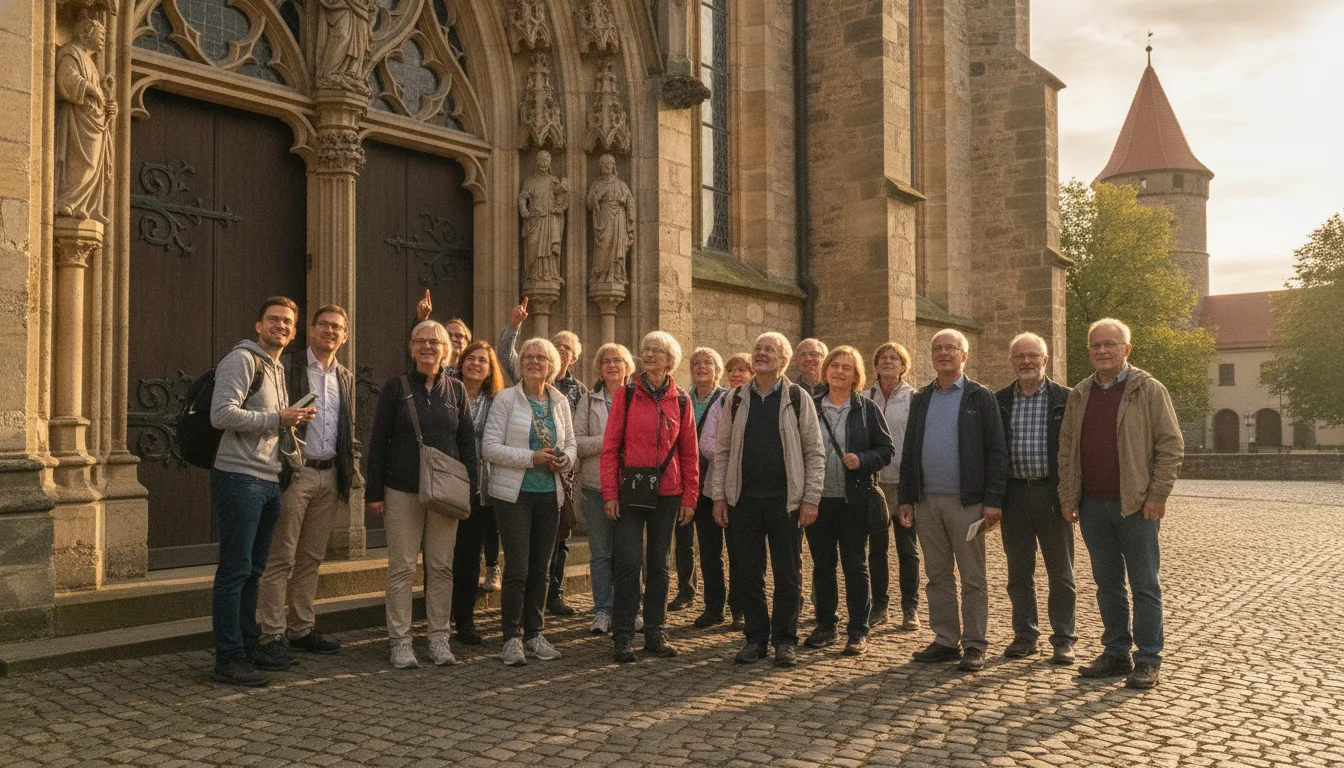
Most pastors who call me about a Reformation trip have already read a few blog posts and picked up a rough shape. Wittenberg, Eisenach, maybe Worms. Then they get stuck on the same wall: how do you turn a handful of famous names into an eight or ten day itinerary that a real group of your people can follow without it feeling like a forced march or a history lecture on wheels? That is the actual question, and it is the one I want to answer here.
I have built heritage journeys for more than forty years, and Reformation routes are some of my favorites to plan because the story has such a clean spine. A monk, a hammer, a set of doors, and a movement that reshaped the church. Your job as the organizer is to take that spine and hang the right stops on it, in the right order, at a pace your congregation can actually walk. Let me show you how I do it, and where the real decisions live for you as the leader.
Start With the Spine, Not the Map
The mistake I see leaders make is opening a map of Germany and trying to connect every Reformation site into one loop. You end up with a route that zigzags, doubles back, and burns half your days on the coach. The better way is to follow the story in order, because Luther’s life is already a route.
He was born and died in Eisleben. He became a monk and lectured in Erfurt. He hid and translated the New Testament at the Wartburg above Eisenach. He nailed the theses, preached, and is buried in Wittenberg. He stood before the emperor at Worms. If you lay those out in the sequence a group can drive, you get a natural line that runs across central Germany, roughly from Eisenach in the west to Wittenberg in the northeast, with Erfurt and Eisleben as the middle beads on the string.
That is your itinerary skeleton. Everything else is a decision about how much time each stop earns and what you add around it. If you want the full planning framework behind this, I lay it out step by step in the group pilgrimage planning guide, which is the piece I point every first-time organizer to before we talk dates.
The Core Reformation Route, Stop by Stop
Here is the itinerary I build from most often for a group of fifteen to thirty. Treat it as a starting frame, not a fixed product. We shape the days around your congregation once we talk.
Wittenberg: Two Nights, the Heart of the Trip
Wittenberg gets the most weight, and it should. This is where the Ninety-Five Theses went up on the Castle Church doors, where Luther preached at the Town Church, where he lived in the Lutherhaus, and where he is buried. I give a group two nights here so you are not rushing. You want an unhurried morning at the Castle Church, time in the Luther House museum, and a slot at the Town Church where Luther actually preached. For a congregation, standing in that pulpit space is often the emotional peak of the whole trip. Do not compress it.
Eisenach and the Wartburg: A Full Day of Contrast
The Wartburg is the castle where Luther hid as “Junker Jörg” and translated the New Testament into German in about eleven weeks. The climb up to it, the room where he worked, and the view over Thuringia give your group the quiet, hidden chapter of the story after the loud public one. In Eisenach below, you also have Luther’s school years and, for groups that care about it, Bach’s birthplace a short walk away. That Bach connection is a gift for church groups with a strong music culture, and it is worth flagging to your people during recruiting.
Erfurt: The Monastery Years
Erfurt is where Luther entered the Augustinian monastery and was ordained. The monastery still stands and you can walk the cloister where he prayed and struggled. Erfurt is also simply a beautiful, well-preserved medieval town, which makes it an easy day for a group that needs a gentler pace. I often place it as a lunch-and-afternoon stop between Eisenach and Wittenberg so the travel days stay short.
Eisleben: Birth and Death in One Town
Eisleben is where Luther was born and where he died, and both houses are preserved and open. It is a shorter stop, half a day, but it bookends the story in a way groups find moving. Standing in the room where the movement’s founder was born and later hearing where he died gives your congregation the full human arc, not just the famous middle.
Worms: The Stand
“Here I stand.” Worms is where Luther faced the Diet and refused to recant. The great Reformation Monument there is one of the most photographed group-photo spots on any of these trips. Worms sits southwest of the core Thuringia and Saxony-Anhalt cluster, so many groups either add it as a day on the front or back of the trip, or fold it into a route that connects to the Rhine. Whether you include it depends on how many days you have, which brings us to the real organizer decisions.
The Decisions That Are Actually Yours
The stops above are the easy part. The choices that shape your trip, and your budget, are these four. This is where your job as organizer really sits.
How Many Days
An eight-day trip covers the core: Eisenach, Erfurt, Eisleben, and Wittenberg, with a day on either end for arrival and departure. A ten-day trip lets you add Worms comfortably, slow the pace, and build in a rest morning, which older groups appreciate. Eleven or twelve days lets you extend into a broader Germany route or add a city like Leipzig or Berlin at the end. My honest advice: for a first Reformation trip with a mixed-age congregation, ten days is the sweet spot. Eight can feel tight, and beyond ten you start paying for days some travelers would rather spend at home.
How Much Study, How Much Sightseeing
This is a spiritual and historical journey, not only a sightseeing tour, and you get to set that dial. Some leaders want a reading from Luther or a short devotional at each key site. Others want the guide to carry the history and keep the group moving. I build the itinerary with room for whichever you choose. Tell me early, because a study-heavy trip needs slightly fewer stops per day so there is time to actually sit and reflect.
When to Go
Reformation Day is October 31, and Wittenberg marks it. A trip timed around late October puts your group in the middle of the commemoration, which is powerful, but it also means booking earlier because you are not the only group with that idea. Late spring, May and June, gives you long daylight and mild weather, which is easier on an older group walking cobblestones. Deep summer is fine but busier at the marquee sites. Winter is quiet and atmospheric but cold, and some smaller sites shorten their hours. Pick the season first, because it drives how far ahead you need to lock the trip.
Who Leads and What It Costs You
Here is the part that decides whether the trip happens at all for many leaders. With fifteen or more paying travelers, you as the group leader travel free. Your flights, hotels, ground transport, and the included site entries are covered. You are not asking your church to send the pastor at the church’s expense. You are organizing a journey your people pay into, and your seat is built into the structure. If you want the full mechanics of how that math works, the piece on how pastors afford to lead a trip walks through it plainly, and how many travelers you need for a free leader seat answers the threshold question directly.
Building the Group That Fills This Itinerary
A great itinerary is worthless if you cannot fill it, so let me be practical about recruiting, because this is the work most leaders underestimate.
Start with your core, not your whole congregation. You do not need to find fifteen strangers. You need the eight to ten people who already love this era of church history, and then let them bring spouses, friends, and study-group partners. Reformation trips recruit well from adult Sunday school classes and from anyone who has taught or sat through a series on church history. Tie the trip to something your congregation is already studying and the interest sharpens fast.
Give people a concrete offer. “We are walking Luther’s route through Germany next May, ten days, Wittenberg to the Wartburg, here is the itinerary and the price” fills a group. “We might do a Germany trip sometime” never does. If you want a fuller playbook on this, the guide on recruiting for a church trip is built for exactly this moment.
Plan far enough ahead. For a group of fifteen to thirty, six to nine months is the working window. It gives your people time to budget and request time off, and it gives you time to recruit, which is the real constraint. A Reformation Day trip or a larger group wants nine to twelve months. Earlier is not just tidier logistics. It is recruiting runway.
Your Real Job Once the Route Is Set
When the itinerary is locked and the free-leader model has taken your personal cost off the table, your attention is freed for the part only you can do. You are not the trip’s accountant or its logistics manager. The operator carries that. You are the shepherd of this group through a story that shaped your faith.
That is the point of building the route well. When the coach, the hotels, the guides, and the site bookings are invisible and handled, you are present to read from Romans in the town where Luther finally understood grace, to lead a moment of reflection at the Castle Church doors, to be with your people in the places that move them. A good itinerary is not a checklist of monuments. It is a frame that keeps your focus where it belongs.
FAQ: Planning a Reformation Group Itinerary
How many days do I need for a Reformation tour itinerary?
Eight days covers the core route of Eisenach, Erfurt, Eisleben, and Wittenberg with arrival and departure days. Ten days lets you add Worms and a slower pace, which is what I recommend for a mixed-age congregation. Beyond ten days you are usually extending into a broader Germany trip.
What is the ideal order of stops on a Luther route?
Follow the story, not the map. Move roughly from Eisenach and the Wartburg in the west, through Erfurt and Eisleben in the middle, to Wittenberg in the northeast, with Worms added on one end if your days allow. Traveling the story in sequence keeps the coach time short and the days coherent.
Should we time the trip around Reformation Day?
You can, and Wittenberg marks October 31 with real weight. Just book earlier, since other groups target the same window. If you want easier weather and lighter crowds for an older group, late spring is the gentler choice. Pick the season first, because it sets how far ahead you must plan.
Does the pastor or group leader really travel free?
Yes. With fifteen or more paying travelers, the group leader’s trip is covered: flights, hotels, ground transport, and the included site entries. Below fifteen the trip is still possible, but the leader pays a participant’s price. Larger groups can sometimes open a second reduced seat for a co-leader or spouse, so raise that early if it matters.
How far ahead should I start planning?
Six to nine months for a group of fifteen to thirty, and nine to twelve months for a Reformation Day trip or a larger group. Most of that lead time is recruiting your people and letting them budget, not booking. Concrete dates and a real itinerary are what move your congregation from interested to committed.
If you are weighing a Reformation journey for your congregation, the fastest way forward is to see the route on a real map with real dates. You can look at how the group experience works on our group heritage tours page, or explore the full route on our Germany heritage page.
Contact us and we will help you shape the itinerary, the timing, and the numbers around your group.