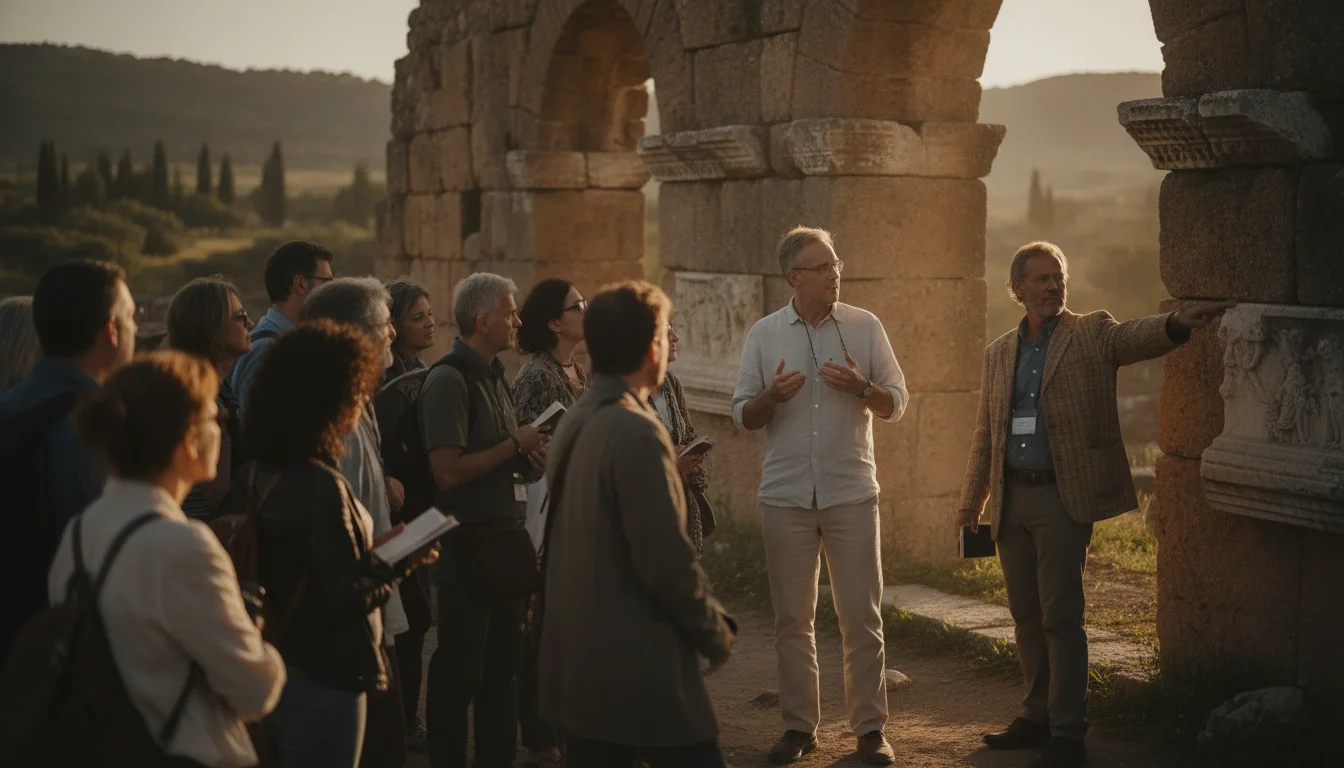
The question I get most often from a first-time group leader is not about price or dates. It is some version of “what am I actually responsible for once we are over there?” Underneath it sits a real fear. A pastor or a rabbi looks at a fifteen-day itinerary across three countries, with coaches and hotels and site permits and meals, and quietly wonders if leading the trip means becoming a travel agent, a bookkeeper, and a tour manager all at once. That fear stops good trips from ever getting off the ground.
I have built heritage journeys for more than forty years, and I want to draw the line for you clearly. There is a clean division of labor between what the tour operator handles and what the leader handles. Once you see where that line sits, the whole thing stops feeling overwhelming, because most of what you were dreading was never your job in the first place.
The Simple Rule: We Run the Trip, You Lead the People
Here is the whole thing in one sentence. The operator is responsible for the machinery of the trip. The leader is responsible for the people on it.
That means everything logistical, the flights, the hotels, the ground transportation, the guides, the site entries, the permits, the meal reservations, the timing, the problem-solving when a road closes or a flight shifts, all of that sits with us. Your job is the part only you can do: gather your community, prepare them spiritually, lead the devotions and the reflections, and be present for your people in the places that move them.
I say this plainly because leaders often assume the two roles are tangled together. They are not. A well-run heritage tour is designed so the organizer never touches a booking system, never negotiates with a hotel, and never counts a receipt. If you find yourself doing operator work on the ground, something has been set up wrong. If you are weighing operators right now, this is one of the sharpest questions to ask a tour operator before you commit: show me exactly where your responsibility ends and mine begins.
What the Tour Operator Handles
Let me be specific, because “we handle logistics” is too vague to plan against. Here is what falls on our side of the line on a typical group heritage journey.
Transportation, Start to Finish
People often ask who arranges the group transportation, and the answer is that the operator does, all of it. International flights as a group booking, airport transfers when the group lands, the private coaches that move you between cities, the drivers, the fuel, the parking, the ferry crossings if the route calls for them. When your itinerary runs from Thessaloniki down to Athens, or from Tel Aviv up to the Galilee, the vehicle is waiting, the driver knows the route, and the timing is built around your day.
You do not book a bus. You do not rent vans. You do not work out how thirty people and their luggage get from a hotel to a hilltop site with a narrow access road. That coordination, including the unglamorous parts like where a full-size coach can legally stop, is ours. The organizer’s only transportation job is telling us the group size and any mobility needs, so we size the vehicles correctly.
Hotels, Meals, and Site Access
We book the hotels, hold the room block, manage the rooming list you give us, and handle the deposits and balances with the properties. We arrange the meals that are built into the itinerary and reserve group seating so a party of twenty-five is not standing at a restaurant door hoping for tables. We secure the site entries and, where they are needed, the special permits and timed tickets that keep a group from waiting in a general line for two hours.
That last piece matters more than most first-time leaders realize. Many meaningful sites require advance group arrangements, and some require a licensed local guide as a condition of entry. Handling those requirements is operator work. You should never be the one calling a national park office in another language to sort out a group booking.
The Local Guide
Yes, heritage tours include a local guide, and arranging that guide is squarely the operator’s job. This is one of the most important things we provide, so let me spend a moment on it.
A local guide is a licensed, on-the-ground expert for the region you are traveling through. In many countries, guiding at major historical and religious sites is a licensed profession, and only credentialed guides are permitted to lead groups there. We engage those guides for you, brief them on the nature of your group, whether you are a Christian congregation walking a Pauline route or a Jewish community tracing heritage sites, and make sure the guide’s focus matches yours.
The local guide handles the historical and archaeological narration, the site-by-site context, the “here is where this happened and here is what you are looking at” layer that gives the trip depth. They also handle the practical navigation of each site: where to enter, where the group photo works, where the restrooms are, how much time each stop really needs. That frees you entirely from being the logistics voice at every site. If you want the full picture of who does what across the whole planning arc, our guide to planning a group pilgrimage walks through it stage by stage.
The Problems You Never See
The part of operator work that is hardest to describe is the part that is invisible when it goes well. A flight time changes and we rebook the connecting transfer before you hear about it. A site closes unexpectedly and we reorder the day so the group barely notices. A traveler needs a pharmacy or a doctor and we know where to send them. Weather reshuffles an outdoor morning and we have already moved the indoor stops forward.
This is the machinery running underneath the trip. A leader should feel it only as smoothness. When people tell me a trip “just flowed,” what they are describing is dozens of small operator decisions they never had to make.
What the Leader Handles
Now the other side of the line. Your responsibilities are real, but notice how different they are in kind. None of them require a booking system or a spreadsheet of vendor invoices. They require exactly the gifts you already have as a congregation leader.
Gathering and Recruiting Your Group
The trip exists because you call your people to it. That is your first and most important job, and it is one only you can do. Nobody at the operator can stand in front of your congregation and say “come walk this road with me.” You know your community, you know who has been longing to make this journey, and you carry the trust that turns interest into a signed commitment. If recruiting feels daunting, we have practical help for that in our piece on how to recruit for a church trip, but the relational work stays with you.
Preparing People Spiritually
A heritage journey is not a sightseeing holiday, and you are the one who makes sure it is not. Before departure, you set the frame: what you are studying, what scriptures the group will read on-site, what this trip means for your community. On the ground, you lead the devotions at the river outside Philippi, the reading of the text at the Sea of Galilee, the moment of silence at a Holocaust memorial. The local guide gives the history. You give the meaning. That is the leader’s irreplaceable contribution.
Being the Pastoral Presence
Fifteen to a hundred people traveling together will have a full range of human moments. Someone gets tired. Someone gets emotional at a site that touches them deeply. Someone in the group needs encouragement, or gentle correction, or simply a familiar face. That pastoral presence is yours. We handle whether the coach arrives. You handle how your people are doing inside it.
Communicating Group Decisions to Us
There is a small band of coordination that sits with the leader, and it is worth naming so nothing falls through. You are our single point of contact for group-level decisions: confirming the final headcount, passing along the rooming list (who shares with whom), flagging dietary needs and mobility considerations, and relaying any special requests your group has. You collect that information from your travelers and hand it to us in one clean channel. We do the rest. A simple group planning checklist keeps that handoff organized so you are never chasing scattered details.
How the Tour Guide Supports the Group Leader
This partnership deserves its own section, because when it works, it is the quiet engine of a great trip. People wonder how a tour guide supports a group leader, and the honest answer is that a good guide makes you look good and frees you to lead.
Think of it as two complementary roles moving through each day together. The guide carries the informational and logistical load at every site, so you are never scrambling to explain a ruin or figure out where the group goes next. That leaves your hands free for the spiritual and pastoral work. When the guide finishes explaining the archaeology of an ancient synagogue or the layout of the agora where Paul spoke, they hand the moment to you, and you lead the reflection. The transition is seamless when both people understand the division.
A strong guide also protects your energy. They manage pace, keep the group together, handle the hundred small “when do we eat, where is the bathroom, how long here” questions, and absorb the logistical friction of the day. By the time an emotionally significant moment arrives, you are not depleted from crowd management. You are present. That is the whole design. We brief guides specifically to support the leader this way, and choosing an operator who understands that dynamic is a real part of how you choose a faith tour operator.
Why This Division Protects Your Trip
I want to close on why this line matters so much, beyond just making your life easier.
When a leader tries to take on operator work, two things go wrong. First, the logistics suffer, because running international group travel well is a full-time craft, not a side task you pick up between sermons. Second, and worse, the leading suffers, because a pastor buried in bus schedules and hotel disputes has nothing left for the people who came to be led. The trip becomes a managed event instead of a shared journey.
The clean division exists to prevent exactly that. It keeps the machinery with the people who run machinery for a living, and it keeps the shepherding with the shepherd. That is not a convenience. It is what makes a heritage journey feel like a pilgrimage rather than a complicated vacation. You can see how the group experience is structured on our group heritage tours page.
FAQ: Operator and Leader Responsibilities
Do heritage tours include a local guide, or do I need to hire one myself?
The operator includes and arranges the local guide. In many countries, guiding at major historical and religious sites is a licensed profession, so the guides we engage are credentialed for the regions you travel through. You never hire or coordinate a guide yourself. We brief them on your group so their focus matches yours, whether Christian or Jewish heritage.
Who arranges the group transportation?
The operator arranges all of it: international group flights, airport transfers, the private coaches between cities, drivers, ferries where needed, and the logistics of moving your group and luggage between sites. Your only transportation input is telling us the group size and any mobility needs so we size the vehicles correctly.
What am I actually responsible for as the leader?
Gathering and recruiting your group, preparing them spiritually, leading the devotions and reflections on-site, providing pastoral presence, and being our single point of contact for group decisions (final headcount, rooming list, dietary and mobility needs). Everything logistical sits with the operator.
How does the local guide support me during the day?
The guide carries the historical narration and the site logistics at every stop, then hands the meaningful moments to you for reflection. They manage pace, keep the group together, and answer the constant practical questions, which protects your energy so you are present for your people when it matters most.
What if a problem comes up on the ground, like a flight change or a closed site?
That is operator work, and you should feel it only as smoothness. We rebook transfers, reorder the day, and solve the problem before it disrupts your group. You are not expected to negotiate with hotels, airlines, or site offices at any point during the trip.
If you want to see exactly where our responsibility ends and yours begins for your specific route and group, that is a conversation we have with every leader before anything is booked. Contact us and we will map out the full division of labor for your trip, so you know precisely what you are signing up to lead and what we are carrying for you.