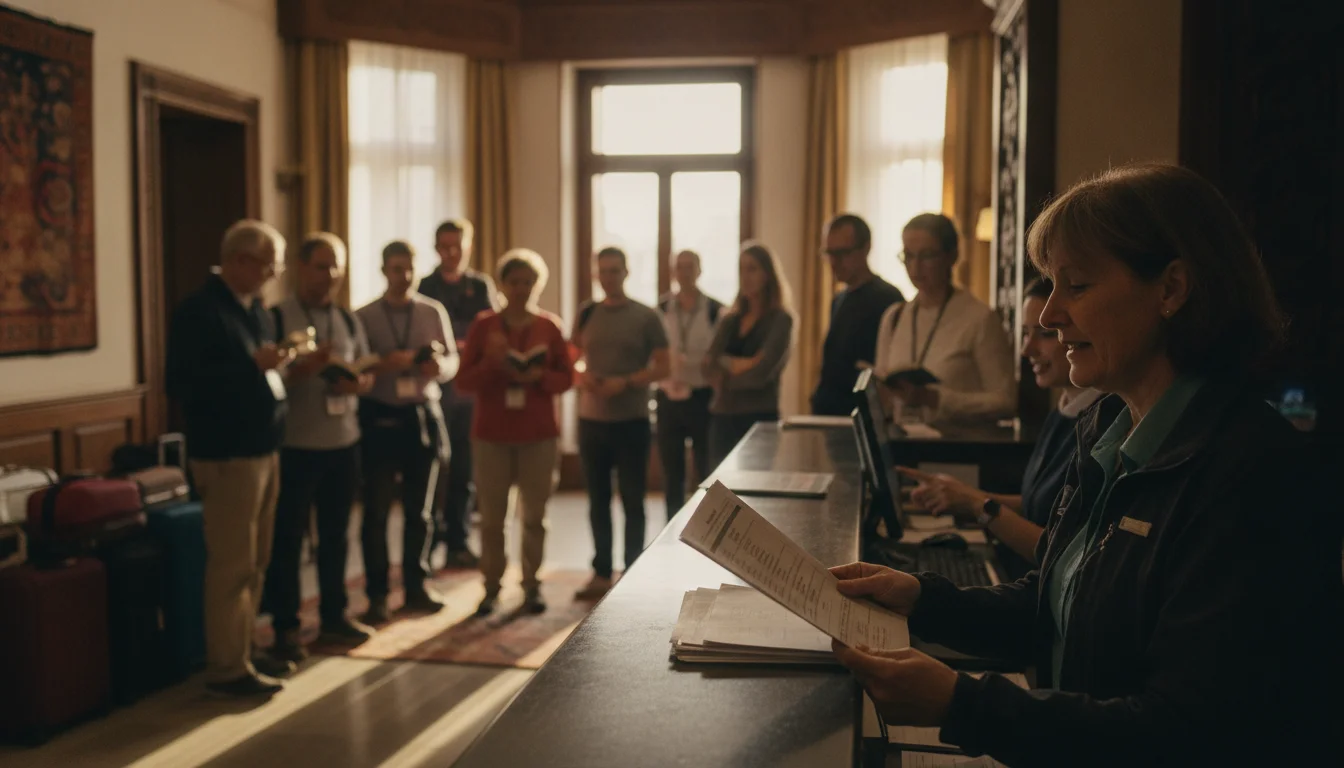
The rooming list is the part of group planning that no pastor or rabbi ever expects to spend time on, and then somehow spends more time on than the itinerary. I have watched it happen for four decades. A leader recruits thirty people, gets everyone excited about walking Paul’s route or standing at a heritage memorial, handles the deposits, and then two weeks before the deadline realizes he has no idea who is sharing a room with whom, who wants a bed to themselves, and who quietly assumed a private room was included.
I have built heritage journeys for more than forty years, and I want to save you that scramble. A rooming list is not complicated once you understand what it actually is and when to lock it. It is simply the document that tells the operator how many rooms to book and who sleeps where. Handled early and handled plainly, it takes an afternoon. Handled late, it eats your last three weeks. This guide walks you through the whole thing from the organizer’s chair, because you are the one who owns it, not your travelers.
What a Rooming List Actually Is
A rooming list is the master document that pairs every traveler in your group with a room. For a group of thirty, that might be twelve double rooms and six single rooms, or some other mix. The operator uses it to book the right room count at every hotel on the itinerary, which is why it has to be right before final payment.
Here is the piece most first-time leaders miss. Hotel pricing for groups is built on double occupancy, meaning two people sharing one room. The per-person price you quote your congregation assumes two travelers split a room and its cost. That is the standard, and it is what makes group pricing work. The rooming list is where you translate your list of names into that structure and flag every exception before it becomes a billing surprise.
So your job is not to arrange people like a seating chart. Your job is to collect three simple facts from each traveler: are they coming as a pair who will share, are they coming alone and willing to share with someone, or are they coming alone and want a room to themselves. Everything else flows from those three answers.
Single vs Double Rooms on a Group Tour
This is the question that drives the whole rooming list, so let me be direct about it.
A double room is shared by two travelers. The cost is split, which is why double occupancy is baked into your group’s per-person price. Couples take a double as a matter of course. Two friends, two siblings, or two members of the same Bible study who agree to share also take a double. When someone books at the standard price, they are booking a bed in a shared room. That is the default, and most of your travelers will fall into it without a second thought.
A single room is occupied by one traveler alone. It costs more, and that added cost has a name that every leader needs to know: the single supplement. This is the extra amount a solo traveler pays to have a room to themselves, because the operator is now paying for a full room that only one person’s fare covers. The supplement is not a penalty and it is not a markup for profit. It is simply the gap between one fare and the real cost of an unshared room.
Here is how I coach leaders to present it. In your recruiting materials and your info sheet, state the per-person price and then, right underneath it, state the single supplement as a clear separate line. Something like: the trip is a set price per person based on two people sharing a room, and a private room is available for an additional supplement. When people see it upfront, nobody feels ambushed. When they discover it three weeks before departure, you have an awkward conversation and sometimes a lost traveler.
A few realities worth telling your group plainly:
- Most solo travelers are happy to share. Widows, widowers, single adults, and members traveling without a spouse often prefer a roommate for the company and the lower cost. Ask the question and you will fill more doubles than you expect.
- Some solo travelers will always want privacy, and that is completely fine. Offer the single supplement, state the number, and let them choose without any pressure.
- The single supplement is per person, not per trip. Four private rooms mean four supplements.
If you want to see how the room mix folds into the overall trip budget, our guide to what a church group trip costs breaks the line items down, and the budgeting walkthrough for a church trip shows where rooming decisions land in the total.
Matching Roommates Without Playing Matchmaker
The part leaders dread is pairing solo travelers who did not arrive with a roommate. It sounds like social engineering, and nobody signed up to be a matchmaker. It is genuinely simpler than it looks.
Ask one question on your sign-up form: if you are traveling alone, would you like us to match you with a roommate of the same gender, or would you prefer a private room with the single supplement? That single question does ninety percent of the work. The people who want to share raise their hand. The people who want privacy raise theirs. You are no longer guessing.
For the ones who want to be matched, keep it easy on yourself. Pair by gender first, which is non-negotiable, and then by anything you happen to know, similar age or similar sleep habits. You do not need a personality test. Most pairings on a heritage trip work fine because travelers are together all day and only sleeping in the room. When a match is uncertain, a quick phone introduction before the trip settles it. I have paired hundreds of strangers this way and the number who asked to switch is very small.
One more piece of advice from experience. Keep a short list of who is willing to be flexible. There is almost always a late cancellation or an odd number that leaves one person without a partner. Knowing in advance who said “I do not mind sharing with whoever” gives you a clean solution instead of a last-minute problem.
The Deadline Is the Whole Game
If you take one thing from this guide, take this. The rooming list has a hard deadline, and that deadline is tied to your final payment date, usually somewhere between sixty and ninety days before departure. The operator has to confirm room blocks with hotels, and hotels release unconfirmed rooms back to general sale. Miss the window and you risk paying more or losing availability entirely.
So set your own internal deadline two to three weeks earlier than the operator’s. Tell your group the rooming list closes on a date that gives you buffer. When you collect the final answers by your date, you have time to chase the three people who always answer late, resolve the two pairings that fell through, and hand the operator a clean list on their date, not a scramble.
I run it in three passes:
- First pass, at sign-up. Capture the rooming preference on the registration form itself, alongside the deposit. You will have most of your data before anyone has thought hard about roommates.
- Second pass, at the midpoint. A month or two out, send one message confirming each person’s room choice and roommate. This is where couples confirm, solo travelers commit to sharing or upgrading, and any changes surface while there is still room to fix them.
- Third pass, final lock. Two to three weeks before the operator’s deadline, close the list. After this, changes may carry a fee, and you say so plainly in advance.
This rhythm keeps the rooming list from ever becoming an emergency. It also fits naturally into the broader timeline in our church group planning checklist, which maps every deadline against your departure date.
Protecting Yourself on the Money Side
A rooming list is a financial document as much as a logistical one, and this is where leaders get burned. Two specifics will save you real money and real awkwardness.
First, tie the single supplement to payment at sign-up, not at the end. If someone wants a private room, collect the supplement as part of their deposit or first installment. When the supplement is due upfront, people make a clear-eyed choice. When you let it ride until final payment, some travelers forget they chose a single and push back on the charge, and you are the one caught in the middle. Fold the rooming choice into your group payment plan so the room cost is collected on the same schedule as everything else.
Second, handle the “my roommate dropped out” case before it happens. When two people book a double and one cancels close to the trip, the remaining traveler is suddenly alone in a room built for two, and someone has to cover the second fare. Decide your policy in advance and put it in writing: either the remaining traveler pays the single supplement, or you keep a flexible-sharer on standby to fill the spot, or the group absorbs it by prior agreement. Any of those works. What does not work is deciding it in a panic two weeks out with a hurt traveler on the phone. Your travel insurance conversation belongs here too, and our note on travel insurance for a church group covers how cancellations play against coverage.
What This Frees You to Do
Here is what I most want you to hear, because it is the whole point. When the rooming list is collected early, presented plainly, and locked on your own schedule, it stops being a source of stress and becomes a ten-minute administrative task. You are not chasing thirty people in the final week. You are not absorbing surprise supplements out of the church budget. You are not refereeing a roommate dispute at the airport.
You are doing your actual job, which is leading. Your role on a heritage journey is to shepherd your people through the places that move them, to read Scripture aloud where it happened, to be present at a memorial or a holy site. The rooming list is plumbing. Get it right early and it disappears, which is exactly what good plumbing does. A trustworthy operator makes this easy, which is why our guide to choosing a faith tour operator is worth a read before you sign anything.
If you are still mapping out the full arc of leading a group, from recruiting to logistics to the day you land, start with our complete guide to planning a group pilgrimage. It puts the rooming list in its proper place: one task among many, and never the one that should keep you up at night.
FAQ: Handling a Group Rooming List
What is a rooming list and when do I need it?
A rooming list is the master document that pairs each traveler with a room and tells the operator how many singles and doubles to book. It has to be final before your group’s final payment date, usually sixty to ninety days before departure, because hotels confirm room blocks by then. Collect preferences at sign-up and lock the list two to three weeks before the operator’s deadline.
What is the difference between a single and a double room on a group tour?
A double room is shared by two travelers who split the cost, and it is the default that group per-person pricing is built on. A single room is for one traveler alone and costs more because one fare now covers a whole room. That added cost is the single supplement, and you should state it as a clear line item in your recruiting materials.
What is a single supplement and who pays it?
The single supplement is the extra amount a solo traveler pays for a private room, since their one fare does not cover a full room that would normally hold two. It is per person, not per trip, so four private rooms mean four supplements. It is not a penalty, just the real cost of an unshared room, and it is cleanest to collect it at sign-up rather than at final payment.
How do I match roommates for travelers coming alone?
Ask one question on your sign-up form: would you like to be matched with a roommate of the same gender, or do you prefer a private room with the supplement. Pair the ones who want to share by gender first, then by age or sleep habits if you know them. Most pairings work fine because travelers are together all day and only sleep in the room, and a short phone introduction before the trip settles any doubts.
What happens if a traveler’s roommate cancels?
Decide the policy before it happens and put it in writing. The remaining traveler either pays the single supplement, gets matched with a flexible standby sharer, or the group covers the gap by prior agreement. The one thing to avoid is deciding it in the final weeks with an upset traveler on the phone, so name the policy in your registration terms from the start.
If you are planning a heritage journey for your congregation and want the rooming details handled cleanly from day one, take a look at how our group heritage tours are structured.
Contact us and we will help you build the room mix and the timeline around your group and your dates.