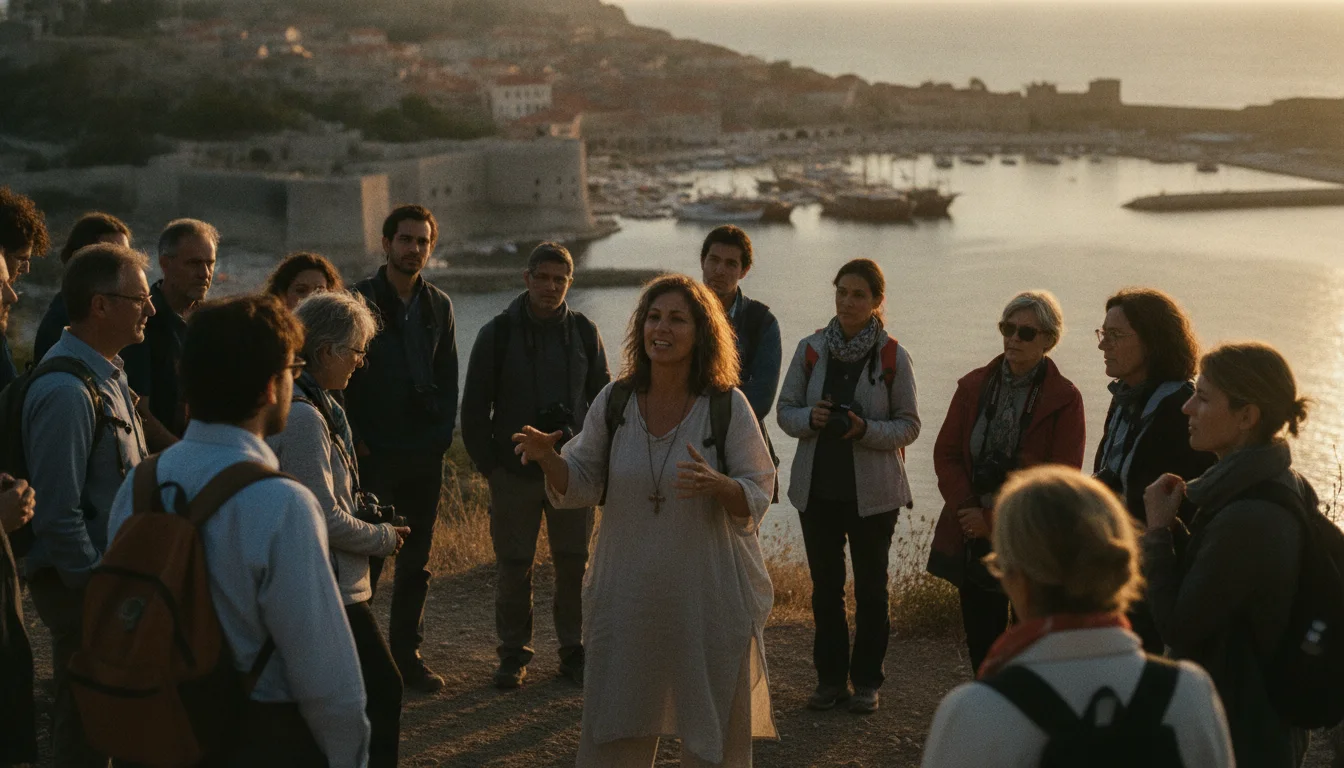
Every few years a pastor or a rabbi calls me and says something I love to hear: “We do not want to just visit one country. We want the whole story.” That is where a bundled trip comes from. One congregation walks the sites in Israel, crosses to Greece, then follows the road into Turkey, all inside a single journey. It sounds like a logistical mountain. It is not, once you know how these trips are built.
I have built heritage journeys for more than forty years, and multi-country group trips are some of the most rewarding work I do. They are also the trips where the organizer’s early decisions matter most. So I want to walk you through how a church group tour bundle across the Holy Land, Greece, and Turkey comes together: how the free-leader benefit carries across the whole trip, how the route is stitched, what it costs, and how you fill a group big enough to make it work. I will also cover two other pairings congregations ask me about a lot: a heritage trip to Poland and Germany, and a trip that combines Israel and Egypt.
Why Congregations Bundle Countries in the First Place
A single-country trip answers one question. A bundled trip answers the arc.
For a Christian congregation, the Holy Land gives you the life of Jesus. Greece and Turkey give you the spread of the church: Paul in Philippi and Corinth, the seven churches of Revelation, Ephesus, Antioch. When you put those in one journey, your people do not just see where the story started. They walk where it went. That through-line preaches itself.
For a Jewish congregation, the same logic holds with different anchors. Israel is the center. Greece carries a deep Sephardic and Romaniote history in Thessaloniki and Ioannina, and Turkey holds the story of the Jews of Istanbul and Izmir. A combined route lets a synagogue group trace a people across borders, not just visit a homeland.
The organizer’s real question is never whether the arc is worth telling. It is whether you can hold three countries together without it turning into a blur. That is solvable, and the solution starts with the leader benefit, because that is usually what makes the budget move.
The Free-Leader Benefit Carries Across the Whole Bundle
Here is the part organizers most want to understand, so let me be direct. When your group reaches fifteen paying travelers, the group leader travels free, and that benefit applies to the full bundled itinerary, not just one leg of it.
That means the leader’s flights, hotels, ground transportation, site entries, and the group meals built into the trip are covered across all three countries. You are not getting a free week in Israel and paying your own way through Greece and Turkey. You are getting one covered seat on one trip that spans three countries. On a longer bundle, that seat is worth more than on a single-country week, which is exactly why the model matters most here.
If you want the mechanics of how the fifteen-traveler threshold works and what the seat covers, I lay it out in our guide on whether the pastor travels free, and there is a companion piece on how many people you need for a leader-free trip. On a bundle, reaching fifteen is usually easier than on a short trip, because the ambition of the itinerary pulls in your more committed travelers. People who would skip a standard week in one country will clear their calendar for a journey that ties the whole story together.
Larger groups open more room. A bundle that fills to twenty-five or thirty can sometimes carry a reduced or complimentary second seat for a co-leader or a spouse. On a three-country trip, a second set of hands is useful, so if your group is trending large, raise it early.
How the Route Actually Gets Stitched Together
The fear I hear most is that a three-country trip means three times the chaos: three sets of transfers, three guides who do not talk to each other, and a group that spends half its time in airports. That is a badly built bundle. A well-built one does not feel like three trips at all.
The route runs in a logical geographic order so you are always moving forward, never doubling back. A common Christian shape starts in Israel for the Holy Land core, flies to Greece for the Pauline sites, then crosses into Turkey for Ephesus and the churches of Revelation before flying home from Istanbul. The flights between countries are short and booked as part of the trip. One operator holds the whole chain, so the guide handoffs, the hotels, and the coaches are coordinated before your group ever leaves home.
The single biggest logistical decision you make is length. Ten days is tight for three countries and works only at a highlights pace. Twelve to fourteen days is the comfortable range, because it leaves room for the moments that matter: reading Scripture at the actual site, sitting quietly at a memorial, letting your people absorb a place instead of photographing it and moving on. If you want to see how a single-country foundation reads first, our ten-day Holy Land itinerary is a useful baseline, and the footsteps of Paul church trip guide shows how the Greece and Turkey legs connect.
You can see how the individual country routes are built on our Israel heritage page, our Greece heritage page, and our Turkey heritage page. A bundle is those three routes joined by short flights and one plan.
What a Bundle Costs to Hold Together
Organizers deserve straight talk on money. A bundled trip costs more per person than a single-country week, because it is longer and covers more ground. What surprises people is that it is often more efficient per day than three separate trips would be, because you fly across the Atlantic once instead of three times.
The costs that drive a bundle are the intercountry flights, the extra nights of hotels, and the additional ground days with local guides. Those are real, and I do not soften them. What offsets them is scale. The more travelers you gather, the wider those fixed costs get spread, and the more comfortably the leader’s free seat sits inside the structure. Fifteen makes it work. Twenty-five makes it work more smoothly.
The practical move for you as the organizer is a payment plan, not a single lump ask. A twelve-day trip across three countries is a meaningful sum, and your people commit far more readily to a deposit plus monthly installments than to one large check. We walk through this in the group trip payment plan guide, and the budget a church trip piece breaks down every line before you set a price. For the widest view end to end, start with our pillar guide on how to plan a group pilgrimage, the map I would hand any first-time organizer.
A Congregation Heritage Trip to Poland and Germany
Not every bundle points east to the biblical world. One of the most requested pairings I build is a congregation heritage trip to Poland and Germany, and it carries a different weight.
This is a memory journey. For a Jewish congregation, it traces the world that was and the catastrophe that ended it: the Jewish quarters of Krakow, the ground at Auschwitz-Birkenau, Warsaw and its ghetto memory, then west into Germany for Berlin’s memorials. For a church group, the same route becomes a serious study of conscience, faith, and moral witness. Either way, it asks for a slower pace and a leader prepared to hold space for heavy days.
The organizer’s decisions here lean less on sightseeing logistics and more on emotional pacing. You want a route that alternates hard sites with room to process, and a guide who handles memorial spaces with care. And you want the leader free to be present rather than managing the trip, which is exactly what the fifteen-traveler benefit buys you. You can see how the regional route is structured on our Poland heritage page and our Germany heritage page. Plan further ahead than usual here, nine to twelve months, because the sites require careful scheduling and a group needs time to prepare for what they will feel.
A Congregation Trip Combining Israel and Egypt
The other pairing I am asked about constantly is a congregation trip combining Israel and Egypt, and it is one of the most natural bundles in heritage travel.
The reason is the Exodus. A group that stands at the pyramids and then crosses into the Sinai and up into Israel is not visiting two countries. It is walking the spine of a story: bondage in Egypt, the wilderness, the promised land. For a church group, you add the flight into Egypt of the Holy Family and the monastic history of the Egyptian church. For a synagogue group, you are tracing the founding narrative of the people itself.
The logistics center on the border crossing and the pacing between two very different countries. It is well-traveled ground, and a single operator manages the crossing and the guide handoff so your group does not carry that stress. Your job is to decide how many days each country gets, and my usual counsel is not to shortchange Egypt to a single day of pyramids. You can see how each side is built on our Egypt heritage page and our Israel heritage page. The free-leader benefit spans the full combined trip here just as it does on the Greece and Turkey bundle, so at fifteen travelers your seat across both countries is covered.
Filling a Group Big Enough for a Bundle
A bundle needs the same fifteen travelers as any leader-free trip, and on an ambitious itinerary that number is often easier to reach. Here is how I coach organizers.
Start with your core, not your whole roster. You need the eight to ten people who already want the big journey, then let them bring others. Couples travel together, small groups travel as a unit, and the ambition of a three-country trip is its own recruiting tool. Give people a concrete reason and real dates. “We are walking from Cairo to Jerusalem next spring, fourteen days, here is the route” fills a group. “We might do a big trip sometime” never fills one.
Plan far enough ahead. A bundle wants nine to twelve months of runway, more than a single-country week, because your people need time to budget for a larger trip and to clear a longer stretch of calendar. That lead time is not just booking. It is recruiting, and recruiting is the real work. Our guide on recruiting for a church trip covers the tactics that move people from interested to committed.
The Leader’s Real Job on a Bundle
I will close with the thing I most want organizers to hear. On a three-country trip, the temptation is to become the operations manager, tracking transfers and counting heads at every airport. The free-leader model exists so you do not have to be that person.
Your job on a bundle is to be the thread that ties the arc together for your people. You are the one who reads the Exodus aloud where it happened, who connects Paul’s letters to the ruins in front of your group, who leads a moment of silence where words are hard to find. The operator makes the logistics invisible so your attention stays on your community. A well-built bundle is three countries that feel like one journey, and a leader who is free, in every sense, to guide it.
FAQ: Bundling a Church or Congregation Group Tour
Does the free-leader benefit apply across all the countries in a bundle, or just one leg?
It applies to the whole trip. With fifteen or more paying travelers, the group leader’s full journey is covered across every country in the bundle: flights, hotels, ground transportation, site entries, and included meals. It is one covered seat on one multi-country trip, not a benefit that stops at the first border.
How long should a Holy Land, Greece, and Turkey bundle be?
Twelve to fourteen days is the comfortable range for all three countries. Ten days is possible at a highlights pace, but it leaves little room to absorb each site. The extra days turn three countries into one coherent journey rather than a rushed checklist.
Can we combine Israel and Egypt, or Poland and Germany, with the same leader benefit?
Yes. The fifteen-traveler leader-free structure works on any bundled route we build, including an Israel and Egypt Exodus trip or a Poland and Germany heritage journey. The route changes, the leader benefit does not.
How far ahead should we plan a multi-country group trip?
Nine to twelve months. A bundle is longer and costs more per person than a single-country week, so your travelers need more time to budget and clear their calendars. That runway is also recruiting time, which is the real work of filling a group.
Is a bundle a lot more expensive than a single-country trip?
It costs more in total because it is longer, but it is often more efficient per day than three separate trips, since you fly across the ocean once. A payment plan with a deposit and monthly installments makes the larger sum manageable.
If you are weighing a bundled trip for your congregation, the smartest first move is to see how the group experience is structured. Start with our group heritage tours page to see how it all fits together.
Contact us and we will help you shape the bundle, run the numbers for your group, and pick the dates that fill.