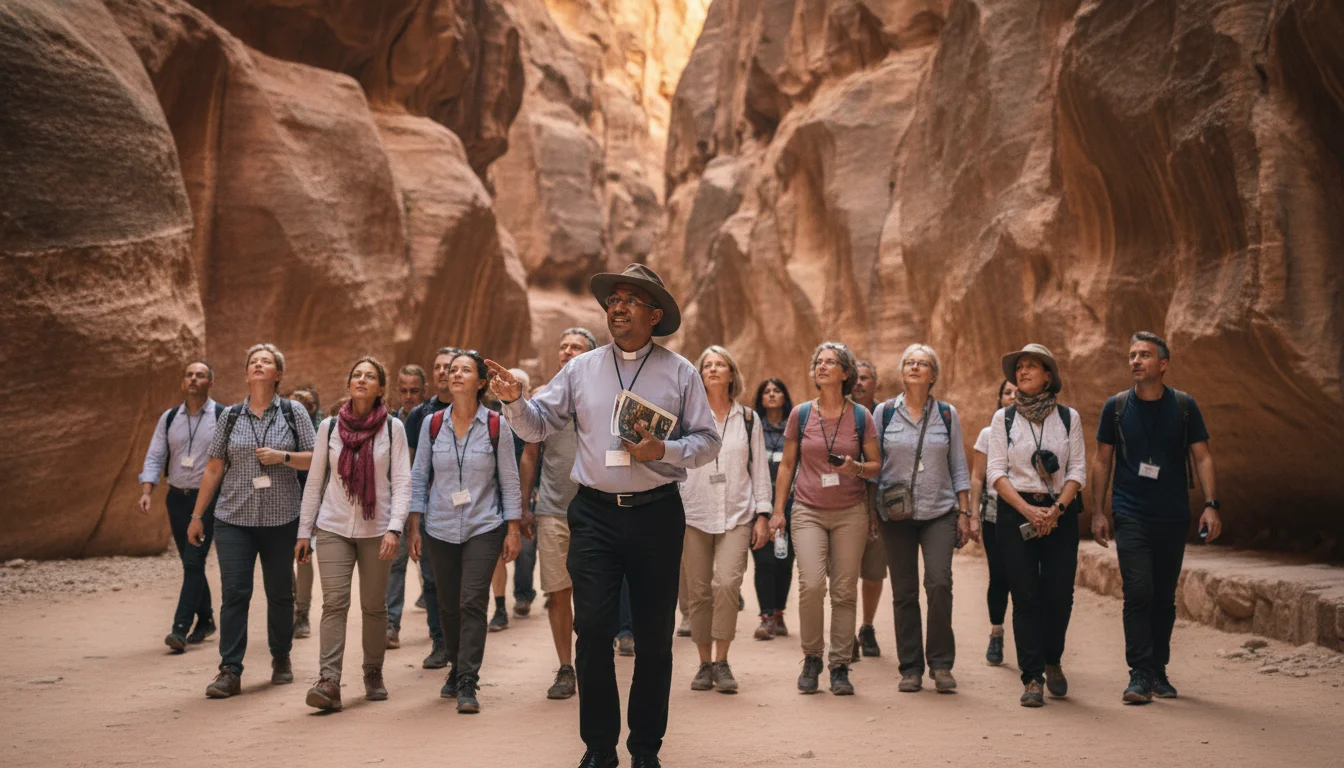
The first question I usually get about Jordan is not about Petra or Mount Nebo. It is quieter than that. A pastor will lean in and ask whether a trip like this is even realistic for a congregation that has never traveled together before. My answer, after more than forty years of building heritage journeys, is that Jordan is one of the most forgiving places to lead your first group. The country is compact, the biblical sites are close together, and the logistics are simpler than most leaders expect. What you need is not courage. It is a plan.
I want to walk you through what it actually takes to organize and lead a church group tour to Jordan. Not the brochure version. The version where you know what you are recruiting toward, what it costs, how your own seat gets covered, and how the trip fits together if you decide to pair it with Israel. This is written for the person doing the organizing, the pastor or ministry leader whose name is on the sign-up sheet, not for the traveler filling a seat.
Why Jordan Works So Well for a First Group Trip
Jordan carries a lot of Scripture in a small footprint. Mount Nebo, where Moses looked out over the Promised Land, sits less than an hour from Madaba and its ancient mosaic map of the Holy Land. The Baptism Site at Bethany beyond the Jordan, where many hold that John baptized Jesus, is a short drive from Amman. Petra, Jerash, the King’s Highway, the wilderness of Wadi Rum where so much of the Exodus wandering echoes. You can build a rich, week-long journey without long transfers eating your days.
For a group leader, that density is a gift. Short driving distances mean fewer things go wrong. Fewer things going wrong means you spend your energy shepherding your people instead of managing a schedule that is always slipping. When I place a first-time leader in Jordan, I am doing it on purpose. It is a country that lets you lead well before you have led at all.
If you are still mapping out the shape of your journey before you commit to a destination, our group pilgrimage planning guide is the place I would start. It lays out the whole arc, from first idea to boarding gate, and everything below assumes you have that framework in the back of your mind.
The Leader’s Seat: How You Travel Free
Let me get to the part most leaders are too polite to ask about directly. How do you afford to go?
The model we build around is straightforward. With fifteen or more paying travelers in your group, the group leader travels free. That means your full trip cost is covered: international flights, hotels, ground transportation, site entries, and the group meals built into the itinerary. You are not paying your own way and hoping the church reimburses you. Your seat is structured into the economics of the group booking.
This is not a discount or a partial credit. A group of fifteen paying participants generates enough margin inside the trip’s costing to carry one additional traveler, and that traveler is you. You are the reason the group exists, so the model is built so your seat is the complimentary one. I walk through exactly why the number lands at fifteen, and what changes above it, in the piece on how many travelers it takes for the leader to go free. If you are wondering whether this applies to pastors specifically, the short answer is yes, and the longer answer is in does the pastor travel free.
Larger groups open more room. A group of twenty-five or thirty can sometimes unlock a second reduced or complimentary seat for a co-leader or a spouse. If that matters to you, and for many leaders bringing a spouse is the thing that makes the whole trip possible, raise it early so we can build toward it from the start rather than trying to bolt it on late.
What a Church Group Tour to Jordan Costs
Cost is where good planning either builds trust with your congregation or quietly erodes it. So let me be plain about how to think about it.
A Jordan group trip is priced per traveler, and the per-person price depends on three things: the length of the itinerary, the hotel category you choose, and your group size. Bigger groups spread the fixed costs (the guide, the coach, the local operators) across more people, which brings the per-person price down. That is the same mechanism that funds your free seat, which is why recruiting well helps everyone, not just you.
I never quote a single number in a guide like this, because a real number depends on your dates, your group, and your route, and a made-up figure would just mislead you. What I will tell you is how to frame it for your people. Give them an all-in price that covers the trip itself, then a short, honest list of what is not included: passport fees, travel insurance, personal spending, and any optional excursions. Congregations forgive a fair price. What they do not forgive is a surprise. Our breakdown of what a church trip to Israel costs uses the same logic and is a useful companion when you are pairing the two countries, which many leaders do.
On the money mechanics, two tools do most of the heavy lifting for a group. A group payment plan lets travelers pay in installments rather than one intimidating lump, and it dramatically improves your conversion from interested to committed. Set a deposit, set a few milestone dates, and let people spread the balance. It is the single most effective thing you can do to help a middle-income congregation say yes.
Israel and Jordan: Building the Combined Journey
The most common question I field after cost is whether to do Jordan on its own or pair it with Israel. For a lot of congregations, an Israel and Jordan church group tour is the trip they actually dream about, and the two countries fit together naturally.
Geographically it is clean. Groups typically cross at the Jordan River or the southern border near Eilat and Aqaba, so you are not backtracking or flying between them. Thematically it is even cleaner. You can stand on Mount Nebo where Moses saw the land he would not enter, then cross over and walk into that same land yourself. Few moments in group travel land the way that one does. You read Deuteronomy 34 on the mountain, and then the group physically does what Moses could not.
Here is my practical counsel on the combined trip. It is longer, usually ten to twelve days, and it asks more of your travelers in both time and budget. So it recruits differently. A standalone Jordan trip of six to eight days is easier for a first-time group and a first-time leader. A combined Israel and Jordan journey is the right call when you already have a core of committed travelers and a congregation that has been asking for the Holy Land for years. If you are leaning that direction, our guides on how to organize a church trip to Israel and the shape of a church group trip to Israel carry straight over. You can also see how the two destinations connect on our Jordan heritage page and our Israel heritage page.
One logistical note leaders forget: the combined trip involves a land border crossing, which adds a step to your day and a small set of documents. It is routine, and your operator handles it, but you want to tell your travelers about it in advance so it feels like part of the adventure rather than a surprise checkpoint.
Recruiting a Group That Reaches Fifteen
This is the work most leaders underestimate, so let me be direct about how it actually happens.
You do not recruit fifteen strangers. You start with the six to eight people in your community who already want to go, and you let them bring others. Every group I have run for four decades started from a small core of the committed, not from a mass appeal to the whole membership roll. Couples travel together. Friends bring friends. A Bible study travels as a unit. Fifteen is very reachable when you build outward from the people already leaning in.
Three things move people from interested to booked:
- A real date and a real itinerary. “We might do Jordan sometime” converts no one. “We are walking from Mount Nebo to Petra next March, eight days, here is the route” gives people something they can actually decide about.
- A reason tied to your community’s life. If your congregation is preaching through the Exodus, or studying the life of Moses, or marking a milestone anniversary, tie the trip to it. The journey stops being a vacation and becomes part of what your church is already doing.
- A payment plan that fits normal budgets. As I said above, installments do more for your numbers than any amount of enthusiasm.
I have written the full recruiting playbook in how to recruit for a church trip, and it is worth reading before you send your first announcement, because the order in which you do things matters more than most leaders realize.
How Far Ahead to Start
Six to nine months is the sweet spot for a group of fifteen to thirty traveling to Jordan. That window gives your people time to budget, request time off, and commit, and it gives you time to do the recruiting, which is the real work. A combined Israel and Jordan journey, or a trip timed around Easter or a major holiday, wants nine to twelve months, partly for the larger group and partly because the best hotels and guides book out early in peak season.
Earlier is not just about logistics. Earlier is recruiting runway. The leaders who fill their groups comfortably are almost always the ones who started the conversation before they felt ready.
Your Real Job as the Leader
Here is what I most want you to hear. Once the free-leader model takes your personal cost off the table and a good operator takes the logistics off your plate, your attention is freed for the thing only you can do. You are not the trip’s accountant or its travel agent. You are its shepherd.
That is the point of the whole structure. Your job on the ground is to read Deuteronomy 34 aloud on Mount Nebo, to lead a quiet moment at the Baptism Site, to be present for your people in Petra when the canyon opens and the Treasury comes into view and someone in your group starts to cry. The operator’s job is to make everything else invisible. When leaders ask me what makes a heritage trip land, it is never the schedule. It is a leader who was free to be fully present. You can see how the group experience is built on our group heritage tours page.
FAQ: Leading a Church Group Tour to Jordan
How many people do I need for the group leader to travel free to Jordan?
Fifteen paying travelers. With fifteen or more, the group leader’s full trip is covered, including flights, hotels, ground transportation, and site entries. Below fifteen the trip is still possible, but the leader pays a participant’s price rather than traveling free.
Can we combine Jordan with Israel in one trip?
Yes, and many congregations do. An Israel and Jordan church group tour usually runs ten to twelve days and crosses at a land border, so you are not backtracking. Standing on Mount Nebo and then crossing into the land Moses saw is one of the most moving sequences in group travel.
How much does a church group tour to Jordan cost per person?
It depends on your itinerary length, hotel category, and group size, since larger groups spread the fixed costs and lower the per-person price. The honest way to handle it with your congregation is one clear all-in price plus a short list of what is not included, such as insurance and personal spending.
Is Jordan a good choice for a first-time group leader?
It is one of the best. The biblical sites sit close together, driving distances are short, and the logistics are simpler than most Holy Land routes. That means fewer things go wrong and more of your energy goes to leading your people rather than managing a schedule.
How far ahead should I start planning?
Six to nine months for a Jordan group of fifteen to thirty, and nine to twelve months for a combined Israel and Jordan journey or a holiday-season trip. Most of that lead time is recruiting your group, not booking, so starting early is what fills the trip.
If you are weighing whether a Jordan trip, on its own or paired with Israel, is realistic for your community, the smartest first move is to run the numbers against real dates. Contact us and we will help you build a route, price it for your group, and work out exactly when your fifteenth traveler makes your own seat free.