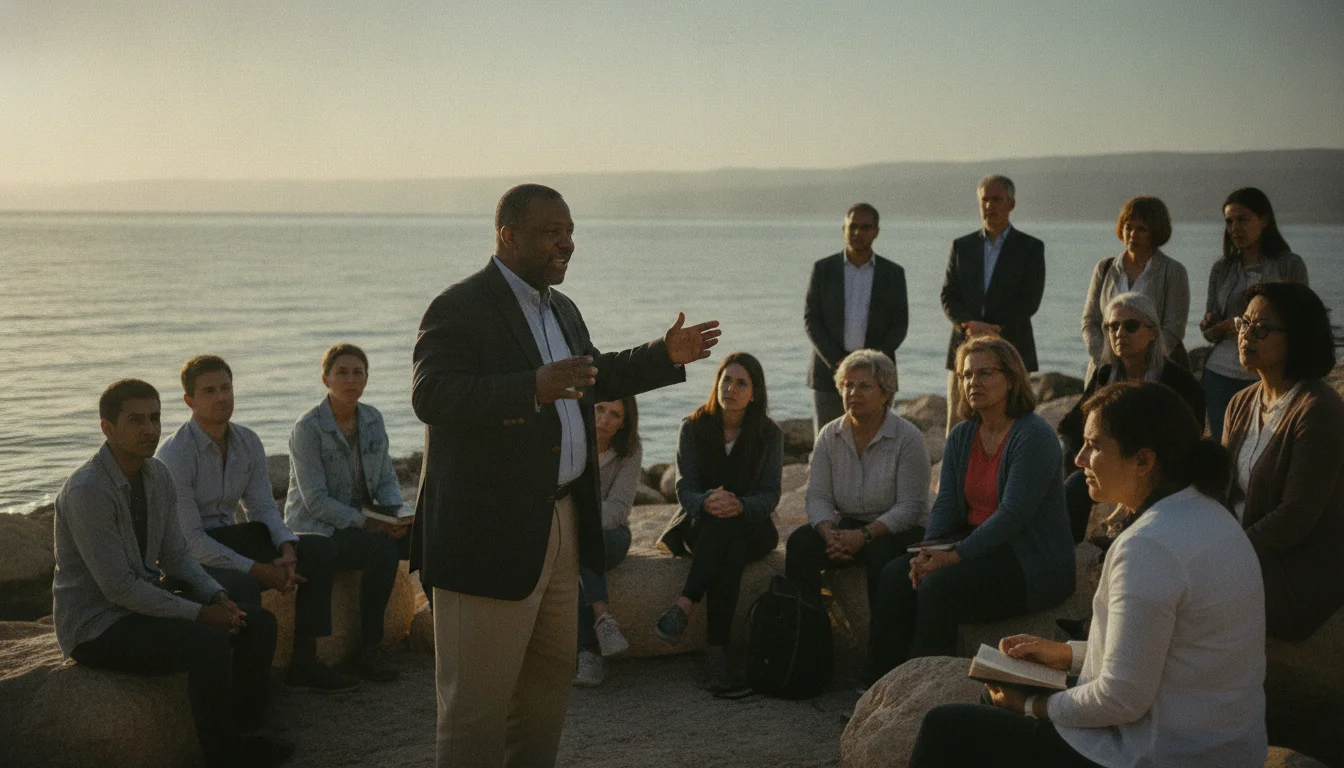
Most Baptist pastors who call me about the Holy Land are not asking whether they want to go. They already want to go. They have preached the Gospels for years, walked their people through Acts, stood at a pulpit and described the Jordan River without ever having knelt beside it. What they are actually asking is a harder question: can they lead a group there without it becoming a second job they cannot afford to take on.
I have built heritage journeys, most of them biblical tours for pastors, for more than forty years, and I want to answer that question the way I answer it on the phone. Plainly, with numbers, and from the perspective of the person doing the organizing. This is not a guide for the traveler in seat 14. It is for the pastor at the front of the coach who recruited everyone, carried the vision, and now needs the trip to actually work. If you are that person, keep reading. I will walk you through the sites that matter for a Baptist group, the economics that make leading affordable, and the planning decisions that separate a trip that fills from one that quietly falls apart.
Why the Holy Land Preaches Differently for a Baptist Congregation
Baptist worship centers on the Word. That is the tradition’s gravity. So a Holy Land trip for a Baptist group is not sightseeing with a devotional bolted on. It is the text made physical. When your people read the Sermon on the Mount while sitting on the hillside above the Sea of Galilee, the passage stops being an abstraction. When they stand in the garden at the Garden Tomb and one of your deacons reads the resurrection account aloud, something happens that no sanctuary can reproduce.
That is the organizer’s real product. You are not selling a vacation. You are giving your congregation the Bible in three dimensions, and you are the one guiding them through it. Everything else in this article serves that.
Best Pilgrimage Sites for Baptist Groups
Let me be specific about the itinerary, because the sites you choose shape the whole trip. For a Baptist group, I build around the places where the biblical text carries the most weight for your people. Here is the core.
The Sea of Galilee and the Galilee region. This is where a Baptist trip comes alive. Capernaum, the Mount of Beatitudes, Tabgha, and a boat ride on the water itself. Most of Jesus’ ministry happened in this small region, and it reads that way when you are standing in it. I usually build in an open-air teaching moment here. Your voice, your people, the same water.
The Jordan River at Yardenit. For a Baptist congregation, this one is not optional. Many groups schedule a baptism or a renewal of baptismal vows in the Jordan. I have watched pastors baptize members of their own church in that river, and it is the moment people talk about for years. If your group wants this, tell me early so we build the logistics around it.
Jerusalem: the Garden Tomb, the Mount of Olives, the Garden of Gethsemane, the Via Dolorosa. The Garden Tomb in particular resonates with Protestant and Baptist groups because it offers a quiet, garden setting for a communion service and a reflection on the resurrection. It is one of the few places in Jerusalem where a group can gather without a crowd pressing in.
Bethlehem, the Judean wilderness, and Masada. These fill in the story around the ministry: the birth, the temptation, the later history of the Jewish people. Masada also gives your group a physical and emotional high point midway through the week.
You do not have to include every site. A strong nine or ten day route usually covers Galilee, Jerusalem, and two or three anchor stops in between. If you want to see how the days actually flow, my ten day Holy Land itinerary breaks it down day by day, and the Israel heritage page shows the full map.
The Economics: How a Baptist Pastor Leads Without Paying His Own Way
Here is the part that takes the pressure off. When you gather fifteen or more paying travelers, your seat as the group leader is covered. That means your flights, your hotel, your ground transportation, your site entries, and the group meals built into the itinerary. You lead the trip at no personal cost.
This is not a discount or a loyalty credit. It is built into how a group booking is costed. Fifteen paying participants generate enough margin to carry one additional traveler, and that traveler is the leader. You are the reason the group exists, so the model is structured around your seat being the free one. I explain the full mechanics in does the pastor travel free, and if you are wondering where the number comes from, how many people you need for a free leader covers the threshold in detail.
For a Baptist church, this reframes the entire budget conversation. You are not asking your board to fund the pastor’s trip out of the general fund. You are organizing a journey your members pay into, and your participation is part of the structure, not a line item someone has to justify. That distinction has saved more trips than I can count.
If you want to understand your all-in numbers before you commit, what a church trip to Israel costs lays out the real per-person ranges, and how pastors afford to lead a trip goes deeper on the leader’s side of the math.
Recruiting: How to Fill a Group of Fifteen From Your Own Church
This is the fear I hear most. A pastor worries he will announce the trip, three couples will sign up, and he will be stuck. So let me be practical about how groups actually fill.
Start with your core, not the whole membership roll. You do not need to convince the entire congregation. You need the eight to ten people who already light up when you mention Israel from the pulpit. Find them first. Then let them bring others. Couples travel together. Bible study groups often go as a unit. Friends invite friends. Fifteen is very reachable when you begin with the people already leaning in.
Give people a real date and a real route. Vague interest never fills a group. “We might do a Holy Land trip sometime” converts almost nobody. “We are walking from Galilee to Jerusalem next March, ten days, and here is what we will see” gives people something to decide about. Tie the trip to a sermon series you are preaching or a book of the Bible your groups are studying, and the interest sharpens fast.
Announce it more than once, and from more than one channel. The pulpit announcement is the start, not the campaign. Bulletin, email, a short interest meeting after service, a sign-up table. I walk through the full sequence in how to recruit for a church trip, which is worth reading before your first announcement.
If your group lands between twelve and fourteen, do not stall. Start planning anyway. I have watched many groups cross from thirteen to seventeen in the final two months, simply because real dates and a real itinerary made the trip feel concrete. Interest firms up when the trip stops being hypothetical.
Evangelical, Non-Denominational, and Pentecostal Groups: The Same Model, Tailored
Baptist is where a lot of my Holy Land groups come from, but the structure works the same for the wider evangelical world, and I tailor the itinerary to the tradition.
An evangelical church tour to Israel usually looks close to the Baptist route: heavy on the Word, strong on Galilee and the Garden Tomb, often with a Jordan River baptism. The teaching moments are the heart of the trip.
A non-denominational church trip to Israel gives you the most freedom to shape the week. Without a fixed liturgical calendar, you can weight the itinerary toward whatever your congregation is studying, add or trade sites, and design your own on-site services. I lean into that flexibility when I build these routes.
A Pentecostal pilgrimage often puts extra weight on the places tied to the Holy Spirit and the birth of the church: the Upper Room on Mount Zion, the Pentecost narrative, and moments built in for worship and prayer that run longer than a typical stop. If you lead a Pentecostal congregation, tell me how much room you want for corporate worship on site, and I will build the schedule to hold it rather than rush it.
The point across all three: the free-leader economics and the planning rhythm do not change. Only the itinerary flexes to fit your people. If you want the general framework before we tailor it, how to organize a church trip to Israel is a solid starting read.
The Planning Timeline That Actually Works
Six to nine months is the sweet spot for a group of fifteen to thirty. That window gives your people time to budget, request time off work, and commit, and it gives you time to recruit, which is the real labor. Larger groups, or trips timed around Easter or a specific season, want nine to twelve months. Earlier is not just about booking flights. It is recruiting runway.
A few decisions to make early rather than late:
- Payment structure. Most church groups run on a deposit plus monthly installments. Setting this up front makes the trip affordable for more of your members, which directly helps you reach fifteen. See group trip payment plans for how to structure it.
- The Jordan River baptism, if you want one. This shapes the day it sits in, so flag it during planning, not after.
- Special access or on-site services. Communion at the Garden Tomb, a teaching slot on the Mount of Beatitudes, extended worship time for a Pentecostal group. These get built into the schedule when I know about them early.
For a full pre-departure sequence, the church group planning checklist keeps you from missing a step.
Your Real Job Once the Logistics Are Handled
Here is what I most want a pastor to hear. When the free-leader model takes your personal cost off the table, it also takes the accountant’s job off your plate. You are not the trip’s bookkeeper. You are its shepherd.
That is the whole point. Your role in the Holy Land is to teach the Word where it happened, to baptize your people in the Jordan, to lead communion in the garden, to read the resurrection account at the empty tomb and let the silence do its work. The operator’s job is to make everything else invisible: the coaches, the hotels, the guides, the entries, the meals, the timing. The free seat is part of how we keep your attention where it belongs, on your congregation and on the text.
FAQ: Leading a Baptist Holy Land Tour
How many people do I need for the pastor to travel free?
Fifteen paying travelers. With fifteen or more, the group leader’s full trip is covered: flights, hotel, ground transportation, site entries, and the group meals in the itinerary. Below fifteen the trip is still possible, but the leader pays a participant’s price. Larger groups can sometimes unlock a second complimentary seat for a co-leader or spouse, so raise that early if it matters to you.
Can my group be baptized in the Jordan River?
Yes. Many Baptist and evangelical groups schedule a baptism or a renewal of baptismal vows at the Jordan, usually at Yardenit. Tell me during planning so I build the day around it. Pastors baptize their own members there, and it tends to become the most talked-about moment of the trip.
What are the most important sites for a Baptist group?
The Sea of Galilee region (Capernaum, the Mount of Beatitudes), the Jordan River, and in Jerusalem the Garden Tomb, the Mount of Olives, and Gethsemane. The Garden Tomb is especially meaningful for Baptist groups because it offers a quiet garden setting for a communion service and a resurrection reflection. Bethlehem and Masada round out the story.
Does this work for non-denominational or Pentecostal churches too?
Yes. The free-leader economics and the planning rhythm are identical. Only the itinerary changes. Non-denominational groups get the most freedom to shape the route, and Pentecostal groups often add Mount Zion and the Upper Room with extra room built in for worship and prayer on site.
How far ahead should I start planning?
Six to nine months for a group of fifteen to thirty, and nine to twelve months for larger groups or holiday-timed trips. The lead time is as much about recruiting your group as booking the trip. Concrete dates and a real itinerary are what move your members from interested to committed.
If you are a pastor weighing whether a Holy Land trip is realistic for your church, start with the framework. My guide on how to plan a group pilgrimage covers the whole process from first announcement to departure, and our group heritage tours page shows how the group experience is built.
Contact us and we will help you run the numbers for your congregation, your dates, and the sites that matter most to your people.