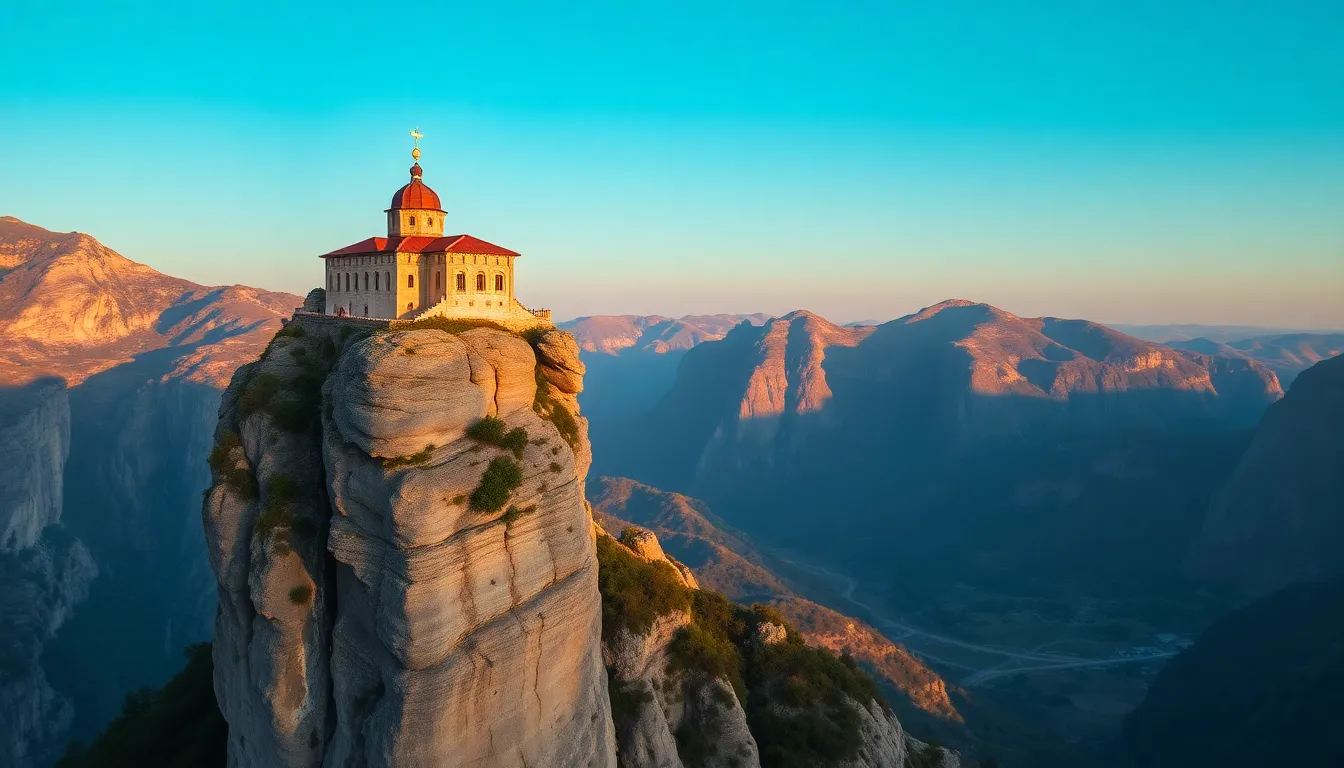
There is a moment on the bridge that crosses to Varlaam Monastery when the whole valley opens beneath you, and someone in every group I have led stops and goes quiet. The monastery sits on top of a sheer rock pillar, hundreds of feet of bare stone dropping straight down, and for centuries the only way up was a net and a rope windlass. People built a place of prayer in the least reachable spot they could find, and they meant exactly that. Meteora means suspended in the air, and Varlaam is one of the reasons the name fits. I bring groups here for the frescoes, yes, but also for what the place says about faith and withdrawal from the world.
Let me walk you through Varlaam and how to visit it well.
The Rock Monasteries of Meteora
Meteora is a cluster of monasteries built atop towering natural rock pillars in central Greece, near the town of Kalambaka. The pillars rose from an ancient seabed, weathered over millions of years into the strange vertical towers you see today. Beginning in the fourteenth century, monks climbed these rocks to live in solitude, first in caves and hermitages, then in monasteries built on the summits.
At its height, Meteora held two dozen monasteries. Today six remain active, and Varlaam is the second largest of them. The whole site is a UNESCO World Heritage area, recognized for both its natural drama and its monastic tradition. It belongs to the world of Eastern Orthodox Christianity, and for a Christian group it offers a window into a form of devotion shaped by withdrawal, discipline, and the deliberate choice of hardship for the sake of prayer.
The point I make to groups is the why. These were not defensive forts, though the height gave protection in turbulent centuries. They were built high to be apart, to put distance between the monk and the world, to make the daily climb toward God a literal thing.
The Founding of Varlaam
Varlaam takes its name from a hermit, Varlaam, who first climbed this particular rock in the fourteenth century and built a small chapel and a few cells. After his death the rock stood empty for a long time. Then in 1517, two brothers from a wealthy family of Ioannina, Theophanes and Nektarios Apsaras, ascended the pillar and rebuilt the monastery, establishing the community that stands today.
The story of how they built it is worth telling your group. Every stone, every beam, every barrel of water had to be hauled up the cliff face by rope and net, or carried by monks climbing ladders pinned to the rock. The main church was completed in 1541 and the entire effort took decades. When you stand inside a building raised that way, the labor and the conviction behind it are part of what you are looking at.
For centuries, access was only by removable ladders or by a net hoisted on a windlass, a system that asked real trust of anyone who used it. There is an old joke among the monks that the rope was replaced only when it broke. Today a bridge and stone steps make the climb manageable, but the old windlass tower still stands, and groups always want to see it.
The Frescoes and What They Hold
The reason art historians single out Varlaam is its frescoes. The main church, the Katholikon dedicated to All Saints, is covered in wall paintings from the sixteenth century, among the finest examples of post-Byzantine religious art in Greece.
The frescoes were painted in the Cretan style, and the most celebrated were the work of Frangos Katelanos, a master painter of the period. The walls carry scenes from Scripture, the lives of the saints, and, vividly, the Last Judgment. The colors have held their depth across five centuries. For a group, walking into this church is a step into a complete visual world, every surface telling a story, the way Orthodox churches were designed to teach and to surround the worshipper.
I ask groups to slow down here and simply look. You do not need to share the Orthodox tradition to feel what the space was built to do. The art was never decoration. It was instruction and devotion in pigment, meant to lift the eye and the mind toward God on every wall.
Beyond the church, Varlaam holds a refectory now used as a small museum, with manuscripts, icons, and religious objects, and the old store rooms that show how a community survived on top of a rock. The original wooden water barrel and the windlass mechanism give a sense of the practical genius the place required.
What Groups See and Do
A visit to Varlaam begins with the approach, across the bridge and up the stone steps cut into the rock. Take your time. The views over the valley and toward the neighboring monasteries are part of the experience and a natural place to gather and talk about the monastic tradition.
Inside, the Katholikon and its frescoes are the heart of the visit. The small museum, the refectory, and the old windlass tower fill out the picture of monastic life. Because this is a working monastery, the atmosphere is one of quiet and reverence, and groups respond to that. It is a place for reflection on devotion, discipline, and the long Christian tradition of withdrawal for the sake of prayer.
Most groups pair Varlaam with the Great Meteoron, the largest monastery, which sits just across the way. The two together give a full sense of Meteora in a single visit. For where this fits in a wider journey, see our guide to following the Apostle Paul through Greece and our deep dive on the Areopagus in Athens.
A Practical Word on Access and Dress
I want to be straight about two things, because both affect planning.
First, the climb. Varlaam is reached by a bridge and then a stairway of stone steps cut into the rock, around 195 of them. There is a handrail, and the pace is yours to set, but it is a real ascent and not every member of a group will manage it. We plan the day so those who cannot climb can enjoy the valley views, the photo stops, and a less demanding monastery, while the rest go up. No one is stranded.
Second, dress. Meteora’s monasteries are active religious houses with a strict dress code. Men need long trousers. Women must wear a skirt below the knee, and wrap-around skirts are usually provided at the entrance for those in trousers. Shoulders must be covered. We brief every group on this in advance so no one is turned away at the door.
We pace these visits around the people you bring and handle the practical details ahead of time.
FAQ: Visiting the Varlaam Monastery
What is the Varlaam Monastery?
Varlaam is the second-largest of the six active monasteries at Meteora in central Greece, built atop a sheer rock pillar. Founded in its present form in 1517 by two brothers from Ioannina, it is known for its sixteenth-century frescoes and its dramatic setting.
Why is Varlaam famous for its frescoes?
Its main church, the Katholikon of All Saints, is covered in post-Byzantine wall paintings from the sixteenth century, including work attributed to the master painter Frangos Katelanos. The frescoes, in the Cretan style, are among the finest religious art of the period in Greece.
How do you reach the monastery?
By a bridge and a stairway of around 195 stone steps cut into the rock, with a handrail. Historically access was only by rope, net, and removable ladders, and the old windlass tower still stands. The climb is real, so we plan the day around members who cannot manage it.
Is there a dress code?
Yes, and it is enforced. Men need long trousers. Women need a skirt below the knee, and shoulders must be covered. Wrap skirts are usually available at the entrance. We brief groups in advance so no one is turned away.
How long should a group spend at Meteora?
Plan a full day. That allows time for Varlaam, a second monastery such as the Great Meteoron, the drives between the rock pillars, and the viewpoints. The frescoes and the museum at Varlaam alone reward an unhurried visit.
Varlaam is the kind of place that gives a group both the awe of the setting and the depth of the art in a single climb, and it stays with people. If you are planning a Greece heritage journey for your congregation, I would be glad to help you build Meteora into it well. You can see how we structure these trips on our Greece heritage page or explore our group heritage tours.
Contact us whenever you are ready to start the conversation.