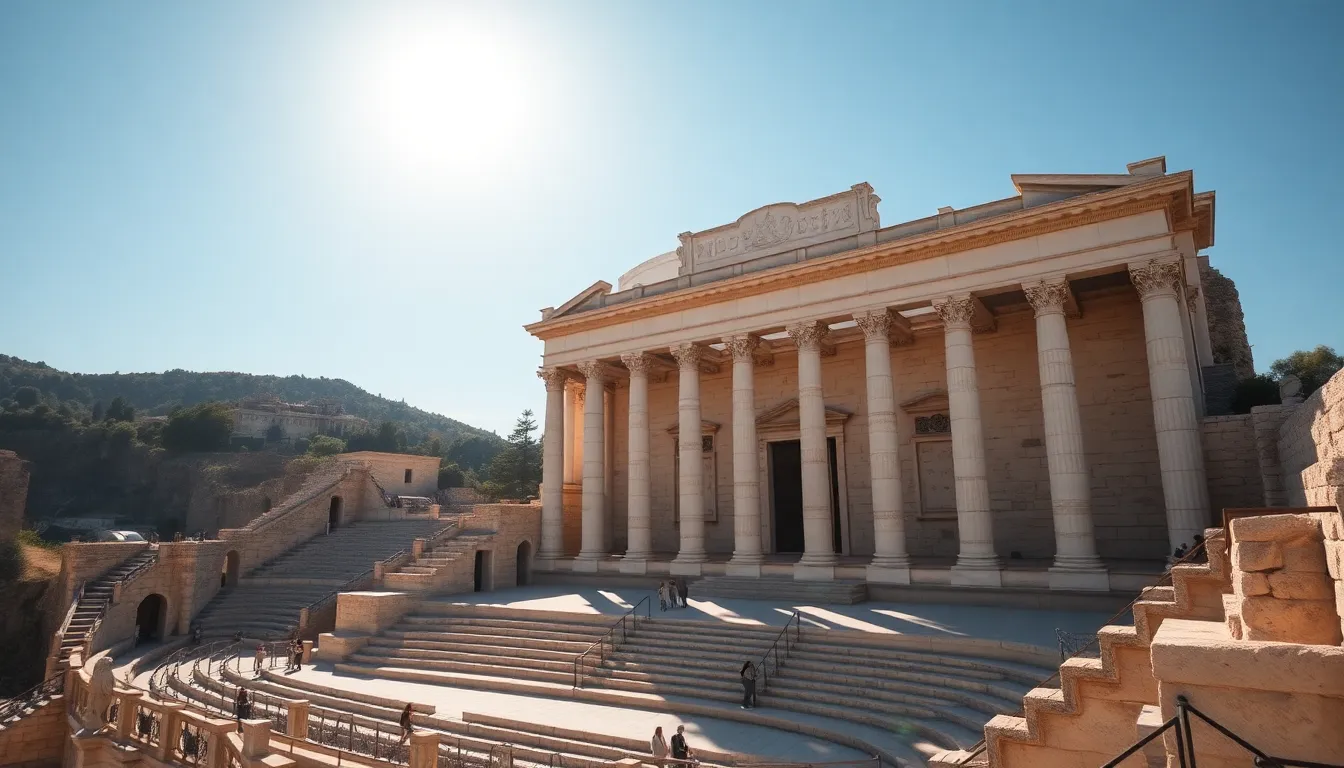
A pastor asked me a question a few years ago that I now hear all the time. He said, “We want to do Patmos and the Revelation, but the seven churches are in Turkey. How do we connect them without it feeling like two separate trips?” It is a good question, and the answer is the reason the Aegean exists in the first place. The seven churches of Revelation and the island where John wrote to them are not two stories. They are one story, separated by a short stretch of water.
This article is about how a Greece heritage itinerary bridges to the Seven Churches of Asia Minor across the Aegean, and how to plan that crossing so it feels like one coherent journey instead of a logistical scramble.
The Geography of Revelation
Start with the map, because once your group sees it, the whole thing makes sense. John was exiled on Patmos, a Greek island in the eastern Aegean. The seven churches he was told to write to, Ephesus, Smyrna, Pergamum, Thyatira, Sardis, Philadelphia, and Laodicea, all sat on the mainland of Asia Minor, what is now western Turkey, directly across the water.
From Patmos, you can practically see the coast where those churches stood. John was not writing to distant, abstract communities. He was writing to churches a short sail away, churches he likely knew, in cities he could almost see from his place of exile. The seven letters in Revelation 2 and 3 are addressed to real congregations in real cities, each with its own character, its own pressures, and its own commendation or rebuke.
When your group grasps this, the Aegean stops being a barrier between two countries and becomes the actual setting of the Book of Revelation. The crossing is the story.
Why the Two Belong Together
For a faith group focused on Revelation, doing Patmos without the seven churches, or the seven churches without Patmos, leaves the story half told.
Patmos is where the vision was given. The seven churches are who it was given for. Stand in the Cave of the Apocalypse, read “to the angel of the church in Ephesus write,” and then cross the water and stand in the ruins of Ephesus itself, and the letter comes alive in a way neither site can manage alone. Your group hears the address on Patmos and arrives at the doorstep a day later.
I cover the island side fully in our overview of Patmos and the Book of Revelation and the grotto specifically in our guide to the Cave of the Apocalypse. This piece is about stitching those to the mainland churches across the Aegean.
The Seven Churches in Brief
Your group does not need to be scholars, but a quick orientation to the seven helps everyone arrive ready. Each letter in Revelation 2 and 3 fits the city it was sent to.
- Ephesus, the great commercial port and home of the temple of Artemis, praised for endurance but warned that it had left its first love. The most extensively excavated of the seven, and the highlight for most groups.
- Smyrna, modern Izmir, the church of suffering, told to be faithful unto death. A living city today, so the ancient remains are limited but the connection is real.
- Pergamum, the city “where Satan’s throne is,” with its dramatic acropolis and great altar.
- Thyatira, the church of works and love, in a city known for its trade guilds, including Lydia’s purple cloth.
- Sardis, the church told it had a name that it was alive but was dead. Striking ruins, including a great temple and synagogue.
- Philadelphia, the faithful church given an open door, in modern Alasehir.
- Laodicea, the lukewarm church, “neither cold nor hot,” in a wealthy banking city with a notoriously poor water supply, a detail the letter plays on directly.
Visiting these in order, reading each city’s letter on the ground in that city, is one of the most coherent Bible studies a group can ever do. The text and the place explain each other.
How the Crossing Actually Works
Here is the practical heart of it. There are two main ways heritage groups bridge Greece and the Seven Churches, and the right one depends on your group and your time.
The Cruise Approach
The cleanest way to connect Patmos with the mainland churches is by sea, on an Aegean cruise that calls at Patmos and at the Turkish port of Kusadasi, the gateway to Ephesus. Several faith-focused cruises are built around exactly this route, often combined with other islands. The appeal is obvious. You follow the water John looked across, you wake up in a new port, and the logistics of borders and transfers are handled for you. For mixed-age groups, the cruise approach removes a lot of friction.
The Land-and-Ferry Approach
The other route combines mainland Greece with a ferry crossing into Turkey, then overland travel through the seven churches. This gives you more time on the ground at each site and more control over the pace, which serious study groups often prefer. It involves a border crossing, separate transport in Turkey, and more moving parts, so it rewards careful planning and a good operator handling the details.
Either way, a few things I tell every group leader planning this crossing:
- Passports and visas. Greece and Turkey are separate countries with separate entry requirements. Check your group’s passports early and confirm current visa rules for Turkey well before you travel.
- Two operators, one trip. A crossing like this touches two countries and often a ship. The value of a single heritage operator coordinating the whole thing, rather than booking pieces separately, is that the seams disappear and your group never feels handed off.
- Build in the read-aloud moments. The whole point is to read each letter where it was sent. Make sure the pace leaves room for it, on Patmos and at each church.
Where This Fits a Greece Heritage Trip
For most groups, the structure that works is to begin in Greece, tracing Paul on the mainland and ending on Patmos with the giving of the Revelation, then cross the Aegean to the seven churches that received it. That sequence carries your congregation from the first European church all the way to the final book of scripture and the communities it was written for. It is, honestly, one of the most complete biblical journeys you can build.
If you want the full map of biblical Greece before adding the crossing, our hub on Greece’s spiritual sites lays out the mainland and the islands together.
One planning note that matters for the budget: with Heritage Tours, the group leader travels free when you bring fifteen or more participants. On a longer, two-country itinerary like this one, that threshold is very reachable for a motivated congregation, and confirming it early makes the whole trip easier to build.
FAQ: The Seven Churches and Greece
Are the Seven Churches of Revelation in Greece?
No. The seven churches, Ephesus, Smyrna, Pergamum, Thyatira, Sardis, Philadelphia, and Laodicea, are in Asia Minor, what is now western Turkey. The connection to Greece is that John received and wrote the Revelation on the Greek island of Patmos, directly across the Aegean from those churches. The two are part of one story separated by a short stretch of sea.
How do you combine Patmos with the Seven Churches?
The most common way is an Aegean cruise that calls at Patmos and at Kusadasi, the port for Ephesus, often combined with other islands. The alternative is a land-and-ferry route from mainland Greece into Turkey with overland travel through the churches. We help groups choose the approach that fits their pace and their people.
Do you need a separate visa for the Turkey portion?
Greece and Turkey are separate countries with separate entry requirements, so yes, you need to confirm Turkey’s current visa and passport rules for your group well before departure. We handle the coordination, but every traveler is responsible for valid documents, and we flag the requirements early in planning.
Which of the Seven Churches is the best to visit?
Ephesus is the highlight for most groups. It is the most extensively excavated of the seven, with a marble main street, the great theater, and the library of Celsus, so the city of Revelation 2 stands largely intact. That said, reading each letter in its own city is the real reward, and several of the others, like Sardis and Pergamum, have remarkable remains of their own.
How long does a combined Greece and Seven Churches trip take?
A trip that covers mainland Greece, Patmos, and the seven churches comfortably runs ten to fourteen days, depending on how much of the Greek mainland you include. Rushing the crossing is the most common mistake, and it costs your group the read-aloud moments that make the journey cohere.
If a Revelation journey that bridges Patmos and the seven churches is taking shape for your congregation, I would love to help you build it without the seams showing. The story is one story, and a trip that follows the water John looked across is one your people will carry for years. You can see how we structure these journeys on our Greece heritage page or learn how the group experience works on our group heritage tours page.
Contact us whenever you are ready to start planning.