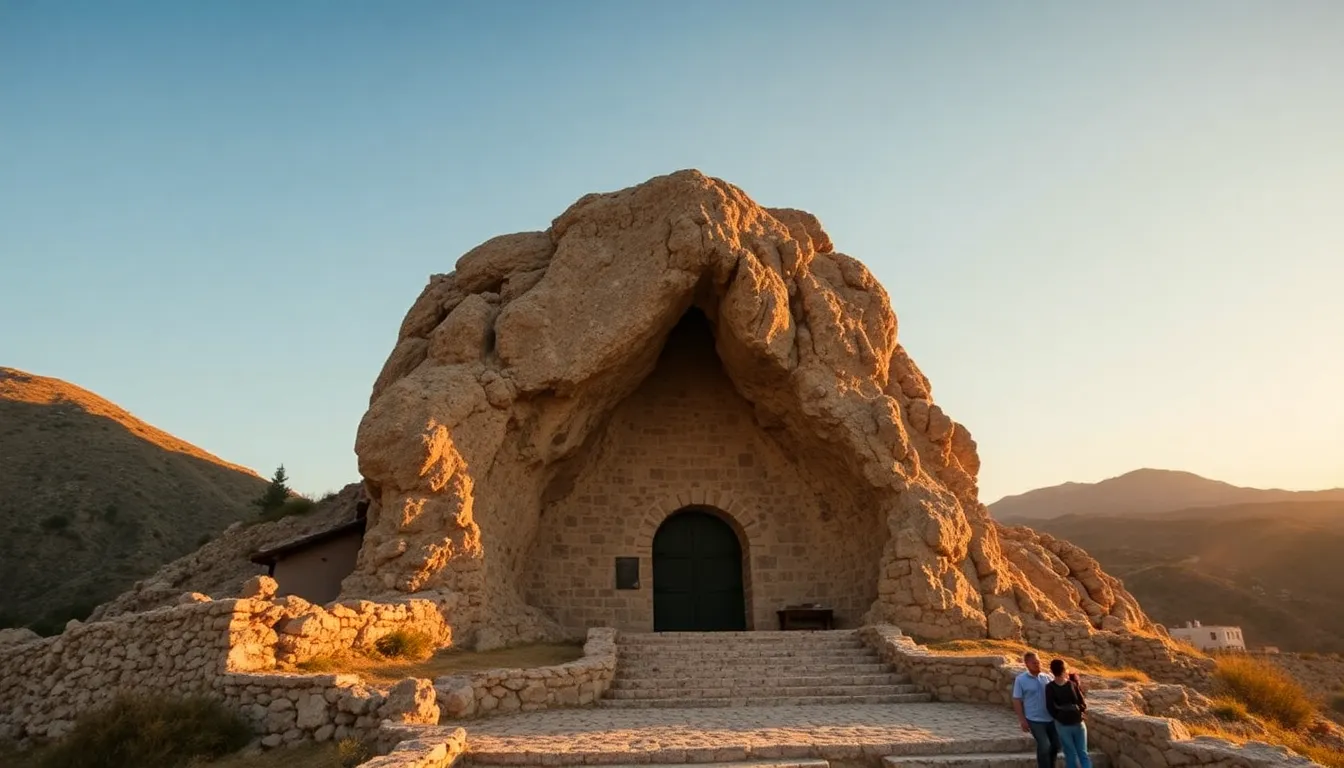
I have stood in a lot of holy places with a lot of groups. Most of the time, people are moved, and then they file out and we move on. The Cave of the Apocalypse is one of the few places where I have watched an entire group go silent and stay silent. There is a low ceiling of dark rock, a crack splitting it overhead, a few oil lamps, and the sense that you are standing inside the room where the last book of the Bible was given. Nobody wants to be the first to speak.
This article is about the cave itself. If you want the wider picture of the island, our overview of Patmos and the Book of Revelation covers the monastery, the logistics, and how it all fits a trip. Here I want to stay inside the grotto, because for a faith group it is the single most concentrated moment on the whole island.
What the Cave Actually Is
The Cave of the Apocalypse, the Greeks call it the Sacred Grotto, sits on the hillside about halfway between the port at Skala and the hilltop town of Chora. Tradition holds that this is the cave where John lived during his exile and where he received the vision recorded in the Book of Revelation.
It is not a large open cavern. It is a low, enclosed grotto, now built into a small monastery complex with a chapel attached. You descend a flight of steps from the road, pass through the chapel, and enter the cave proper. The space is dim, close, and worn smooth by nearly two thousand years of pilgrims. The first thing most people notice is how small and how quiet it is. The second is the rock itself.
The Rock Features and the Tradition
This is what makes the cave unlike any other site your group will visit, and it is worth preparing your people for, so they know what they are looking at.
Orthodox tradition marks several specific features in the rock:
- The triple crack in the ceiling. Directly overhead, the rock is split into a threefold fissure. Tradition holds that the voice of God spoke to John through this crack, and the Orthodox understand the three-part split as a sign of the Holy Trinity.
- The place where John rested his head. A worn hollow in the rock wall is venerated as the spot where John laid his head to sleep.
- The handhold. A natural groove in the rock is shown as the place John would grip to pull himself up from the ground, the strength of an old man in exile.
- The ledge that served as a desk. A shelf in the rock is marked as the surface where his scribe, Prochoros, is said to have written down the words John dictated.
I always tell groups how to hold these. Some are devotional traditions rather than provable history, and that is exactly how the church here presents them. You do not have to settle the question to be moved by it. What is not in question is that you are standing in the grotto that Christians have venerated as the place of the Revelation for the better part of two thousand years. That continuity of devotion is its own kind of weight.
The Weight of Standing Inside Revelation
Here is what I have learned to do with a group inside the cave. I keep it short, and I let the place do the work.
We read Revelation 1:9 through 1:19 aloud, quietly. John on the island, “in the Spirit on the Lord’s day,” hearing the voice like a trumpet, turning to see the one “like a son of man.” You read those words standing in the actual grotto, looking up at the actual crack in the rock, and something happens that does not happen in a sanctuary back home. The book stops being a strange, symbolic text people are a little afraid of, and becomes a real account of a real man in a real cave who was given something overwhelming.
I have seen lifelong believers say afterward that Revelation finally made sense to them, not the symbols, but the experience behind it. The fear, the awe, the sense of being shown something far larger than yourself. That is what the cave gives a group. It is the experiential center of any Revelation-focused trip.
How Groups Experience the Cave Well
A few practical notes, because the cave is a working sacred site and not a tourist attraction, and a group that comes in prepared has a far better experience.
Dress modestly. Shoulders and knees covered. This is enforced, and rightly so. Bring a scarf or a layer that packs easily.
Keep it reverent and quiet. No photography is permitted inside the cave itself. I tell groups this is a gift, not a restriction. Without phones up, people are actually present.
Go early or late if you can. The cave is small and cruise-ship crowds can fill it. An early morning visit, before the day boats arrive, gives your group the silence the place deserves.
Mind the steps. You descend into the grotto on stone steps that can be uneven and slick. For older group members, take it slowly and use the handrails.
Brief your group beforehand. Five minutes of context on John’s exile and what the rock features mean transforms the visit. People who understand what they are looking at are moved. People who walk in cold often just see a dark cave.
Where the Cave Fits in a Trip
The cave anchors a Revelation pilgrimage. For most heritage groups, it is the emotional peak of the Patmos stop, and Patmos is often the closing movement of a Greece journey that begins by tracing Paul on the mainland. From the founding of the European church to the final vision of scripture, the cave is where the arc lands.
Groups focused on Revelation also pair Patmos naturally with the Seven Churches of Asia Minor across the water, the very churches John was told to write to. I cover that bridge in our guide to the Seven Churches connection and the Aegean crossing. For the full map of biblical Greece, our hub on Greece’s spiritual sites lays it all out.
One planning note worth keeping in view: with Heritage Tours, the group leader travels free when you bring fifteen or more participants. For a pastor building a Revelation-focused trip for a congregation, that is real money back in the budget.
FAQ: The Cave of the Apocalypse
What is the Cave of the Apocalypse?
It is the grotto on the island of Patmos where, according to Christian tradition, the Apostle John lived during his exile and received the vision recorded in the Book of Revelation. The Greeks call it the Sacred Grotto. It is now enclosed within a small monastery on the hillside between the port and the hilltop town of Chora, and it has been venerated as the site of the Revelation for nearly two thousand years.
What are the marks in the rock of the cave?
Orthodox tradition identifies several features: a triple crack in the ceiling understood as the place the divine voice spoke and as a sign of the Trinity, a hollow where John rested his head, a groove he used as a handhold, and a ledge where his scribe wrote down the words. These are venerated devotional traditions, presented as such by the church.
Can you take photos inside the cave?
No. Photography is not permitted inside the cave itself, and the visit is meant to be quiet and reverent. Many group members tell me afterward that the absence of phones was part of what made the moment so present.
Is there a dress code for the cave?
Yes. Shoulders and knees must be covered, as at any active Orthodox sacred site. I tell every group to bring a scarf or a light layer that packs easily so no one is turned away or caught off guard.
How long does a group spend in the cave?
The cave itself is small, so the time inside is short, often twenty to thirty minutes. But the impact is out of proportion to the duration. A brief reading of Revelation 1 inside the grotto is, for many groups, the most memorable single moment of the entire trip.
If you are imagining a Revelation journey for your congregation, the cave is the place I would build it around. Stand your people inside it, read the opening of Revelation, and the rest of the trip takes care of itself. You can see how we structure these journeys on our Greece heritage page or learn how the group experience works on our group heritage tours page.
Contact us whenever you are ready to start planning.