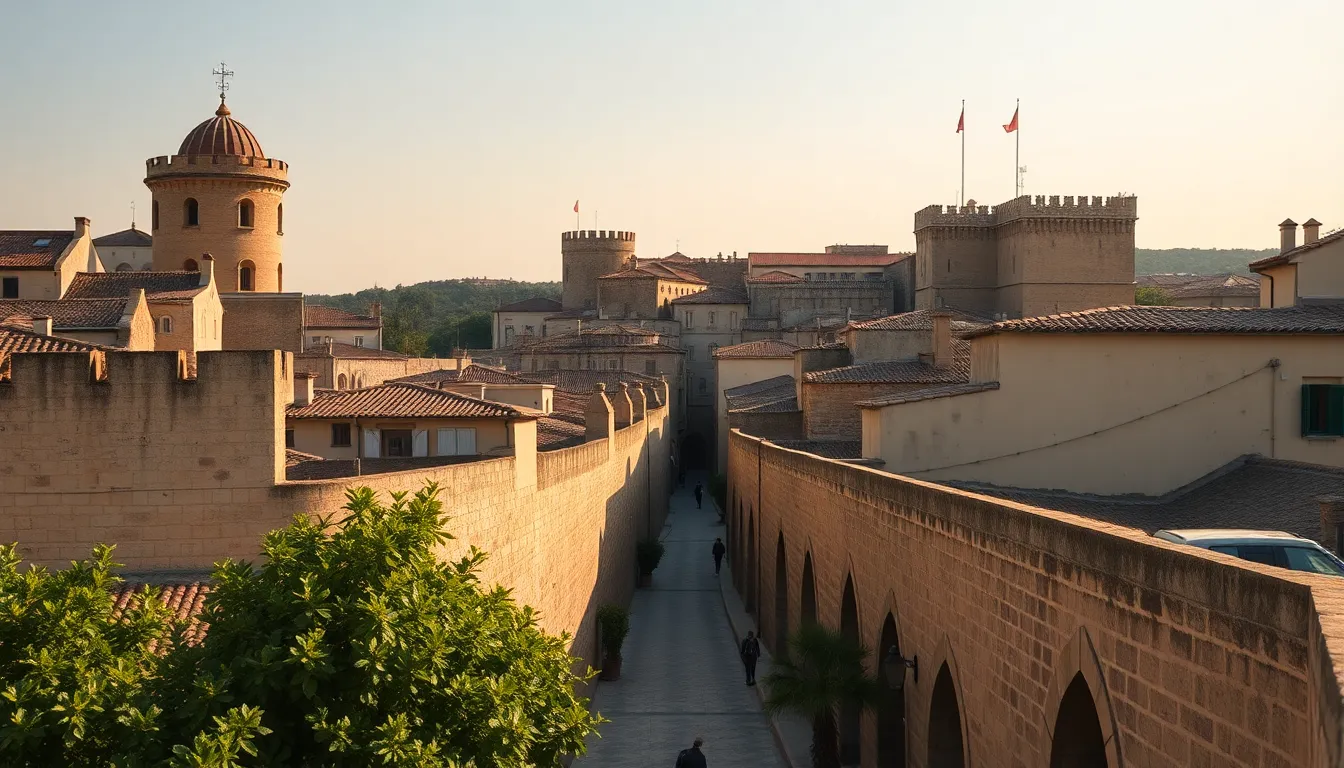
I take groups into the Old Town of Rhodes through the gate near the harbor, and I always slow down right inside the walls. People expect a Greek island, sun and sea and tavernas, and instead they find themselves inside a complete medieval city, cobbled streets and stone towers, built by crusader knights. Then a few minutes later we turn into the Jewish Quarter, and the city changes again. Rhodes holds two stories at once that most travelers never connect, and standing where they overlap is what makes this island so rich for a heritage group.
Rhodes sits in the far southeastern corner of Greece, closer to Turkey than to Athens. That location shaped everything about it. Crusaders, Ottomans, Italians, and a centuries-old Jewish community all left their mark, and the Old Town wears all of it at once. Let me orient you to the layers.
The Knights’ Old Town: A Crusader City That Survived
The walled city of Rhodes is one of the best-preserved medieval towns in Europe, and the reason is the Knights of Saint John. After they lost the Holy Land, the order took Rhodes in the early fourteenth century and ruled it for more than two hundred years, building the fortifications, hospitals, and palaces that still define the Old Town today.
The Street of the Knights
The Street of the Knights runs straight up through the heart of the medieval city, and walking it is the easiest way to feel what the order was. It is lined with the “inns” of the different national groups, or tongues, of the knights, France, Italy, Spain, Provence, each with its own coat of arms over the door. The street is remarkably intact. When your group walks up it, they are walking the same paved slope the knights walked, between the same walls.
The Palace of the Grand Master
At the top stands the Palace of the Grand Master, a vast fortress-palace that anchors the whole Old Town. Much of what stands today was rebuilt by the Italians in the twentieth century, but the scale and the medieval bones are real, and the inside holds mosaics and grand halls that give your group a sense of the power the order held in the eastern Mediterranean.
The Walls and the Harbor
The medieval walls still ring the city, and a walk along or beneath them is one of the better things to do with a group that has an extra hour. Down at Mandraki Harbor, the spot traditionally associated with the Colossus of Rhodes, one of the ancient wonders, gives you a chance to reach even further back into the island’s deep history.
La Juderia: The Jewish Quarter of Rhodes
A few minutes’ walk from the Street of the Knights, the city shifts into La Juderia, the Jewish Quarter, and for many groups this is the heart of the visit. The Jewish community of Rhodes was Sephardic, connected to the wider world that formed after the expulsion from Spain in 1492, but it developed its own island character over the centuries, shaped by Ottoman rule and proximity to Turkey.
One of the Best-Preserved Jewish Quarters in Europe
What makes La Juderia remarkable is that it physically survived. The narrow streets, the stone houses, the small synagogue courtyards are still intact. Many Jewish quarters in Europe were destroyed in the war or redeveloped afterward. La Juderia was not. Walking through it, your group can read the scale of the community in the buildings themselves: modest homes and workshops, woven into the fabric of the walled city for centuries. The community numbered roughly two thousand before the war.
The Kahal Shalom Synagogue
The Kahal Shalom Synagogue, built in 1577, is the oldest synagogue in Greece still in use. The interior is beautiful in its plainness, with an elevated bimah and a women’s gallery in the Sephardic tradition. In summer, services are held for the small remaining community and for visitors who come to pray. The adjoining museum tells the story of the community in careful detail.
The Square of the Jewish Martyrs
At the heart of La Juderia is the Square of the Jewish Martyrs, with its memorial fountain. In July 1944, the entire Jewish community of Rhodes, roughly seventeen hundred people, was assembled and deported to Auschwitz. The names are inscribed on the memorial. Reading them aloud with a group is a practice we encourage. These were not abstract numbers. They were the people who lived in the houses you just walked past. I have stood in this square with many groups, and it is always the quietest moment of the day.
For the wider story of Greece’s three Jewish traditions, our Jewish heritage in Greece guide sets Rhodes alongside Thessaloniki and Ioannina.
The Island’s Layers of Faith
What I want a group to carry away from Rhodes is the sense of how many faiths and powers passed through this one walled city. Within a few hundred meters you have crusader Christianity in the knights’ churches and palaces, Islam in the Ottoman mosques and the minarets that still rise over the Old Town, and Sephardic Judaism in La Juderia. Each ruled or lived here in turn, and each left stone behind.
For a heritage group, that density is the gift. You do not have to drive between sites to feel the sweep of history. You walk it, in a single morning, on foot, through one set of walls. I often tell groups that Rhodes is a place where the layers do not sit in separate museums. They sit on top of each other in the streets.
Beyond the Old Town, the island itself rewards a slower stay. The village of Lindos, with its acropolis above a white-washed town and a small bay, is the classic excursion, and the medieval and ancient layers continue there. But for a heritage group, the walled city is the core, and it is where I spend most of our time.
Practical Orientation for Groups
A few things I always tell leaders planning a Rhodes day:
- The Old Town is car-free and cobbled. Wear good shoes. The streets are uneven, and the cobbles can be hard on ankles and on travelers with mobility limits. Plan a slower pace and frequent benches.
- La Juderia and the knights’ city are walkable together. You can see both in a single unhurried day, which makes Rhodes efficient for a group.
- Check synagogue and museum hours. The Kahal Shalom Synagogue and its museum keep seasonal hours, busier and more open in summer. Confirm before you fix the route.
- Summer is hot and crowded. Late spring and early fall are kinder for walking the Old Town. Start in the morning when the cruise crowds are thinnest.
Rhodes is reached by air from Athens or by ferry, and most heritage groups fly in to save time. It pairs naturally with a Jewish heritage route, and it works equally well as a meaningful day for a mixed Christian and Jewish group who want to understand the crusader and Sephardic worlds in one place. For comparison with the mainland’s most ancient Jewish tradition, see our Ioannina heritage guide.
One thing worth knowing as you plan: with Heritage Tours, the group leader travels free when you bring fifteen or more participants. For many congregations and communities, that makes a fuller itinerary possible, and it is worth factoring in early.
FAQ: Visiting Rhodes for Heritage Travel
What is the oldest synagogue in Greece, and is it in Rhodes?
Yes. The Kahal Shalom Synagogue in La Juderia, built in 1577, is the oldest synagogue in Greece still holding services. In summer, the small remaining community and visiting groups gather there for prayer. The adjoining museum tells the story of the Sephardic community of Rhodes.
Can a group see both the Jewish and crusader sites in one day?
Comfortably. La Juderia and the Street of the Knights are a few minutes’ walk apart inside the same walled city. A single unhurried day covers the Palace of the Grand Master, the knights’ street, the synagogue, and the Square of the Jewish Martyrs, with time to sit and reflect.
What happened to the Jewish community of Rhodes?
The community numbered roughly two thousand before the war. In July 1944, around seventeen hundred members were assembled in what is now the Square of the Jewish Martyrs and deported to Auschwitz. Very few survived. The synagogue, the quarter, and the memorial remain as living evidence of the community that lived there for centuries.
Is the Old Town hard to walk for older travelers?
It takes care. The streets are cobbled, uneven, and car-free, which is part of their charm but can be tiring. We plan a slower pace, build in rest stops, and order the route to keep the meaningful sites reachable for everyone in the group.
How do groups usually reach Rhodes?
Most heritage groups fly from Athens, which takes under an hour and saves the long ferry crossing. Rhodes fits well into a Jewish heritage itinerary or a mixed Christian and Jewish route, and it stands on its own as a place where crusader, Ottoman, and Sephardic histories sit side by side.
If Rhodes is calling to you for your group, I would be glad to help you shape the visit so both stories, the knights and the Juderia, land the way they should. The layers are right there in the streets once your people are walking them. You can see how we build these trips on our Greece heritage page or learn how the group experience works on our group heritage tours page.
Contact us whenever you are ready to start planning.