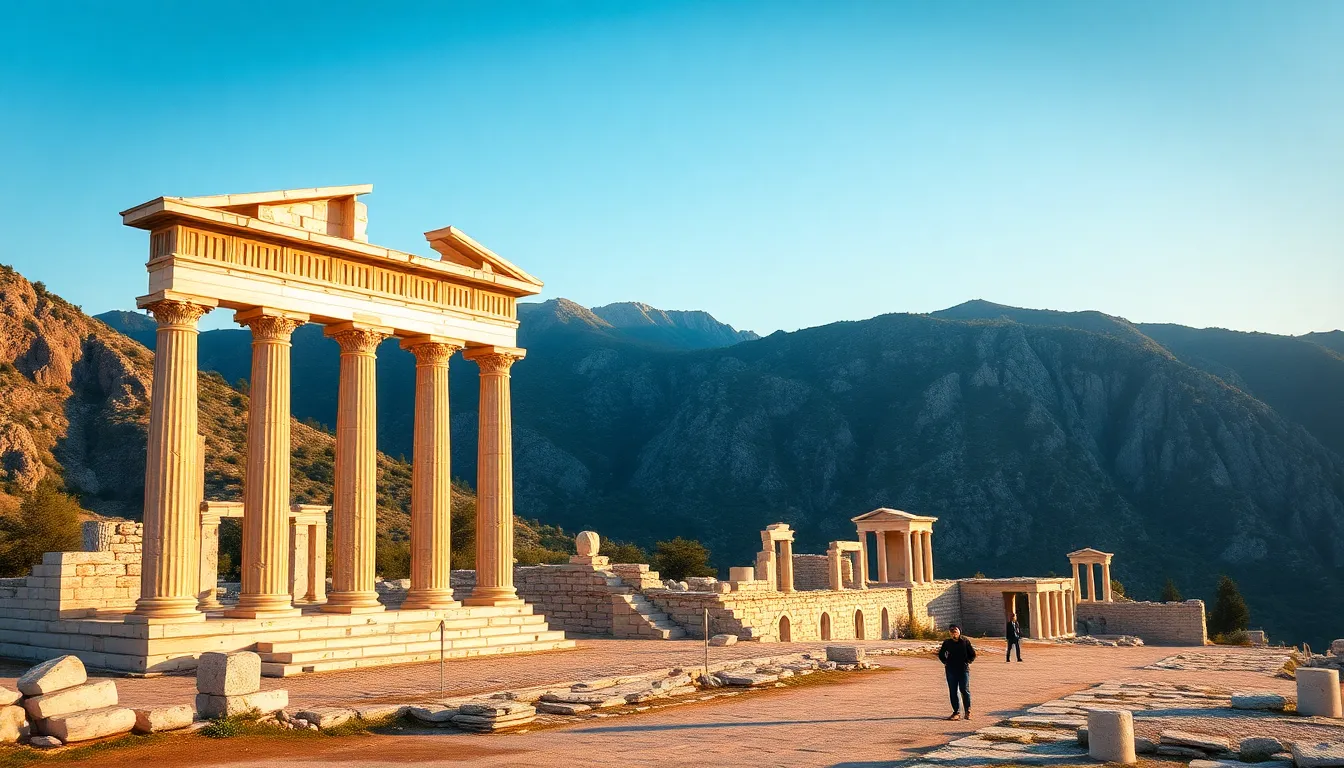
The road up to Delphi climbs the slopes of Mount Parnassus, and when you finally arrive and look out, you understand why the ancients believed this was the center of the world. The mountains fall away toward the sea, the air is thin and clear, and the ruins of the Temple of Apollo sit on a terrace that feels suspended between earth and sky. I bring Christian groups here not to admire pagan religion, but to understand it. Delphi was the spiritual heart of the Greek world for a thousand years. To grasp what the gospel walked into when it reached Greece, you have to stand somewhere like this.
Let me walk you through Delphi, and how to read it with your group through a heritage lens.
The Center of the Greek World
For the ancient Greeks, Delphi was the navel of the earth. A stone called the omphalos marked the exact spot, and the myth held that Zeus released two eagles from opposite ends of the world, and they met here. For roughly a thousand years, this was the most important religious site in Greece, and arguably in the entire Mediterranean before Rome.
Pilgrims came from across the Greek world and beyond. Kings, generals, and ordinary people made the journey to consult the oracle before going to war, founding a colony, or making any decision of weight. City-states built treasuries here, small stone buildings to hold their offerings, lining the Sacred Way that climbs toward the temple. The wealth and prestige poured into this one mountainside was immense.
When your group stands among these ruins, the point to make is scale. This was not a fringe cult. This was the spiritual establishment of the Greek world, as central to their lives as any institution we might name. That is the world the early church entered.
The Temple of Apollo and the Pythia
At the heart of Delphi stood the Temple of Apollo, and within it the oracle herself, the Pythia. The Pythia was a priestess who delivered the prophecies of the god Apollo. According to the ancient accounts, she sat over a chasm in the temple, breathed in vapors that rose from the rock, fell into a trance, and spoke. Her utterances, often cryptic, were interpreted by the priests and delivered to those who had come to ask.
The oracle’s answers were famously ambiguous. The most famous example is the warning given to King Croesus, that if he went to war he would destroy a great empire. He did go to war, and the empire he destroyed was his own. The Greeks treated the oracle with deep seriousness all the same. Its pronouncements shaped wars, laws, and the founding of cities.
On the temple itself were carved the maxims of Greek wisdom: “Know thyself” and “Nothing in excess.” Those phrases tell you something about what this religion offered, a search for wisdom and guidance, channeled through a god who could not finally be known, whose answers shifted and concealed as much as they revealed.
Reading Delphi Through a Heritage Lens
This is where I slow down with Christian groups, because Delphi is not a New Testament site, and it should not be presented as one. Its value is that it shows you the religious landscape the gospel confronted.
When Paul preached at Athens, on Mars Hill, he stood before people shaped by exactly this world, a world of many gods, of oracles and altars, of a hunger for divine guidance met by ambiguity and the unknown. The altar “to an unknown god” that Paul seized upon in Acts 17 makes more sense once you have stood at Delphi. The Greeks were profoundly religious. They sought the divine everywhere. But the answers they received were riddles delivered through vapor and trance.
I do not draw the contrast crudely, and I would caution any group leader against mockery. The honest move is to let your people feel the genuine spiritual longing of the place, the real seriousness with which these pilgrims came, and then to consider what it meant for a message to arrive offering a God who could be known, who spoke plainly, and who answered. Delphi sharpens the encounter at Athens. That is its worth on a heritage journey.
For where this connects, see our deep dive on the Areopagus in Athens, where Paul addressed this very culture, and our guide to following the Apostle Paul through Greece.
What Groups See and Do
A visit to Delphi follows the Sacred Way, the path that climbs from the entrance up through the sanctuary. Along it stand the treasuries, most famously the reconstructed Treasury of the Athenians, and the remains of monuments dedicated by the cities of Greece.
Higher up sits the Temple of Apollo, with its surviving columns and the terrace where the oracle once operated. Above that, the ancient theater and, higher still, the stadium where the Pythian Games were held, second in prestige only to the Olympics. The climb is gradual but steady, and the views grow more extraordinary the higher you go.
The Delphi Archaeological Museum, beside the site, is one of the finest in Greece. Its centerpiece is the Charioteer of Delphi, a bronze statue of remarkable preservation, along with the omphalos stone and countless offerings recovered from the sanctuary. I always include the museum. It puts faces and objects to the religion you have just walked through.
For a group, this is a place for observation and conversation rather than a formal devotional. Walk the Sacred Way, take in the temple, and gather afterward to reflect on what it means that the gospel entered a world this religiously rich and this spiritually unsatisfied.
A Practical Word on Access
Delphi is built on a mountainside, and there is no avoiding the slope. The Sacred Way climbs steadily over uneven ancient stone, and reaching the temple, theater, and stadium means continuous uphill walking. It is one of the more demanding sites in Greece for a mixed-age group.
That said, the lower portion of the site, including the Sacred Way and the approach to the temple, is reachable by those who take it slowly, and the views are rewarding well before the top. Members who cannot manage the full climb can still see a great deal and then spend their time in the museum, which is largely level. Bring water, wear proper shoes, and plan for morning in the warmer months. We pace the visit around your group and make sure no one feels left behind.
FAQ: Visiting the Oracle of Delphi
What was the Oracle of Delphi?
Delphi was the most important religious sanctuary in ancient Greece for around a thousand years, centered on the Temple of Apollo. The oracle was delivered by a priestess called the Pythia, who fell into a trance and spoke prophecies attributed to the god Apollo. Pilgrims came from across the Greek world to consult her.
Is Delphi a biblical site?
No. Delphi is not mentioned in the New Testament. Its value on a Christian heritage trip is that it shows the deeply religious pagan world the gospel entered. It gives essential context for understanding Paul’s encounter with Greek religion at Athens in Acts 17.
What can you see at Delphi today?
The Sacred Way lined with treasuries, the Temple of Apollo, the ancient theater, and the stadium, all set on the slopes of Mount Parnassus. The adjacent Delphi Archaeological Museum holds the famous bronze Charioteer of Delphi and the omphalos stone.
Is Delphi a difficult site to walk?
Yes, it is one of the more demanding. The Sacred Way climbs steadily over uneven stone. Members who cannot manage the full ascent can see the lower sanctuary and spend more time in the largely level museum. We pace the visit to the group.
How does Delphi connect to a heritage trip?
Delphi sharpens the encounter at Athens. Standing in the spiritual capital of the Greek world helps a group understand what Paul faced when he preached to a people surrounded by gods, oracles, and altars, and what it meant to offer them a God who could be known.
Delphi is not a stop for admiring idols, but for understanding the world the gospel walked into, and it deepens every site that follows. If you are planning a Greece heritage journey for your congregation, I would be glad to help you weave it in well. You can see how we structure these trips on our Greece heritage page or explore our group heritage tours.
Contact us whenever you are ready to start the conversation.