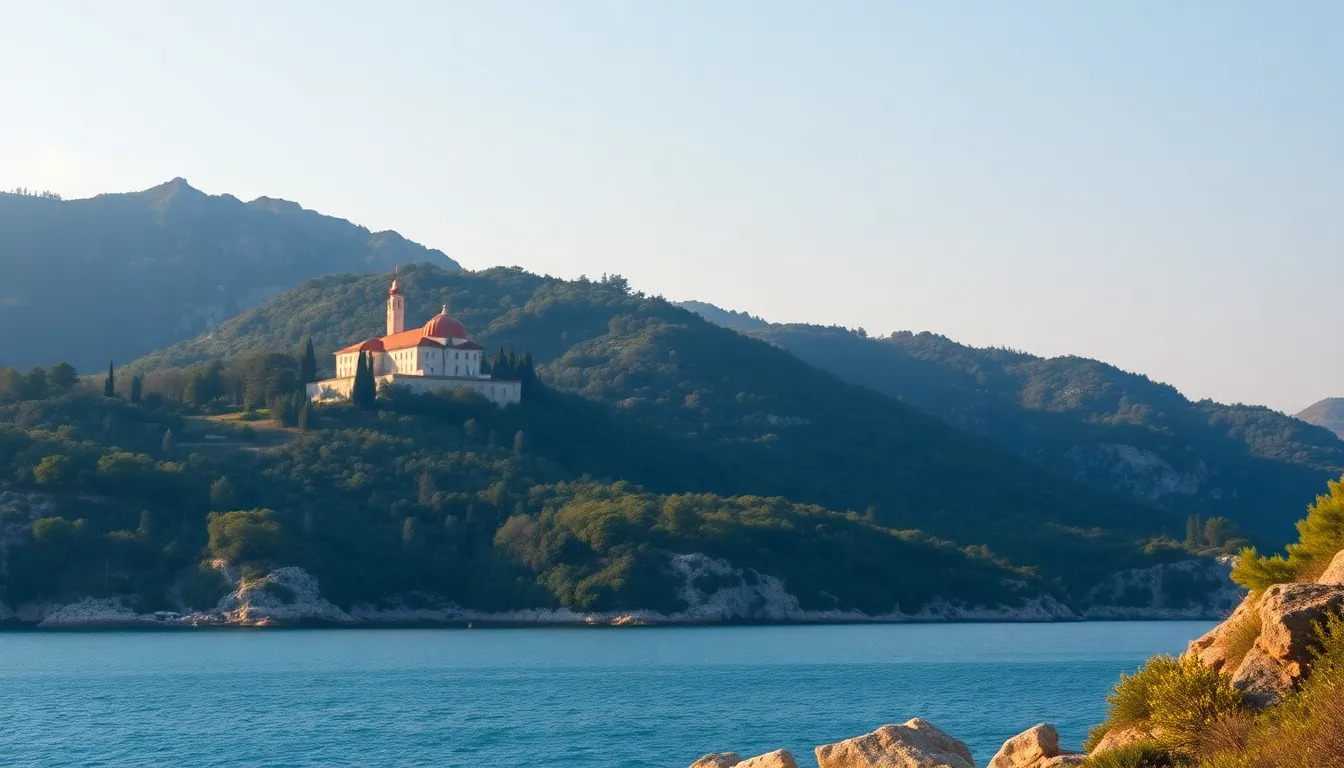
I want to be straight with you about Mount Athos from the first line, because it is unlike anything else I help people plan. Most heritage sites in Greece, you bring your whole group, all ages, men and women, you walk in, you read scripture, you walk out moved. Mount Athos is not that. It is a self-governing monastic republic where time has nearly stood still, where only men may enter, and where a visit takes weeks of paperwork and a real spiritual seriousness to arrange. For the pilgrim it is right for, there is nothing like it on earth. For most groups, the honest answer is that you experience it from the sea.
Let me explain what Mount Athos actually is, who can go, what a visit involves, and how a heritage group fits it into a Greece journey realistically.
What Mount Athos Is
Mount Athos is a peninsula in northern Greece, the easternmost of the three fingers of the Halkidiki peninsula, rising to a peak of just over two thousand meters. For more than a thousand years it has been home to Orthodox monasticism, and today it is a self-governing monastic republic within the Greek state, often called the Holy Mountain, in Greek the Agion Oros.
There are twenty ruling monasteries on the mountain, along with smaller communities, hermitages, and individual hermits living in caves. Around two thousand monks live there now, following the Orthodox liturgical day, which begins in the small hours and runs on Byzantine time. The monasteries hold some of the greatest treasures of the Christian world, ancient manuscripts, relics, and icons, including the tradition that the Virgin Mary herself was given the mountain as her garden.
It is governed by its own administration, the Holy Community, and while it sits inside Greece, it runs its own affairs and keeps the Julian calendar. Walking onto Mount Athos is, in a real sense, walking back several centuries. That is the point of it.
The Male-Only Rule
This is the part I make sure every group leader understands before anything else, because it shapes who can even consider a visit. By a tradition known as the avaton, in force for over a thousand years, women are not permitted to enter Mount Athos. The rule extends to female animals as well, with a few practical exceptions like cats and hens.
The tradition holds that the mountain is dedicated to the Virgin Mary and is set apart for a life of male monastic devotion. Whatever one makes of it, it is absolute, it is legally recognized by Greece and the European Union, and it is not going to change. There is no exception process.
What this means in practice for a heritage group is simple. A trip onto the mountain itself is only an option for the men in your party, and only for those prepared for what an actual pilgrimage there involves. For a mixed congregation, the way to honor Mount Athos is from the water, which I will come to.
The Diamonitirion: The Permit to Enter
For the men who do go, you do not simply show up. Entry requires a permit called the diamonitirion, and the process needs planning well in advance.
Here is the shape of it. The number of non-Orthodox visitors admitted each day is strictly limited, only a handful, so you apply to the Pilgrims’ Bureau in Thessaloniki months ahead, providing passport details and your intended dates. Orthodox pilgrims have a somewhat easier path and a larger daily quota; non-Orthodox Christians face tighter limits and longer waits. Once approved, you collect the diamonitirion in Ouranoupoli, the small town that serves as the gateway, and from there you take a boat down the coast to the monastery you are visiting.
A few realities I make sure pilgrims understand:
- It is a pilgrimage, not a tour. You stay as a guest in the monasteries, which offer simple hospitality, a bed and meals, freely. You are expected to join the rhythm of prayer, attend the long services, and respect the silence. This is not sightseeing.
- The days are demanding. Services run for hours, often beginning around three or four in the morning. Travel between monasteries is on foot over mountain paths or by boat. It asks something of you physically and spiritually.
- Plan months ahead. Between the permit quota and the limited beds, a serious visit needs to be arranged well in advance. This is not a stop you add to an itinerary at the last minute.
How Heritage Groups Actually Experience Athos
For the great majority of heritage groups, mixed in age and including women, the right and rewarding way to encounter Mount Athos is by boat.
Cruises run along the Athos coastline from Ouranoupoli, sailing close to the shore, by law no nearer than five hundred meters, so passengers can see monastery after monastery rising out of the forest above the sea. From the water you take in the scale of the place, the dramatic monasteries clinging to the cliffs, the peak of Athos towering behind, and the sense of a world entirely apart. Guides on board explain the monasteries and the life within them. Everyone in your group, men and women alike, shares the experience.
I have brought many groups to Athos this way, and people are not shortchanged by seeing it from the sea. There is something fitting about beholding the Holy Mountain from a respectful distance, the way it has guarded its solitude for a thousand years. For mixed congregations, the coastal cruise is the visit, and it is a genuine one.
Where Athos Fits a Greece Heritage Trip
Mount Athos sits in the north of Greece, near Thessaloniki, which places it close to the Pauline sites of Macedonia. That makes it a natural addition to a journey that traces Paul through Philippi, Thessaloniki, and Berea. A coastal cruise of the Holy Mountain pairs beautifully with that northern leg, showing your group what Greek Orthodox monasticism became in the same region where the European church was born.
For groups continuing south or to the islands, our hub on Greece’s spiritual sites lays out the full map, and our guide to Meteora, the monasteries in the sky covers the other great Orthodox monastic site, one that the whole group can walk into. For the Revelation end of a Greece journey, see our overview of Patmos and the Book of Revelation.
One planning note worth keeping in view: with Heritage Tours, the group leader travels free when you bring fifteen or more participants. For a pastor shaping a northern Greece itinerary that includes an Athos coastal cruise, that is real budget back, and it is worth factoring in early.
FAQ: Mount Athos Pilgrimage
Can women visit Mount Athos?
No. By a tradition over a thousand years old, known as the avaton, women are not permitted to enter Mount Athos. The rule is absolute and legally recognized. For mixed groups and for the women in your party, the way to experience the Holy Mountain is by a coastal cruise that sails close to the shore, where everyone can see the monasteries from the sea.
What is the diamonitirion?
The diamonitirion is the permit required to enter Mount Athos. Men apply in advance through the Pilgrims’ Bureau in Thessaloniki, with strict daily quotas, especially for non-Orthodox visitors, and collect the permit in the gateway town of Ouranoupoli before sailing to a monastery. It needs to be arranged months ahead.
Is visiting Mount Athos a tour or a pilgrimage?
For those who enter, it is a pilgrimage, not a tour. You stay as a guest in the monasteries, join the long services that begin in the small hours, eat the simple shared meals, and respect the silence and the rhythm of monastic life. It asks real spiritual and physical seriousness.
How do most heritage groups see Mount Athos?
By boat. Coastal cruises from Ouranoupoli sail along the Athos shoreline, keeping the legal distance from land, so everyone in the group, men and women, can view the monasteries rising above the sea while a guide explains the life within. For most mixed congregations, this is the visit, and it is a meaningful one.
Where is Mount Athos and how does it fit a Greece trip?
Mount Athos is in northern Greece, near Thessaloniki, close to the sites of Paul’s mission in Macedonia. A coastal cruise of the Holy Mountain pairs naturally with a Pauline journey through Philippi, Thessaloniki, and Berea, adding the dimension of living Orthodox monasticism to the story of the early church.
If a northern Greece journey is taking shape for your congregation, the Holy Mountain from the sea is something I would want your people to see. It is a window into a world that has guarded its prayer for a thousand years, and the view from the water leaves a mark. You can see how we structure these journeys on our Greece heritage page or learn how the group experience works on our group heritage tours page.
Contact us whenever you are ready to start planning.