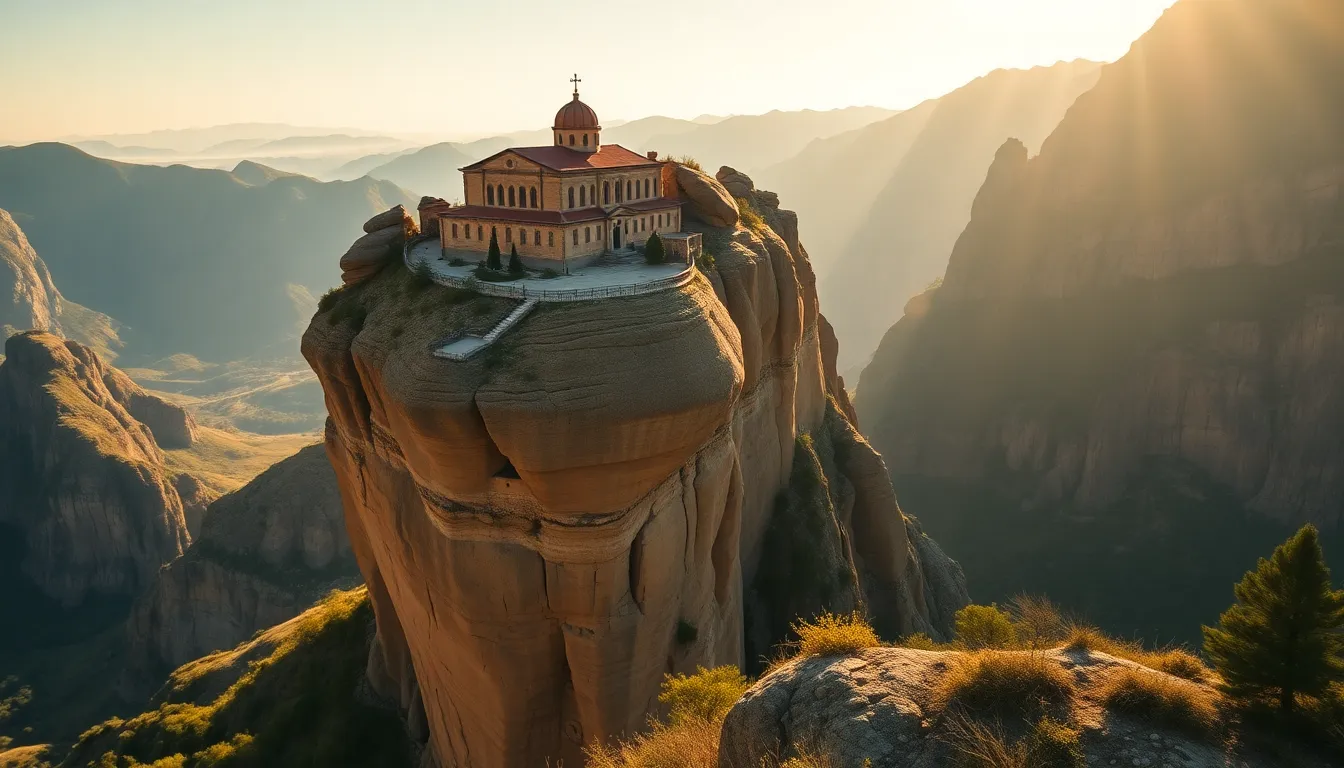
I have watched a lot of groups round the bend on the road up to Meteora and lose the ability to speak. You come up through the town of Kalambaka, the plain of Thessaly spread out behind you, and then these enormous gray rock pillars rise straight out of the ground, hundreds of feet high. And on top of them, impossibly, sit monasteries. Built up there. Lived in for six hundred years. Somebody in the van always asks the same thing: “How did they get the stones up there?” The answer is part of why Meteora moves people the way it does.
The name Meteora means “suspended in the air,” and that is exactly what these monasteries look like. For a faith group, it is one of the most extraordinary sights in all of Greece, and one of the few places where the Orthodox monastic tradition is still living right in front of you.
Let me walk you through what a visit involves, and how to plan one for your congregation.
How the Monasteries Got There
It helps your group to understand the why, because the strangeness of the place has a reason behind it. Hermit monks first came to these rocks as early as the eleventh century, living in caves and crevices in the cliffs, seeking solitude and a life of prayer cut off from the world.
In the fourteenth century, as the region grew dangerous and unstable, those scattered hermits began to organize into communities, and they built monasteries on top of the pillars themselves. Up there, they were safe from raiders and undisturbed in their prayer. At the height of the tradition there were twenty-four monasteries crowning the rocks.
For centuries, the only way up was by rope ladders that could be pulled in, or by nets and baskets hauled up by a windlass. There is an old story, probably true, that when a visitor nervously asked a monk how often they replaced the rope, the monk answered, “When the Lord lets it break.” Your group will hear that the access was a matter of total trust in God, and standing at the base of the rock looking up, they feel exactly what that meant.
The Six Active Monasteries
Of the original twenty-four, six remain active today, and these are the ones your group can visit. Each has its own character, and you cannot do all six well in a single day, so part of planning is choosing which to include.
- The Great Meteoron (Monastery of the Transfiguration), the largest and oldest, founded in the fourteenth century. It has the most extensive complex, a fine museum, and a former refectory. This is the one most groups make their centerpiece.
- Varlaam, the second largest, with beautiful frescoes and a preserved windlass tower that shows exactly how supplies and people were once hauled up.
- Roussanou (Saint Barbara), perched dramatically on a narrower pillar, now a convent. Its position makes it one of the most photographed.
- Holy Trinity (Agia Triada), the most isolated, reached by a climb of steps cut into and around the rock. The effort keeps the crowds thinner and the atmosphere quieter.
- Saint Nicholas Anapausas, smaller, with vivid sixteenth-century frescoes by the Cretan painter Theophanes.
- Saint Stephen, the most accessible, reached by a small bridge rather than a long climb, which makes it the practical choice for groups with members who cannot manage many stairs. It is now a convent.
For a group, I usually plan two or three monasteries in a day, chosen to balance the visit. One large one for the scale and the museums, one for the frescoes, and Saint Stephen if accessibility is a concern.
The Living Orthodox Tradition
Here is what I most want your group to understand before they arrive: Meteora is not a ruin and it is not a museum. Monks and nuns still live and pray here, as they have for six hundred years.
That changes how you visit. When you walk into a working monastery, you are a guest in someone’s home and house of prayer. The frescoes on the walls are not exhibits, they are the devotional environment the community lives inside. You may hear chanting. You may pass a monk going about the day. For a Protestant group unfamiliar with Orthodox monasticism, this is often eye-opening, a form of Christian devotion that has continued unbroken since long before the Reformation.
I find this is where the richest conversations happen. Standing in a six-hundred-year-old monastery still alive with prayer, your group thinks about endurance, about a faith handed down through centuries of upheaval, about what it means to give a whole life to God. Meteora preaches without anyone saying a word.
How Groups Visit Meteora
A few practical things shape every Meteora visit, and a prepared group has a far better day.
Dress code is strict and enforced. These are active monasteries. Women must wear long skirts (wraps are usually available to borrow at the entrance, but bring your own to be safe) and everyone needs shoulders covered. No shorts. I send every group a clear note on this before we go, because nothing sours a morning like being turned away at the gate.
There are a lot of steps. Most monasteries are reached by stone staircases cut into the rock, sometimes well over a hundred steps. This is the single biggest planning factor for older groups. Saint Stephen, reached by a bridge, is the gentle option, and I build itineraries around the group I actually have.
Check opening days. Each monastery closes on a different day of the week, and the schedule shifts between summer and winter. A good operator plans the route around what is open the day you are there. This is not something to leave to chance on arrival.
Stay overnight in Kalambaka. The town at the base puts you minutes from the rocks. Staying there lets you start early, before the day-trip buses arrive from Athens, and gives your group the monasteries in morning light and relative quiet.
Where Meteora Fits a Greece Itinerary
Meteora sits in central Greece, in Thessaly, which makes it a natural stop between the Pauline sites of the north (Thessaloniki, Philippi, Berea) and Athens to the south. Many groups break the long drive south with a night at Meteora, and it turns a travel day into one of the highlights of the whole trip.
It pairs especially well with a Pauline journey. After tracing the founding of the European church on the ground, Meteora shows your group what that faith became, monks who carried it up onto the rocks and kept it burning for six centuries. For the full picture of biblical and Christian Greece, our hub on Greece’s spiritual sites maps it out. And if your itinerary continues to the islands, our overview of Patmos and the Book of Revelation covers the Revelation end of the journey.
One thing worth keeping in view as you plan: with Heritage Tours, the group leader travels free when you bring fifteen or more participants. For a pastor building a Greece itinerary that includes Meteora, that is real budget back in your pocket, and it is worth factoring in early.
FAQ: Visiting Meteora
What is Meteora and why is it important?
Meteora is a cluster of enormous rock pillars in central Greece topped by Eastern Orthodox monasteries, some built in the fourteenth century. The name means “suspended in the air.” It is one of the most important monastic centers in the Orthodox world and a UNESCO World Heritage Site, recognized for both its natural setting and its living religious tradition, which has continued unbroken for six hundred years.
How many monasteries can you visit at Meteora?
Six monasteries remain active and open to visitors, out of the twenty-four that once stood on the rocks. Most groups visit two or three in a day, since each involves a climb and they cannot all be done well at once. We help groups choose which to include based on their interests and their mobility.
Is there a dress code for the Meteora monasteries?
Yes, and it is strictly enforced. These are working monasteries. Women must wear long skirts and everyone must have shoulders covered, with no shorts. Wraps are usually available to borrow at the entrances, but I advise every group member to come dressed appropriately so no one is turned away.
Can older travelers visit Meteora?
Yes, with planning. Most monasteries involve long stone staircases cut into the rock, which can be demanding. Saint Stephen is reached by a short bridge rather than a long climb, making it the accessible choice. We structure the day around the group we have, so that everyone can take part in the meaningful moments.
How much time should a group spend at Meteora?
I recommend at least a full day, with an overnight in the town of Kalambaka at the base. Staying nearby lets your group start early, before the day buses arrive from Athens, and experience the monasteries in morning light and relative quiet. A rushed afternoon stop misses what makes the place special.
If a Greece journey is taking shape for your congregation, I would build a night at Meteora into it without hesitation. There are few places where the faith feels as visibly enduring as it does on top of those rocks. You can see how we structure these journeys on our Greece heritage page or learn how the group experience works on our group heritage tours page.
Contact us whenever you are ready to start planning.